
By Iakovos Mylonas
Claim 1: The Cypriot government refused to pay its CERN contributions several years ago and Cyprus lost its membership status.
Claim 2: Cyprus lost its membership status and was replaced by Turkey.
Conclusion: Both claims are false. Official information from CERN itself, as well as a written response from the organisation to Fact Check Cyprus, confirm that the Republic of Cyprus has remained an Associate Member State continuously from 2016 to the present day. Turkey has held the same status independently since 2015, and each country's participation is entirely separate and unrelated.
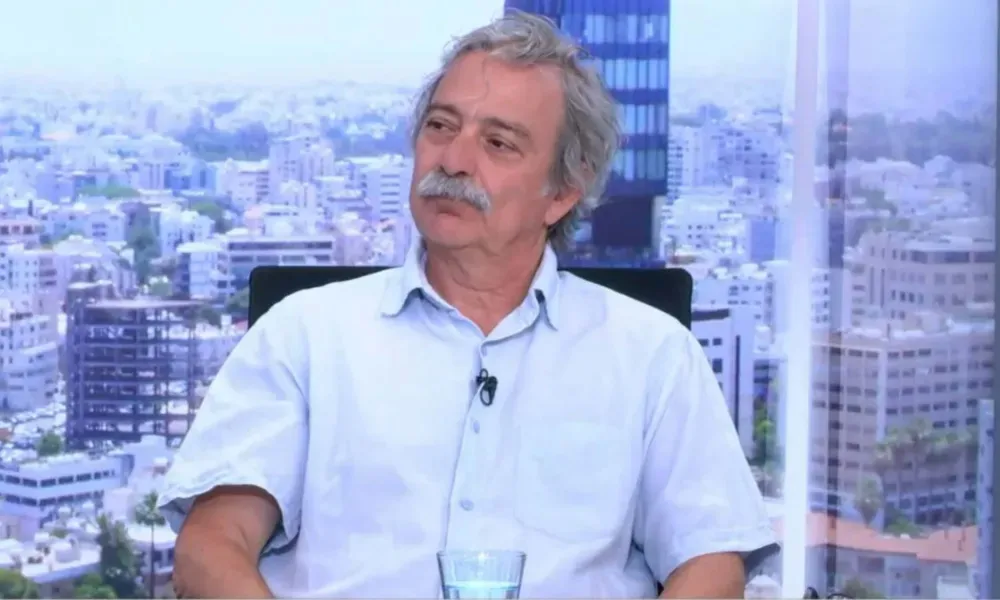
In a video (reel) posted on 8 July 2026 by the Direct Democracy Cyprus party's Facebook page, MP Yiannis Laouris spoke about Cyprus' participation in CERN and referred to Cypriot scientist Panos Razis as the individual who spearheaded the country's entry into the CERN programme about a decade ago.
He went on to claim that the Cypriot government refused to pay CERN contributions several years ago and that Cyprus consequently lost its membership status. He further claimed that Turkey took Cyprus' place.
The video had attracted more than 15,000 views and 182 reactions.
The European Organization for Nuclear Research (CERN) is the world's largest particle physics laboratory. Founded in 1954, it is based on the French-Swiss border near Geneva and operates as a global centre of excellence where thousands of leading scientists collaborate to study the fundamental building blocks of matter and the forces governing the universe.
CERN is internationally known for operating the Large Hadron Collider (LHC) and as the birthplace of the World Wide Web.
However, the core claim that Cyprus was removed from CERN because of unpaid contributions and replaced by Turkey is false.
What the Facts Show
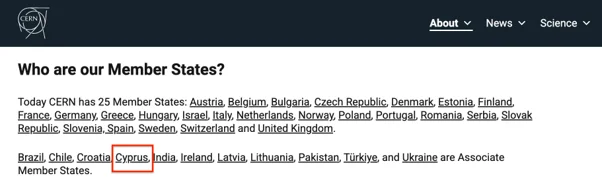
On CERN's official member states webpage, Cyprus is clearly listed among its Associate Member States.
Under the heading "Who are our Member States?" Cyprus appears immediately after Croatia in alphabetical order. The archived version can be accessed here.
Nowhere on CERN's membership pages is there any indication that Cyprus lost, suspended or otherwise forfeited its status.
CERN's dedicated Cyprus relations page confirms that the Republic of Cyprus became an Associate Member in the pre-stage to membership on 1 April 2016 for a minimum period of 24 months. There is no record of any subsequent suspension, interruption or termination of that status.
The timeline matches the video's reference to an event that occurred roughly a decade ago. However, there is no evidence whatsoever that Cyprus subsequently lost its status.
The claim appears to stem from a real political debate concerning the duration of Cyprus' transitional membership stage.
According to CERN's official participation regulations, Associate Membership in the pre-stage to full membership is typically intended to last between two and five years before transition to Full Member status.
The Republic of Cyprus has remained in the same category since 2016, a fact that has drawn domestic political criticism.
For example, parties such as AKEL, through statements such as this one, have criticised successive governments for delays in advancing towards full membership and for failing to develop a strategic plan for maximising the benefits of participation.
However, the prolonged duration of this transitional phase has nothing to do with unpaid fees, refusal to pay contributions or expulsion.
The Republic of Cyprus continues to meet all financial obligations associated with its current status and fully retains the participation rights of Cypriot researchers within CERN programmes.
As an illustration, according to CERN's 2026 annual contributions budget, Cyprus contributes 1,150,850 Swiss francs annually, equivalent to approximately €1.22 million.
By comparison, countries with similar or larger economies that are full members, such as Greece, contribute 12,408,100 Swiss francs per year, or roughly €13.15 million.
Turkey, meanwhile, became an Associate Member State of CERN on 6 May 2015 following an association agreement signed on 12 May 2014.
That means Turkey obtained its Associate Member status one full year before Cyprus acquired the same status.
Given that Turkey's accession predates Cyprus', it is impossible that Turkey later occupied a position vacated by Cyprus.
Fact Check Cyprus found no publication, CERN statement or parliamentary document supporting claims that the Cypriot government refused to pay contributions or that CERN threatened Cyprus with removal because of debt.
The only recent parliamentary discussion identified regarding Cyprus and CERN concerned a request by the House Foreign Affairs Committee for a national strategy to maximise the benefits of Cyprus' existing participation, not any risk of losing membership status.
CERN's Official Response
To fully verify the claims, Fact Check Cyprus contacted CERN's Press Office directly.
A spokesperson responded in writing:
"Since 1 April 2016, the Republic of Cyprus has been an Associate Member of CERN. In total, 11 countries are Associate Member States of CERN: Brazil, Chile, Croatia, Cyprus, India, Ireland, Latvia, Lithuania, Pakistan, Turkey and Ukraine. The status of each country is independent of all others and one does not affect the other."

Conclusion
Claims that Cyprus lost its position at CERN because of unpaid contributions and that Turkey took its place are false.
The official written response provided by CERN to Fact Check Cyprus confirms that Cyprus has remained an Associate Member State continuously since 2016.
While Cyprus' prolonged stay in the same transitional membership category has become a subject of domestic political debate, it is not the result of expulsion, suspension or failure to meet financial obligations.
Turkey's participation is a completely separate and independent process and has no connection to Cyprus' status within CERN.