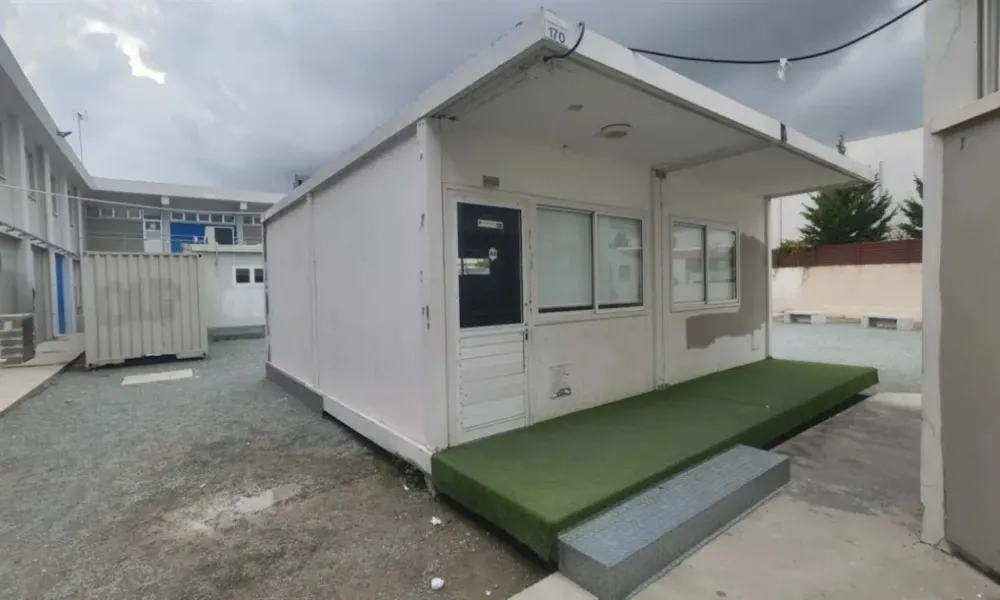

Portable classrooms were introduced in public schools as a temporary solution to address urgent accommodation needs. However, according to a Special Report by the Audit Office, in many cases this temporary measure has taken on a semi-permanent or even permanent character, with some units remaining in place for more than a decade.
The report examines the use of portable classrooms as a tool for addressing overcrowding in public schools and highlights both the scale of the issue and the challenges facing the Ministry of Education in planning school infrastructure.
From Temporary Measure to Standard Practice
According to figures cited by the Audit Office, more than 500 portable classrooms are currently operating in public schools. Approximately 440 are located in pre-primary and primary education, while another 69 are used in general secondary, technical and vocational education.
The Audit Office noted, however, that it was unable to confirm the exact number, as the Ministry of Education does not maintain an updated central register of portable classrooms and the schools where they are installed.
To determine their actual length of use, a sample of 27 schools was examined, containing a total of 29 portable classrooms. Of these, 10 had remained at the same school for five to six years, another five for seven years or more, while in two cases there were no records indicating when they had been installed.
The detailed review found, among other examples, that a portable classroom at the Third Ypsonas Kindergarten has been in operation since August 2014, meaning it has remained in use for more than a decade.
More Students, More Portable Classrooms
The report links the increased demand for portable classrooms to growth in the student population, particularly in compulsory pre-primary education.
Between 2019 and 2025, enrolment in pre-primary education increased by 42 per cent, while during the first year of implementation of the new age threshold, student numbers rose from 10,531 to 11,340, an increase of 8 per cent.
By contrast, primary education recorded a 2 per cent decline, while general secondary and technical education saw a 6 per cent increase.
For the 2025-26 school year, 30 of the island's 326 primary schools (9 per cent) requested a total of 35 new portable classrooms, while similar requests were submitted by 17 of the 273 public kindergartens (6.2 per cent).
Following an assessment of requirements, the ministry approved 36 new classrooms, including 24 for primary schools and 12 for kindergartens, as well as 10 smaller classrooms for special education.
At the same time, the cost of constructing, transporting and installing portable classrooms increased significantly, rising from around €500,000 during 2019-23 to €1.76 million in 2024 and 2025 alone.
Safety and Infrastructure Concerns
Beyond the length of time the classrooms remain in use, the Audit Office also identified safety and operational concerns.
Site inspections revealed cases where portable classrooms were not connected to the main school buildings by covered walkways, schoolyards featured dangerous slopes without protective railings and the available educational space had been reduced.
The report also cites specific examples.
At the Second Ypsonas Kindergarten, six classes were accommodated in three permanent classrooms and three portable classrooms.
At the Third Ypsonas Kindergarten, five classes operated in two permanent classrooms, two portable classrooms and a Home Economics laboratory temporarily provided by a neighbouring primary school.
The Audit Office further found that, unlike other school developments, planning approval is not obtained for the installation of portable classrooms, despite the fact that in many cases they effectively function as permanent extensions of school facilities.
The Ministry's Promises
In its response to the Audit Office, the Ministry of Education said the increased use of portable classrooms is mainly linked to the expansion of compulsory pre-primary education, rising numbers of students with a migrant background and significant population growth in specific school districts.
The ministry also stated that it plans to create an electronic platform through which consolidated information on public school buildings, their capacity, portable classrooms and maintenance requirements will be recorded.
In addition, it said it would work with the Department of Town Planning and Housing to establish procedures governing the installation of portable classrooms, including obtaining planning approval where required.