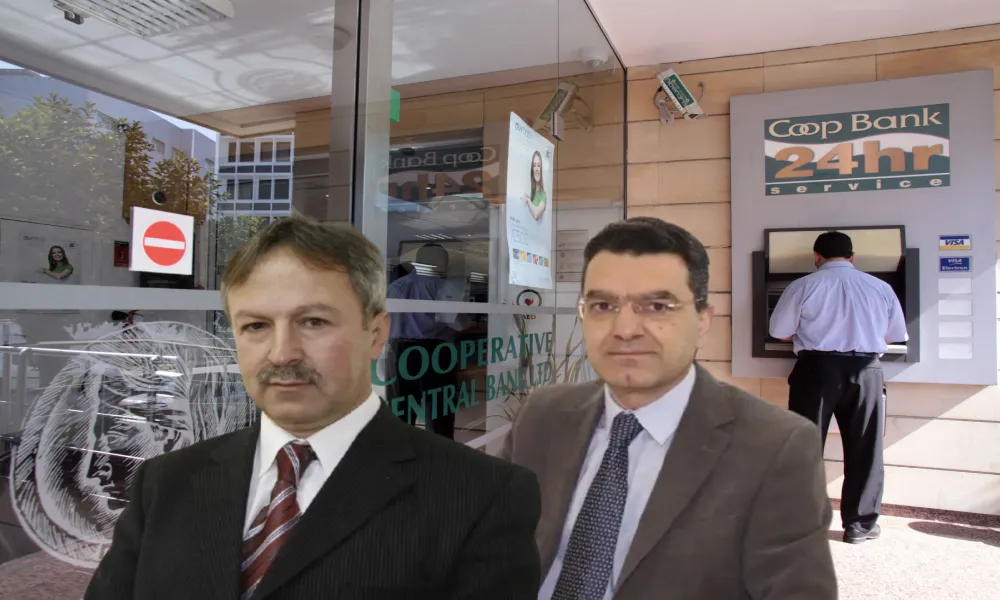

The chairman of the committee overseeing the Pancyprian Co-operative Participations and Promotion of Co-operativism Company, Panikos Chambas, and the chairman of the Economy and Competitiveness Council, economist and former chairman of the Fiscal Council, Dimitris Georgiades, discussed the prospects, challenges and risks of the new venture to establish a Co-operative Credit Institution, speaking on Politis radio. Both were clear that citizens are not currently buying shares in a bank, but participating in an organisation whose goal is to create one.
The public offering by the Pancyprian Co-operative Participations company covers the issuance of up to 42 million new shares at €1 each, with a minimum participation of 100 shares. Sixty per cent of the issue is aimed at individuals and 40% at Cypriot companies, and the offering can be expanded to up to 100 million shares in the event of oversubscription.
We are not a bank at the moment
Chambas said clearly that the new venture does not yet hold a banking licence. "We are not a bank right now. We are the company that will build the bank," he said, noting that Cyprus has been without a co-operative credit institution since 2018.
He said two of the key issues for the licensing application are securing capital and staffing the management team, adding that staffing preparations are at an advanced stage, though names cannot yet be announced. Applications are expected to be filed simultaneously with the Central Bank of Cyprus and the European Central Bank before the end of 2026, he said, adding that once capital and a board are in place, work on building the bank will begin, in parallel with the licensing process. He estimated the new bank could begin operating from 2028 onwards.
Georgiades focused on the risks involved at this stage, urging interested citizens to study the prospectus carefully. "There is certainly risk," he said, noting that the risks are set out clearly enough in the relevant document. He stressed that it is important for people to understand they are not currently buying shares in a bank itself, explaining that citizens are buying shares in an organisation whose goal is to create the bank. The bank's own shares will belong to the co-operative company currently being established, which is expected to control 60% of the new bank if the venture proceeds as planned. He said anyone choosing to participate should understand the risks and examine who is behind the effort, their track record, and whether they can be trusted.
What happens to the money if the venture does not proceed
One of the key questions raised concerned what would happen if a banking licence is ultimately not granted, or the venture does not go ahead. Chambas said this scenario is addressed in the prospectus, urging citizens to read it very carefully before buying shares. "It should be a conscious decision on their part, not an emotional one," he said.
According to Chambas, funds from the public offering are initially deposited with the underwriter, and once transferred to the company, shares are issued electronically to participants. If the venture does not proceed, the money will be returned following the company's liquidation.
Georgiades, however, focused on the level of expenses that may have been incurred by that point. He explained that the money would be returned after expenses are deducted, with the amount depending on the stage the venture has reached. "If it progresses significantly and continues for another year or two, and millions in expenses are incurred, then those will be deducted before the money is returned to those who put in capital," he said. Despite the risks, Chambas expressed confidence in the venture's progress. "There is no scenario where we do not go ahead," he said, revealing that two rounds of gauging public interest had already taken place. In a survey conducted across Cypriot towns and villages, 1,577 people were asked to indicate how many shares they would buy. "They effectively voted, dropping into a ballot box how many shares they would buy, and then we opened them in front of them and counted," he said.
According to Chambas, the 1,577 respondents indicated they would buy shares worth a total of €5.976 million. "In life, you have to take some risks. Those risks need to be controlled," he said.
How it will differ from other banks
A central question in the discussion was whether a new Co-operative Credit Institution could genuinely operate differently from other banks, given it will be subject to the same strict supervisory framework.
Chambas said the goal is to build a bank that helps citizens rather than one that leads them into difficulty. "We chose to revive the idea on the basic principle of each for all and all for each," he said, adding that this would operate within an environment of strict supervision, modern corporate governance and reliable technology. He said the new bank aspires to become the preferred partner of households, balancing profitability, social mission and sustainable growth. "Cyprus cannot continue to have an oligopoly in banking," he noted.
Asked whether the new co-operative bank would make it easier to obtain loans, Chambas avoided a direct yes. "It depends what we mean by easier," he said, noting that non-performing loans burden not only banks but society and the economy as a whole. He said the real difference would lie in stronger advisory support for customers. "We will have more advisers, to guide the customer sensibly, so that mistakes are not made on either side and we end up with the same problems we have already lived through," he said, adding that the new bank would be an advisory bank, a citizens' bank, one that ultimately belongs to its customers.
Georgiades, for his part, noted that international experience does not show that co-operative institutions necessarily offer better interest rates to depositors or borrowers. He explained that their key difference is that they traditionally lend more based on their relationship with the customer, require fewer guarantees, and tend to be more flexible. "Naturally, that increases the risk," he stressed.
The risk of repeating past mistakes
The discussion also addressed the risk of repeating the political and party interference associated with the former co-operative movement. Chambas said the key safeguard is supervision. "The safeguard is the supervisory authorities. The Central Bank of Cyprus. That's it. No one escapes that," he said.
Responding to concerns that political parties would once again exploit the new co-operative venture, he noted that the effort is backed by a broad range of co-operative companies, trade unions and other organisations. "Everyone votes, everyone belongs to a party. Are parties going to be kept outside this organisation? The point is that we are supervised," he said.
Georgiades acknowledged that the risks exist. "Of course these risks exist. We saw it in the past too," he said, stressing that the people who staff the organisation and the culture that develops will play a decisive role. On the "one member, one vote" principle specifically, he noted that the model works when members share common goals and face common challenges. But when an organisation brings together different interests, from profit-seeking companies to depositors and borrowers with different priorities, "that is where the problems will start," he said, adding that it is a matter of maintaining the right culture internally for the model to work.
Is €42 million enough?
Georgiades also raised the question of whether €42 million is enough to build a viable bank in today's environment. He explained that the amount may be sufficient to get the venture off the ground and launch the bank, particularly if the initial plan involves operating just two branches. However, he said a prolonged licensing process or additional requirements from the European Central Bank and the Central Bank of Cyprus could significantly increase costs. "Expenses keep running," he said, also raising the question of whether a contingency plan exists in case an additional €30 million to €40 million is required at a later stage of the process.