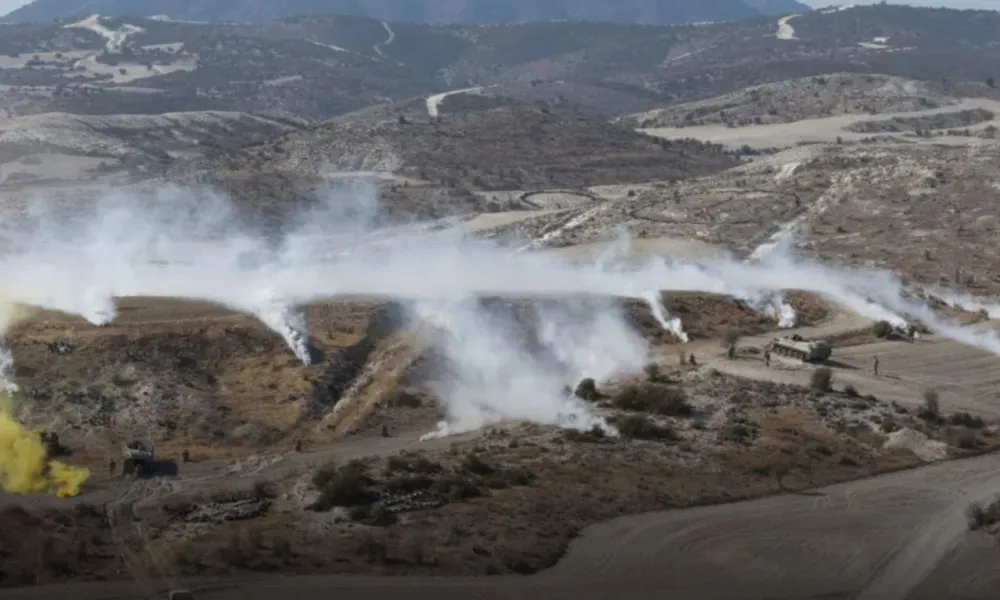

Responsibility for the decisions that led to Monday's wildfire at the Kalo Chorio firing range extends beyond the 70th Engineer Battalion that carried out the ammunition destruction operation and reaches into the upper ranks of the Cyprus National Guard (NGC) hierarchy, according to military sources and information obtained by Politis.
The incident, which placed nearby communities and homes at risk amid extreme temperatures, has intensified calls for clearer answers than those so far provided by Defence Minister Vasilis Palmas, who has ordered an investigation into the blaze.
The questions are particularly significant given that a long-standing National Guard directive, in force for more than 20 years, expressly prohibits military training activities during the summer months, including ammunition destruction operations.
The same directive reportedly states that:
"No live firing shall be conducted when temperatures exceed 38C without prior approval from National Guard Headquarters."
Approval process under scrutiny
A key question facing the Ministry of Defence is whether the required procedures were followed before the operation took place.
Specifically, attention is focused on whether the 70th Engineer Battalion sought and obtained the necessary approvals from all relevant departments within National Guard Headquarters (GEEF) and whether senior military leadership was informed.
If the approval chain was followed, the central question becomes why none of the officials involved rejected the request to destroy ammunition during a period of exceptionally high temperatures and elevated wildfire risk.
A military source told Politis that the possibility of the engineering unit acting without the required approvals is considered unlikely.
According to the source, the safeguards built into the system are such that ammunition destruction operations cannot normally proceed without the necessary authorisations.
Questions over urgency
Another issue concerns whether the ammunition involved required immediate disposal.
Neither the Ministry of Defence nor National Guard Headquarters has publicly clarified what type of ammunition was being destroyed or whether there were urgent operational reasons requiring the procedure to go ahead.
If immediate destruction was unavoidable, the source said, enhanced safety measures and additional wildfire prevention resources should have been deployed to address any potential outbreak.
Authorities were aware
Statements made by Chief Fire Officer and national wildfire coordinator Nikos Longinos suggest that all relevant state agencies were aware that the operation was due to take place.
During an interview with Politis Radio, Longinos said a notification letter had been sent to the competent authorities before the ammunition destruction operation.
He also noted that the Department of Forests and other agencies had repeatedly warned about the heightened danger posed by prevailing weather conditions.
"A single flame can bring disaster," Longinos said, adding that activities capable of causing ignition should not be carried out during the summer period.
Based on these remarks, Politis notes that the notification must have originated from National Guard Headquarters, indicating that approval had been granted and that relevant authorities had been informed of the timing of the explosions.
Palmas accused of acting prematurely
Particular attention has been drawn to comments made by Defence Minister Vasilis Palmas, who, despite ordering an investigation, appeared to place responsibility squarely on the 70th Engineer Battalion.
The minister stated:
"Responsibility has a name and a surname, and responsibility for this fire lies with the 70th Engineer Battalion. Under such conditions, at 40 degrees Celsius, while heavy weapons explosions are prohibited during the summer months, they proceeded with the destruction of these munitions, with the tragic result of a wildfire."
Those comments reportedly caused dissatisfaction in military circles, where officials argue that the decision-making process involves multiple levels of the National Guard hierarchy.
While the battalion carried out the operation and may bear responsibility for its implementation, critics argue that approval for such activities is not taken at battalion level alone.
Additional pressure over missing explosives case
The criticism directed at the defence minister has also been fuelled by the unresolved theft of 13.6 kilograms of explosive material from the Kalo Chorio firing range earlier this year.
The incident, which occurred in February, remains unsolved and the explosives have not been recovered.
A Defence Ministry spokesperson has said the investigation into Monday's wildfire is expected to be completed within 10 days.
Parliament to seek answers
Political parties are expected to raise the issue in parliament in the coming days.
Lawmakers are expected to seek explanations regarding the National Guard's training and operational activities, as well as the safety measures and procedures designed to prevent similar incidents.
The parliamentary discussion is expected to examine all aspects of the ammunition destruction operation and the circumstances that led to the wildfire.