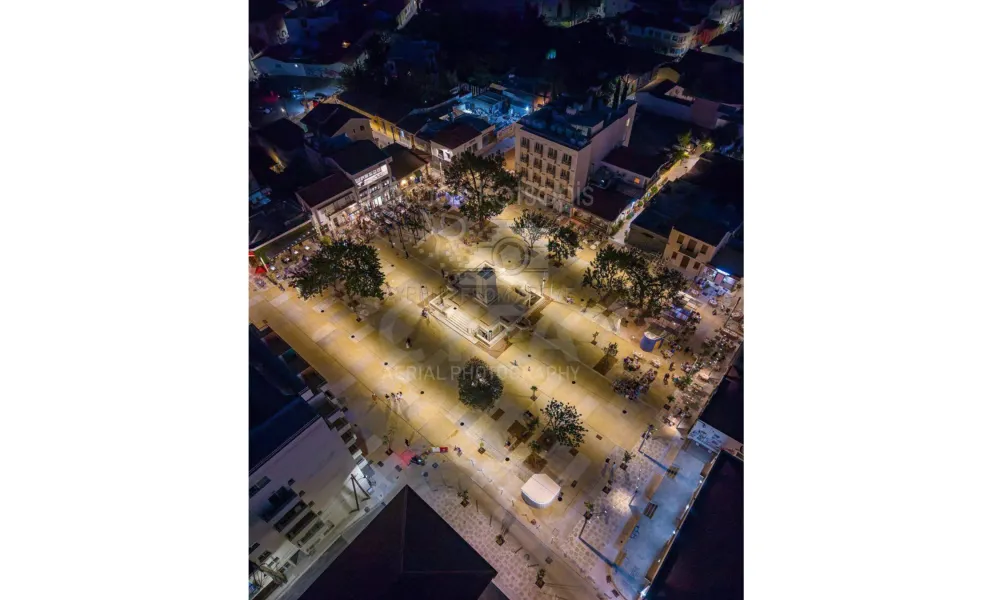

From the design and greenery to accessibility, the timeline and overall cost, the new look of Heroes Square has become the focus of discussion in Limassol. The temporary handover of the project has brought to the forefront the question of whether the redevelopment has lived up to expectations, with differing views emerging and the architect clarifying the issue of the trees.
Since Thursday, when the project was handed over by the contractor to the municipality, various opinions, both positive and negative, have been expressed regarding whether the redevelopment has achieved its purpose, the length of time it required and whether the final result meets expectations and justifies the cost.
On the other hand, it should be noted that the handover is temporary and that some works are still pending, including urban furniture, shrub planting and the underground hall beneath the monument. These are expected to be completed over the coming months, as weather conditions currently impose certain constraints.
To date, approximately 40 new trees have been planted.
The strongest criticism has focused mainly on the greenery and the trees in the square, with the architect making clear that none of the existing trees was cut down as part of the redevelopment.
According to him, the trees were preserved and underwent treatment work in cooperation with agronomists from Limassol Municipality, members of the design team and representatives of the Department of Forests.
According to the same explanation, the previous layout had trapped the roots of the trees beneath concrete surfaces, while the creation of four new "oases" has provided more space for their development.
At the same time, two large mulberry trees were transplanted to other locations within the square, while two cypress trees and one large pine tree were preserved following changes to the design of the Electricity Authority of Cyprus (EAC) substation.
The only loss, according to the architect, was a terebinth tree in front of the Rialto Theatre, which fell during the initial works. A new tree has been planted in its place.
The new planting scheme is nevertheless expected to significantly change the appearance of the square in the coming years.
Dozens of new trees have been planted along surrounding roads, while pine and flamboyant trees have been placed in the centre of the square.
In addition, plans provide for the introduction of shrubs, flowers and climbing plants, as well as a large bamboo arch structure in the area of the public toilets.
Two underground reservoirs will collect rainwater for irrigation, while the square's two fountains have also been restored.
A more positive assessment has been offered by former Rialto Director General Georgia Detser, who spent years closely connected to the square through the operation of the theatre.
In a social media post, she recalled that the old Heroes Square was a space dominated by cars, varying ground levels and obstacles for people with mobility difficulties.
In her view, the new square returns public space to people, providing a unified and more accessible environment connected to the Rialto Theatre and suitable for events, gatherings and everyday use.
Detser also introduces another dimension to the discussion by recalling the distinctive and contradictory history of Heroes Square.
Cabarets and brothels, regular patrons and people living on the margins existed side by side for decades with the Rialto Theatre, the Dance House, artists and cultural events.
It is a history which, she notes, should not be lost within the square's new image.
Reactions are expected to continue, particularly once the remaining works are completed and the final shape of the space begins to emerge.
The key issue, however, is not only how the square looks today, but how it will function and how it will be experienced by the people of Limassol in the years ahead.