
Thirty years after the killings of Tassos Isaac and Solomos Solomou, members of their families and eyewitnesses have spoken to the Cyprus News Agency (CNA) about the events of August 1996, sharing personal testimonies of the days that changed their lives forever.
Those interviewed include Anastasia Isaac, Stella Solomou, eyewitnesses Yiannis Antoniou (now Deputy Government Spokesman) and Andreas Pettemerides, as well as Dr Kyriakos Yiangou, representing the Isaac-Solomou Memory Initiative.
At the same time, Nicolas Constantinides, President of the Kyrenia Bar Association, examines the legal dimensions of the killings, focusing on Turkey's conviction by the European Court of Human Rights, the current status of arrest warrants and legal avenues still available to the Republic of Cyprus, including the possible issuance of European Arrest Warrants.
The 1996 anti-occupation motorcycle march to Kyrenia
In the summer of 1996, the Cyprus Motorcyclists Federation organised a pan-European anti-occupation march beginning in Berlin and ending in occupied Kyrenia.
Following a joint decision by the political leadership and motorcycle organisers to cancel the Cyprus leg of the march, a group of riders disagreed and continued towards the Deryneia crossing point and other checkpoints, where serious clashes erupted inside the buffer zone.
On 11 August 1996, in the Deryneia buffer zone, 24-year-old Tassos Isaac was beaten to death by Turkish Cypriots and members of the Grey Wolves, while UN peacekeepers remained inactive as the attack unfolded before them.
Three days later, during Isaac's funeral, his 26-year-old cousin Solomos Solomou attempted to remove a Turkish flag from a flagpole at a military outpost.
He was shot dead in front of television cameras, in scenes broadcast live around the world and widely condemned internationally.
Anastasia Isaac: "Justice is not only about the killers"
Anastasia Isaac, daughter of Tassos Isaac, said:
"My father sacrificed himself for the freedom of our homeland. His sacrifice was not the result of a military conflict between armies, but of a peaceful anti-occupation demonstration by motorcyclists demanding something self-evident, freedom of movement in their own country."
She said the message of his sacrifice remains unchanged 30 years later.
"It is a timeless lesson of courage, dignity and selfless struggle for the freedom of our homeland."
Asked what it is like to carry the name of a man who has become a symbol in Cyprus, she replied:
"It is an honour to grow up carrying the name of Tassos Isaac, a pure-hearted man whose only act was trying to save another person's life."
She said she joined the Isaac-Solomou Memory Initiative in 2016 and continues to take part in its activities.
"Together with the Initiative, we have grown, and drawing inspiration from their sacrifice, we continue passing on the message of remembrance until justice is delivered."
For her, true justice goes beyond bringing the killers to court.
"Real justice for me would not only be the obvious, namely seeing the murderers of both my father and Solomos brought before justice, but also justice for everyone who has suffered as a result of the Turkish invasion and occupation."
She said this includes families of missing persons, war victims and people who remain unable to return to their homes, properties and places where they grew up.
Her message to younger generations was simple:
"Do not forget. We must not forget our history, our homeland, and the people we lost."
Stella Solomou: "We do not seek revenge"
Stella Solomou, sister of Solomos Solomou, said that 30 years later her family still feels immense pride in his courage.
"His memory remains forever alive in our hearts. He is a beacon that will never go out."
At the same time, she expressed frustration that neither the killers of her brother nor those of Tassos Isaac have faced justice.
"The fact that the murderers remain free and protected by the occupying power demonstrates the hypocrisy of those who speak about human rights."
Describing her brother, she said:
"He was a giving person, full of life, with genuine love for his family, friends and homeland. He always had the courage of his convictions and never bowed before injustice."
She said his desire for freedom led him consciously to climb the flagpole.
"His action was not impulsive. It was a conscious decision in the face of the injustice of occupation."
Recalling her final memory of him, she spoke about seeing him two days before his death.
He had bought a black belt, and when she complimented it, he immediately gave it to her.
"That was Solakis. Someone who loved bringing joy to the people he loved without expecting anything in return."
She also revealed that he had told friends of his intention to take down the flag but had deliberately not told his brother because he knew he might try to stop him.
Asked what would constitute true justice, she was unequivocal:
"The real vindication of my brother's sacrifice would be the bringing of his killers to justice and the withdrawal of Turkish troops from Cyprus."
She added:
"We do not seek revenge. We seek justice and freedom."
Eyewitnesses recall the events
Deputy Government Spokesman Yiannis Antoniou, who at the time worked as a reporter for Phileleftheros, recalled mounting tensions before the events.
He said threats from the Denktash administration that Turkish forces would intervene if motorcyclists attempted to enter the occupied areas created a highly charged atmosphere.
When organisers decided to end the march, many police units withdrew from Deryneia.
However, thousands gathered after motorcyclists rejected the decision and continued towards the buffer zone.
Antoniou said journalists could see military mobilisation on the occupied side.
He recalled being pelted with stones by an aggressive crowd before witnessing Isaac trapped in barbed wire and beaten with metal rods.
"It was one of the most difficult reports I ever wrote. It was the first time I had seen a person killed, and in such a brutal manner."
He added that it took years before he could return to the Deryneia crossing point and that photographs from that day remain painful to view.
Eyewitness Andreas Pettemerides described the events of 14 August 1996, when crowds gathered after Isaac's funeral.
He recalled breaking through a police cordon and entering the buffer zone.
At one point he tried to stop a man from advancing alone through the barbed wire.
That man was Solomos Solomou.
Pettemerides remembered Solomou breaking through the barriers and climbing the flagpole despite efforts by UN personnel to stop him.
"When I saw him climbing the pole, I felt at that moment that something terrible was going to happen."
A volley of gunfire followed.
"For several seconds there was chaos. Solomos fell after the shots."
He said UN personnel were initially afraid to approach Solomou and that he remained on the ground for about ten minutes before peacekeepers retrieved him.
ECHR ruling and arrest warrants
Kyrenia Bar Association President Nicolas Constantinides said the sacrifices of Isaac and Solomou remain a reminder that freedom is never guaranteed and that justice should never give way to forgetfulness.
He noted that the European Court of Human Rights ruled against Turkey in June 2008 for violations of the right to life under the European Convention on Human Rights.
According to Constantinides, the Court attributed the killings to agents of the Turkish state, making Turkey internationally responsible.
However, he stressed that state responsibility does not eliminate individual criminal responsibility.
"Legality cannot be reconciled with impunity."
According to information provided to the House of Representatives in November 2025 by then Justice Minister Marios Hartsiotis, eight arrest warrants remain in force in relation to the murder of Tassos Isaac, three of which are accompanied by Interpol Red Notices.
For Solomou's killing, five arrest warrants remain active, although Red Notices have been issued for only two of the wanted suspects.
Constantinides said authorities should utilise all available legal mechanisms, including European Arrest Warrants, which are binding throughout the European Union and could lead to the arrest and extradition of suspects if they enter EU territory.
Preserving memory
Dr Kyriakos Yiangou said the Isaac-Solomou Memory Initiative, established in 2008 by an independent group of young people with no party affiliation, is dedicated to preserving the memory of the two men and promoting the values associated with their sacrifice, including dignity, justice and freedom.
The initiative organises annual events, including the large commemorative march held before the yearly memorial services.
It has also organised international remembrance journeys, including a "Freedom March" from Berlin to Cyprus in 2016 and a cross-Greece journey in 2021 marking the 25th anniversary of the killings.
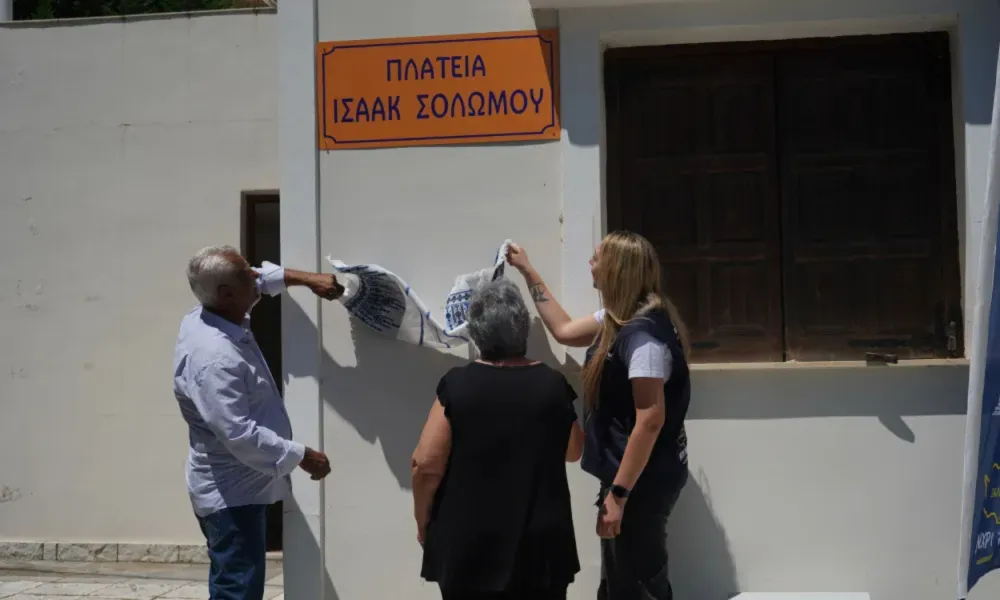
In recent years, the initiative has worked with local authorities to name streets and squares after Isaac and Solomou in locations visited during these commemorative journeys.
"No sacrifice is wasted if we do not forget it," Stella Solomou said.
Source: CNA