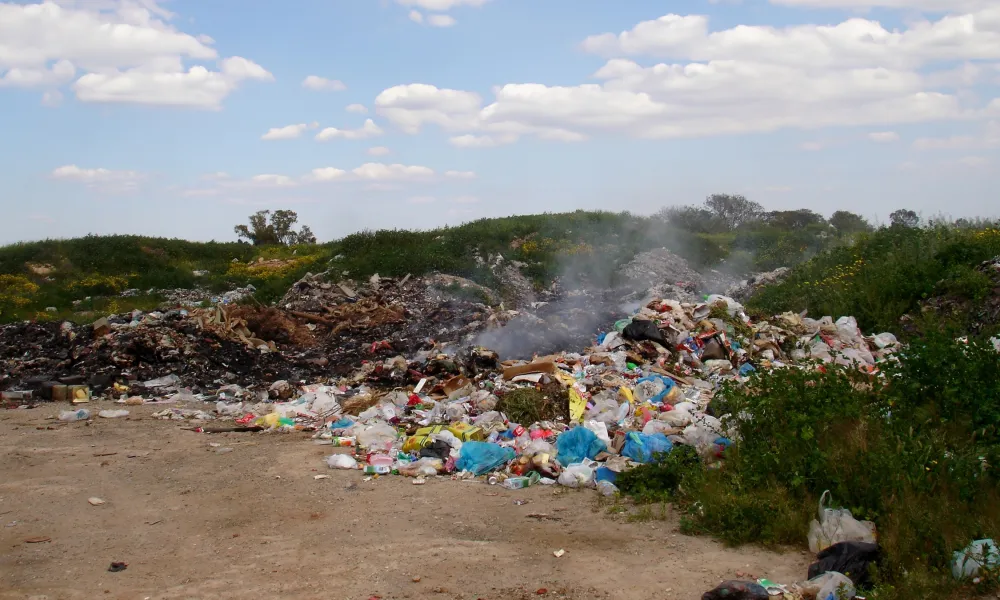

Cyprus’s third nationwide campaign to clear illegal dumping sites now covers 340 locations across 102 communities, with additional applications still under assessment. The €1 million initiative aims to protect the environment and public health while reducing the risk of fires.
Implementation has been under way since late July, following the Cabinet’s approval on 16 July 2026 of €1 million in emergency financial assistance for communities.
More applications under assessment
According to the latest update from the Department of Environment, 102 communities have been informed that the clean-up of 340 illegal dumping sites has been approved. The communities submitted the required information and estimated costs within the deadline.
The department said the process remains open, with further applications from interested communities currently being assessed.
Financial assistance is provided as an approved amount for each community, covering the collection, transport and management of waste in accordance with existing legislation. Any costs exceeding the approved amount must be covered by the community concerned.
Work can begin immediately
“The communities that have been informed may immediately begin the clean-up work,” Acting Director of the Department of Environment Elena Stylianopoulou told Politis.
“Under the terms of the campaign, all required supporting documents must be submitted to the Ministry of Interior by the end of September 2026 to enable payment of the financial assistance.”
Stylianopoulou said the Department of Environment would also conduct on-site inspections to confirm that the approved work had been completed.
President of the Union of Cyprus Communities Andreas Kitromilides told Politis that some communities had already begun clearing illegal dumping sites in late July.
These included communities with their own work crews, as well as those that had managed to secure contractors before the summer holiday period and had access to licensed facilities accepting the collected materials.
“Those that did not manage to do so are now taking the necessary steps,” Kitromilides said.
Grants of up to €15,000
Kitromilides said individual communities would receive part of their required expenditure from the state’s €1 million allocation. Grants range from €4,000 to €15,000, depending on the needs of each community.
Eligible work includes the collection and removal of solid waste, such as mixed construction and demolition debris, bulky objects and other illegally discarded materials. Funding may also cover restoration work where this is considered necessary.
Preventing dumping sites from returning
“Beyond financial assistance, particular emphasis is being placed on measures to prevent illegal dumping sites from reappearing,” Stylianopoulou said.
Communities are required to inform the Ministry of Interior about the measures they intend to introduce after each site has been cleared.
The campaign also seeks to strengthen cooperation between local authorities and the Department of Environment. Inspectors may be appointed where necessary to support more effective enforcement of the legislation.
Around 850 illegal sites across Cyprus
The Fire Service estimates that there are around 850 illegal dumping sites across Cyprus, describing them as a major vulnerability in wildfire prevention.
Although several other fire-prevention issues were addressed in recent months, illegal dumping sites continue to represent what the authorities have described as a “ticking time bomb”.
Before the start of the current fire season, the Fire Service prepared and sent every community council a list of illegal dumping sites requiring clearance, together with locations where dry vegetation needed to be removed.
Under existing legislation, local authorities are responsible for identifying and clearing sites where waste has been dumped illegally. However, following their stated financial difficulties, the government decided to provide financial assistance for a third consecutive year.
The government has acknowledged that the rapid removal of illegally discarded waste is essential to protecting the environment and public health, as well as preventing fires.
Cameras planned as a deterrent
Procedures have also begun to install cameras at cleared but unguarded locations, giving municipalities and communities a tool to prevent illegal dumping sites from being recreated.
Following conditional approval from the Commissioner for Personal Data Protection, representatives of the authorities involved met at the Ministry of Interior on 20 July to determine the next steps.
The approval is linked to the commissioner’s separate decision to allow municipalities, under specific conditions, to install cameras in parks and public spaces as a deterrent against vandalism.
According to the Ministry of Interior, signs must be installed informing people that an area is under camera surveillance.
Technical specifications for the cameras must still be prepared before a procurement tender can be launched. The authorities must also select the locations where the cameras will be installed.
A decision will then be taken on the body responsible for managing the surveillance footage. According to the ministry, the unions representing Cyprus’s communities and municipalities are the leading options.