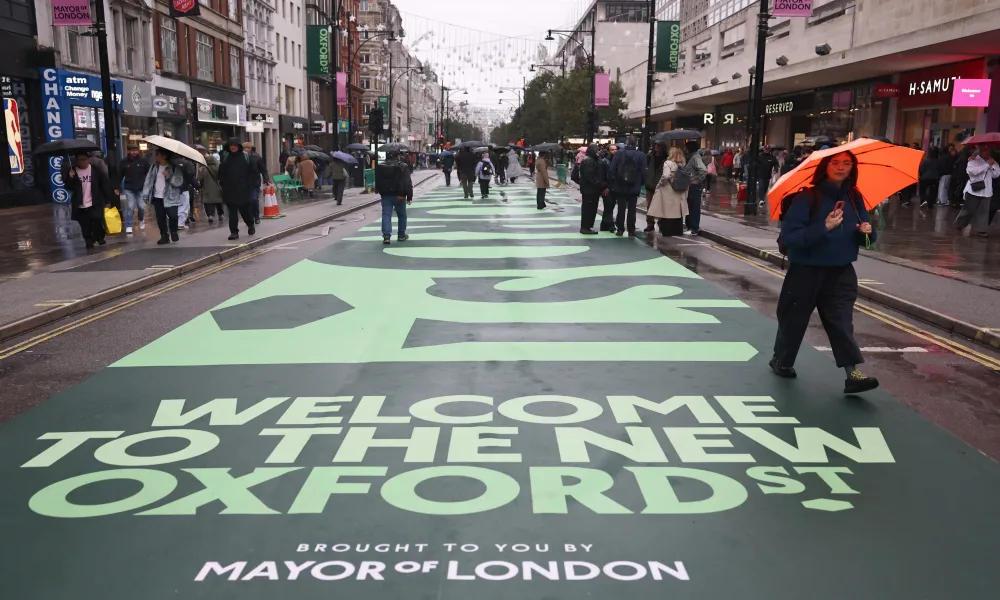

London's famous Oxford Street has taken on an entirely new look since Monday, 26 October, with one of Europe's busiest shopping streets handing almost a kilometre of road space over to pedestrians by removing cars, buses, taxis and bicycles from a major section of the thoroughfare.
The pedestrianisation covers the stretch from Orchard Street, near Selfridges, to Great Portland Street, and forms the first phase of a wider regeneration plan being promoted by London Mayor Sadiq Khan.
The move has reignited debate in Cyprus, where pressure from sections of the business community continues to influence discussions about whether private vehicles should return to Makarios Avenue in Nicosia and what the future should be for Anexartisias Street in Limassol.
The contrast between the two approaches could hardly be sharper.
Warm welcome, but not without criticism
The first day of the scheme was met with overwhelmingly positive reactions from visitors and shoppers, who were able to walk freely along road space that had previously been dominated by traffic.
Images from the opening day showed people taking photographs in the middle of the street and children playing in areas once occupied by vehicles. Many visitors welcomed the change, praising the greater priority now being given to pedestrians.
The project is part of a broader strategy to revitalise the commercial district and follows similar urban planning choices adopted in cities such as Paris.
The changes, however, have not been universally welcomed.
Taxi drivers raised concerns about accessibility for elderly people and individuals with disabilities, while traffic congestion was reported on neighbouring roads. Authorities also had to intervene after a number of cyclists ignored restrictions and entered the pedestrianised zone despite the ban.
Nevertheless, London's direction appears clear, with city authorities continuing to invest in creating a more attractive and people-focused retail environment.
Cyprus remains divided
While London is treating the removal of cars as an opportunity to strengthen its city centre, the debate in Cyprus remains deeply contested.
In Nicosia, a section of shop owners continues to press for the return of private vehicles to Makarios Avenue, arguing that traffic restrictions have negatively affected business activity.
The issue has also become politically charged. Although the municipal council approved the partial reopening of the avenue, the decision has yet to be implemented.
Notably, Nicosia's deputy mayor recently acknowledged that no study exists demonstrating that bringing cars back would increase commercial activity.
A similar picture has emerged in Limassol, where discussions about the future of Anexartisias Street have continued for years.
Rather than complete pedestrianisation, some business owners favour a one-way traffic system combined with wider pavements, arguing that this would strike a balance between accessibility and commercial needs.
As a result, two of Cyprus' most important shopping streets remain caught in a broader debate in which the demands of specific business groups often appear to compete with wider urban planning objectives.
More than a question of cars
Pedestrianisation alone is not a guarantee of commercial success, particularly in cities such as Nicosia and Limassol, which do not benefit from the same level of public transport infrastructure as London or Paris.
Accessibility, organised parking facilities, high rents, the mix of retail offerings and the ability to attract visitors beyond traditional shopping hours are all factors that influence the success of a commercial district.
These challenges cannot be solved simply by removing or returning cars.
At the same time, shopping streets are public spaces and not exclusively commercial environments.
Business owners have every right to express concerns about the impact of urban planning decisions. However, policymakers must also consider the needs of residents, workers, pedestrians and people with disabilities when designing city centres.
The transformation of Oxford Street therefore raises a broader question for Cyprus: are local authorities prepared to pursue long-term urban development strategies, or will they continue to search for compromises that leave longstanding issues unresolved?
Ultimately, the key issue is not how many cars pass a shopfront, but how many people a commercial street can attract and how many reasons it gives them to stay.