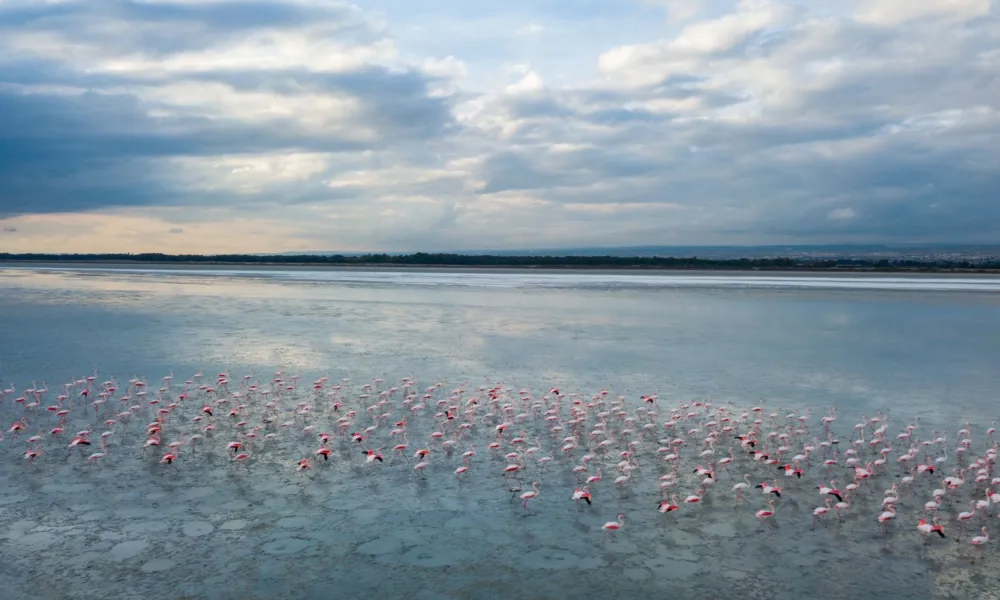



Experts, academics, researchers and professionals have examined ways to strengthen the resilience of the Akrotiri Salt Lake ecosystem at a joint workshop held on Wednesday at the Akrotiri Environmental Education Centre.
The workshop was organised as part of the ARISE Darwin project and focused on assessing how sustainability targets for the area could be achieved, according to a statement by the British Bases.
Three-year conservation partnership
ARISE is a three-year partnership involving the Republic of Cyprus, the Open University of Cyprus and the University of Kent. It is funded through the UK Government’s Darwin Plus grants programme.
“The ARISE project aims to address these environmental threats through scientifically informed restoration actions, habitat management, stakeholder engagement and discussion on how to address these key issues within the framework of the project,” the statement said.
During the workshop, participants examined different scenarios and their potential impact on the area’s sustainability targets.
They also explored the possible causes of these impacts and considered how changes within the ecosystem could affect its long-term resilience.
New habitats created around salt lake
Margarita Stavrinidi, Senior Officer at the British Bases’ Department of Environment, said the project had already carried out significant conservation and management work around Akrotiri Salt Lake.
New habitats have been created, including two new lakes within the eucalyptus forest, which support rare plant species and greater bird diversity.
“Access to sensitive areas has been restricted, allowing the vulnerable ecosystem to recover naturally. At the same time, important data on rare plant species has been collected and seeds have been preserved in the national genetic material bank,” she said.
Access to sensitive areas regulated
Dr Elli Tzirkalli, a Postdoctoral Researcher at the Open University of Cyprus, briefed participants on the progress of the project.
She said vehicle and visitor access to sensitive habitats across the Akrotiri peninsula has also been regulated as part of conservation efforts.
Last October, participants developed a series of possible scenarios for the future of Akrotiri up to 2050.
At Wednesday’s workshop, they were asked to assess how each scenario could affect sustainability targets for both local people and the natural environment.
Balancing conservation with community needs
The aim is to identify management options capable of achieving the best possible balance between protecting the natural environment and meeting the needs of the local community.
“Support from academics, researchers, non-governmental organisations, government departments and the local community will allow us to combine conservation actions in the field with participatory planning, so as to ensure the long-term resilience of the area, based on scientifically informed evidence and with the participation of the people who use and manage Akrotiri Salt Lake,” Tzirkalli said.
The project therefore combines practical conservation measures with research and community involvement in an effort to strengthen the long-term resilience of one of Cyprus’ most environmentally sensitive areas.
Source: CNA