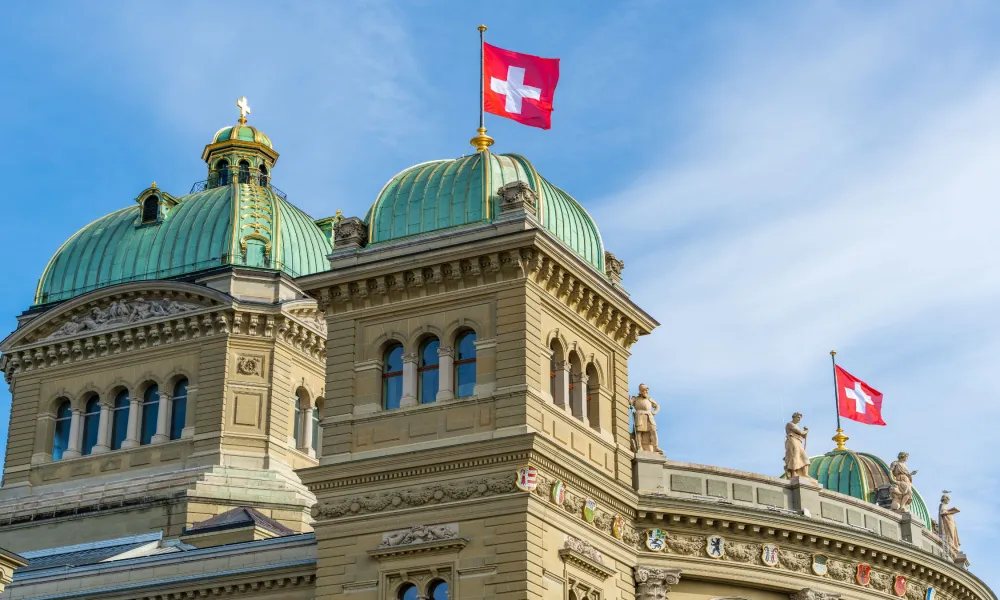



Swiss voters will head to the polls on Sunday to decide whether the country should adopt a stricter constitutional definition of neutrality, with the latest opinion polls pointing to a rejection of the proposal.
While neutrality remains deeply rooted in Swiss national identity, debate has intensified over what the principle should mean in practice, particularly following Russia’s invasion of Ukraine and Switzerland’s decision to adopt European Union sanctions against Moscow.
Initial polls suggested the result could be close. However, the two most recent surveys, published last week, indicate that well over 60% of voters oppose the initiative, in line with the government’s position.
Centuries of Swiss neutrality
Switzerland’s neutrality has deep historical roots. It has been recognised under international law since 1815 and reflected in the federal Constitution since 1848.
The Alpine country traditionally refrains from taking sides in wars between other states.
However, Russia’s invasion of Ukraine and Switzerland’s adoption of EU sanctions against Moscow have reignited debate over how neutrality should be interpreted in a changing geopolitical environment.
The organisation Pro Suisse, which launched the popular initiative Safeguarding Swiss Neutrality, is seeking to establish a more restrictive definition.
‘Opportunity to restore credibility’
Jean-Daniel Ruch, a former Swiss diplomat and co-founder of the Geneva Centre for Neutrality, argued that Switzerland’s approach to international conflicts has become inconsistent.
“Our compass must be respect for international law. And we have lost it in recent years, taking very strong positions against Russia, but, by contrast, extremely weak positions against Israel, which violates international law as much as Russia does,” Ruch told AFP.
“On Sunday, we have an opportunity to restore the credibility of neutrality,” he added.
Moscow, which has accused Bern of abandoning its neutrality by aligning itself with EU sanctions, has welcomed the initiative.
Some opponents have consequently characterised the proposal as “pro-Russian”.
“Putin would rub his hands together if we accepted this initiative,” Socialist lawmaker Samiel Bentaah warned during a recent debate.
What would change?
Under Switzerland’s current federal Constitution, neutrality is not given a detailed definition in a specific article, although the principle is reflected in the powers granted to parliament and the government.
The initiative seeks to explicitly describe Swiss neutrality as “permanent and armed”.
It would prohibit Switzerland from joining any “military or defence alliance”, such as NATO, except in circumstances involving an attack or preparations for an attack against Switzerland.
The proposal would also prevent Switzerland from imposing sanctions on a country involved in a war, except when those sanctions have been decided by the United Nations.
Government warns against rigid approach
Those on both sides of the debate say they want to preserve Swiss neutrality. The disagreement centres on how restrictive its definition should be.
The Swiss government and parliament oppose the initiative, arguing that it would create an excessively rigid framework and reduce Switzerland’s ability to respond to international developments at a time of heightened geopolitical tensions.
“For 180 years, since the birth of Switzerland, neutrality has allowed us to avoid war,” Foreign Minister Ignazio Cassis told Swiss public radio, while stressing that the principle “has always been used with some degree of flexibility”.
“Neutrality does not mean indifference. Neutrality does not mean that Switzerland turns a blind eye when international rules are violated,” he said.
Among Switzerland’s main political parties, only the Swiss People’s Party, the country’s largest political force and a party of the radical right, supports the initiative and is closely associated with it.
Food self-sufficiency also on ballot
Swiss voters will also decide on a separate initiative concerning the country’s food self-sufficiency.
The proposal seeks to increase Switzerland’s food self-sufficiency rate to 70% within 10 years, compared with 42% in 2024.
Opinion polls indicate that voters are also expected to reject that initiative on Sunday.
Source: CNA