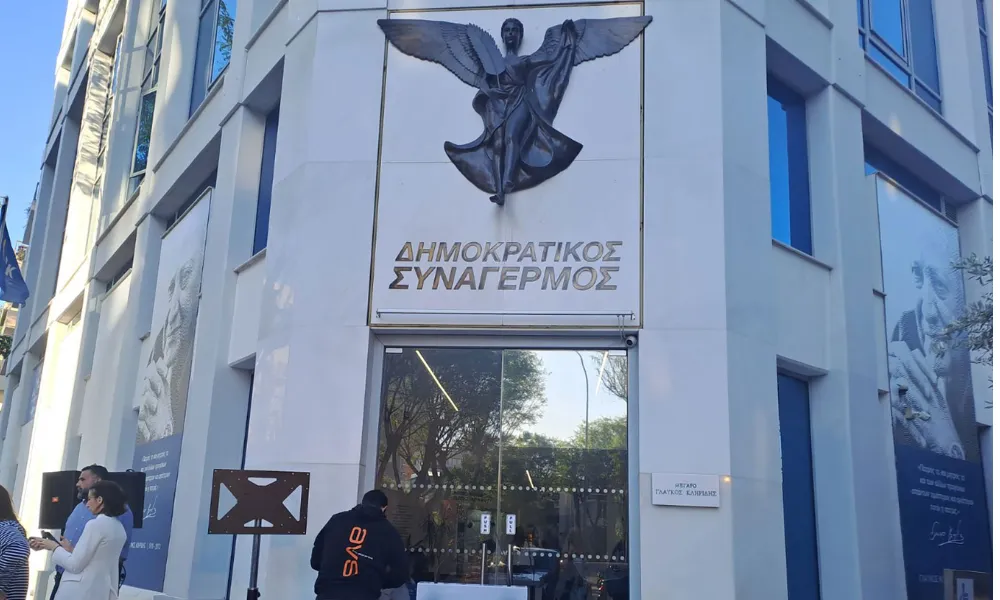
The party made pointed remarks at critics who linked the support of Fidias Panayiotou’s movement to political concessions or broader political bargaining. DISY stressed that its understanding with direct democracy was limited strictly to social policy issues, which it said are longstanding party positions and priorities.
At the centre of the agreement are housing, support for families and addressing low birth rates, as well as measures to strengthen low and middle pensions. The party also insisted that the agreement was reached with full transparency and bears no connection to the presidential elections, while criticising the government for its handling of rising prices and the cost of living.
DISY published the full text of its announcement.
The party said it had agreed with direct democracy on three areas of social policy aligned with its programme for the coming years, as presented during the election campaign.
“The agreement concerned social policies and not trade-offs or other arrangements such as any link with the presidential elections, which some appear to have been pursuing. This agreement was reached with complete transparency and made all citizens aware,” the statement said.
It added that the following issues remain key priorities in its engagement with the executive:
- The resolution of the housing crisis.
- Support for families and measures to address declining birth rates
- Support for low-income pensioners and middle pensions
DISY argued that these priorities reflect ongoing challenges linked to the high cost of living and criticised the government for failing to set the right priorities or adequately address rising prices in recent years.
The party also called on other political forces to support these goals, stating that instead of complaining, they could contribute to broader consensus, which DISY says it seeks to build.
It cautioned, however, that implementation depends on detailed conditions and fiscal capacity, including the sustainability of the Social Insurance Fund and contribution levels.
DISY also thanked direct democracy for supporting Ms Demetriou’s re-election as President of the House, noting with satisfaction that “no trade-off was requested, something we could not have agreed to in any case.”
Support measures for families
Among the proposals outlined is financial support for newborn children, with €5,000 for the first child, €10,000 for the second and €15,000 for the third and each subsequent child, to be paid in instalments.
DISY said it agrees with this direction and has consistently emphasised the need to support families with children and students. It highlighted its proposals to increase child benefit and student grants and to expand income criteria to cover low and middle-income households.
The party noted, however, that Parliament does not have the constitutional authority to increase public spending independently, stating it will continue to press the executive on the issue.
It also supports policies aimed at increasing birth rates, including scaling support according to the number of children and combining one-off payments with existing child benefits.
Pensions
On pensions, the proposal includes raising the minimum pension to €1,088, in line with the minimum wage.
DISY said its own assessments indicate there is scope within the Social Insurance Fund to significantly increase low and middle pensions, citing strong annual surpluses driven by higher employment and contributions.
It stressed that any adjustment should take into account lifetime contributions and years of employment, in the interest of fairness and to maintain incentives for work.
The party also warned that pension increases should not lead to higher contributions from businesses and employees, arguing that such a move could reduce incomes, harm competitiveness and risk job losses.
It reiterated that improvements must be based on actuarial studies and must not undermine the sustainability of the fund.
Housing
On housing, direct democracy proposed the development of 10,000 energy-efficient affordable housing units on state land.
DISY said it agrees that tackling the housing crisis requires the construction of a large number of new homes to stabilise prices and reduce rents. It supports strengthening the Cyprus Land Development Corporation and providing it with state land to deliver affordable housing.
However, it noted that such projects will take time and proposed additional measures, including stronger incentives for the private sector, planning relaxations for building additional housing units in rural areas, and financial incentives for young couples to purchase and renovate older, unused properties.
Around 30,000 housing units across Cyprus are estimated to be connected to electricity and water but remain unused, the party noted.
It also suggested targeted expansion of residential zones to allow more property owners to develop housing.
DISY concluded that both large-scale construction and the reintegration of existing housing stock are essential solutions, adding that all new or renovated homes should meet strict energy efficiency standards.