
It is no longer a secret, nor are we bringing news from afar, that the current political landscape on the domestic front is full of unceasing backstage manoeuvring aimed at the next presidential election. Even if the parties wanted to shift this impression, it would in any case be impossible for them to convince anyone, through their current political practice, that every step and move they make is free of the calculations of a contest for power.
To be fair, it should be noted that the parties only entered the run-up to 2028 once the new balance of power had emerged from May's parliamentary election. Given that timing, today's state of affairs at the Presidential Palace had, in effect, already overtaken the parties, since Nikos Christodoulides had, much earlier, entered a pre-election posture in every sense, placing almost every lever of power at his disposal in an effort to shape events decisively.
The 2028 presidential election may still be around 20 months away, but the first political moves have already begun. The real manoeuvring always happens backstage, where alliances are tested, balances are shaped and strategies are drawn up. And in this conversation, one party finds itself back at the centre. That party is the Democratic Party.
Fourth place, but...
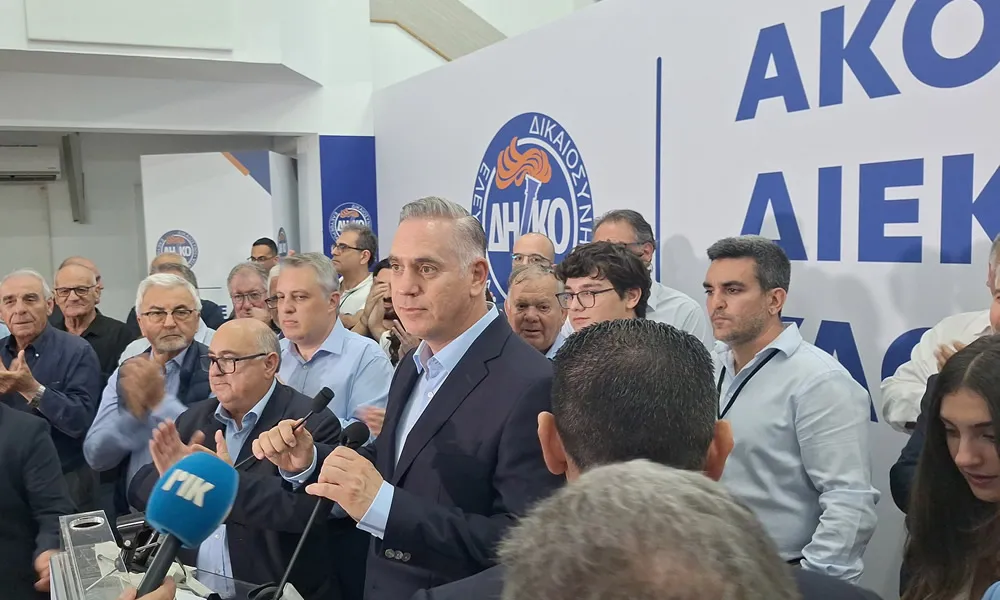
The bigger picture is that although Diko lost ground in the recent election and finished in fourth place, it nonetheless retains, precisely because of how the vote was distributed, an outsized role relative to its size, thanks to its ability to remain a dynamic player in the contest for power.
This is, of course, nothing new. For decades, Diko has held a unique position within the Cypriot political system, because it has almost always been the essential interlocutor for anyone hoping to win the presidency.
Diko's big bet, by all indications, was preserving a level of public support that its current leadership under Nicholas Papadopoulos could use as the opening move in a serious conversation about cooperation, whether to continue the current Christodoulides government or, under different conditions, to back Disy's candidacy as an equally cohesive force. In short, for both Nikos Christodoulides and Disy, the privileged interlocutor is, once again, the Democratic Party.
Scenarios and Diko
The first scenario, then, concerns the current president. Nikos Christodoulides, who wants to present himself during his presidency as a candidate with serious prospects of re-election, would logically seek to preserve the current political alliance. Diko, for its part, will weigh whether continuing this cooperation serves its own political interests.
But if the political balance shifts, if the government loses standing in the public consciousness, or if a strong rival emerges, nothing guarantees that today's arrangement will hold. Diko has no tradition of locking itself into political choices once it judges that the environment has changed. On the contrary, its political practice is defined by tactical moves and adaptation to evolving conditions.
Disy knows this too. If it wants to return to power, it will struggle to ignore Diko's importance. It will face a dilemma: either choose a clean political confrontation, or seek, once again, cooperation with the perennial power-broker.
Akel faces the same dilemma. If it seeks the presidency in earnest, it will need to decide whether to try to build a different political majority or turn to Diko as well. If it takes the latter path, it will need to explain to voters how its sharp political differences with Diko can be reconciled with a possible governing partnership.
The advantage of locking in Diko
The numbers, but above all the political climate, suggest that whoever secures Diko as part of a partnership holds an advantage. Diko and its leadership know they can negotiate with both Nikos Christodoulides and Disy, and with whichever candidate emerges from Disy's own internal party election, positioning themselves as the necessary second pillar of any cooperation. Diko's interlocutors also understand that they gain an edge over their rivals if they manage to bring Diko onside from the very start of the campaign for the 2028 election.
This dynamic is reinforced by the fact that neither Nikos Christodoulides, nor Disy, would want Elam as their first-round interlocutor and partner. Under certain conditions, that may become unavoidable in the second round, but in the first phase of the election, this would look like the wrong tactic for either the president or Disy. To be fair, there is also no indication that Elam will abandon its own practice of contesting the presidential election on the first Sunday, then playing, under different conditions of course, its own supplementary role in backing a candidate in the runoff.
Joining forces as the lead partner
Given this, and through the practical acknowledgement of Diko's de facto role as power-broker, a possible conversation about joining forces with Akel also remains on the table. This possibility, however, has less to do with Diko backing whichever candidate Akel might propose, and more with Diko pursuing the possibility of fielding its own candidate. Nicholas Papadopoulos' party does not want to rule out such a possibility and would, of course, welcome it gladly. Under other circumstances, however, there is, for now at least, no apparent prospect of Diko backing a third candidate proposed by Akel.
The two big parties
What is interesting, though, is not only Diko's own strategy. It is the enduring behaviour of the two big parties. Both Disy and Akel, regardless of whether this materialises most of the time, almost always seek out the same political interlocutor. The party that until yesterday might have faced criticism suddenly becomes a valuable partner.
Within this environment, Diko has every reason to feel politically secure. It knows that regardless of who leads in the polls, it will not be left out of the initial manoeuvring. And as long as it knows it will once again be in demand, it has no reason to reveal its intentions early.
The most likely outcome is that it will follow its tried-and-tested recipe of political patience. It will keep communication channels open with all sides, monitor the polls, weigh the political balance of power, and make its final decisions once it knows who can offer it the greatest degree of political influence.