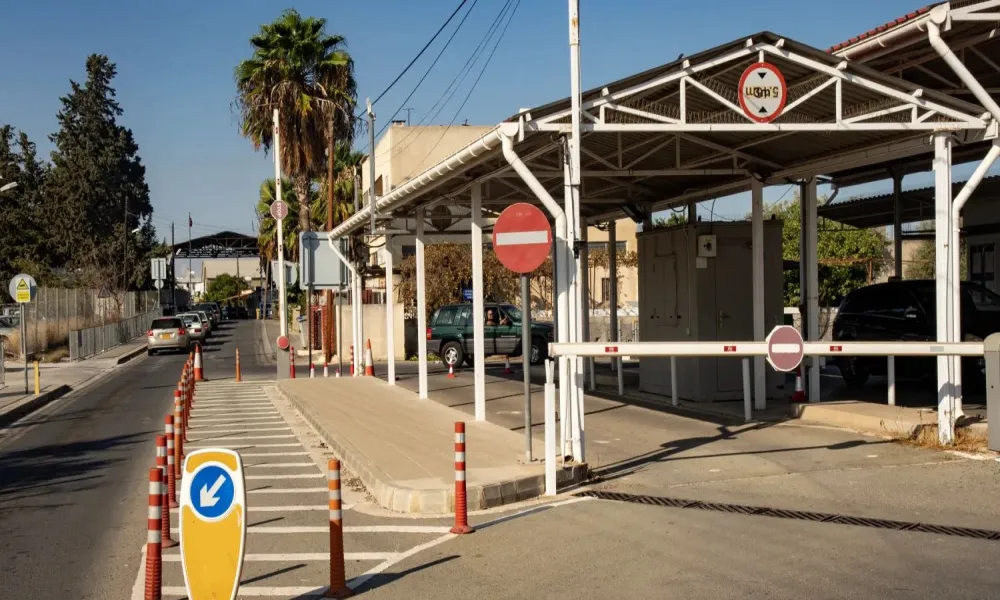

The Republic of Cyprus appears to be seeking a solution to one of the two major issues complicating its path towards joining the Schengen area: the unique status of crossing points located within the British Sovereign Base Areas.
Nicosia and London are reportedly coordinating efforts to upgrade controls at the Pergamos and Strovilia crossing points, with the aim of creating a "technical equivalent" that would satisfy Schengen requirements without creating a conventional border between the Republic of Cyprus and the British Bases.
The issue is one of two concerns previously highlighted by Politis among EU member states regarding Cyprus' Schengen accession. The second remains the Green Line.
The British Bases paradox
Speaking to Politis, Dr Nasia Hadjigeorgiou, associate professor and researcher in transitional justice and human rights, said the crossing points located within the British Sovereign Base Areas create a highly unusual situation.
Under such an arrangement, the United Kingdom, a country outside both the European Union and Schengen, would effectively be carrying out controls linked to an external Schengen border.
Hadjigeorgiou explained that although the Sovereign Base Areas are outside the EU, a special framework governing relations between the Bases and the Republic of Cyprus continued after Brexit.
“There is an agreement between the Republic of Cyprus and the United Kingdom, linked to Brexit arrangements, which provides that, as far as possible, the Bases will follow EU law so that the Bases and the Republic of Cyprus can function as if there were no borders between them,” she said.
She noted that this philosophy dates back to the Treaty of Establishment and was designed to avoid the creation of a traditional or "hard" border between the two territories.
Even while the UK was an EU member, the Bases were never formally part of the Union. Following Cyprus' accession in 2004, a special arrangement was established under which the Bases apply certain aspects of EU law where necessary and feasible.
“When the UK left the European Union, the same understanding remained on the ground because the rest of Cyprus stayed within the EU,” she said.
A more complex Schengen question
According to Hadjigeorgiou, Schengen makes the issue considerably more complicated.
Unlike other areas of EU law, Schengen concerns controls directly linked to entry into the border-free travel area.
She pointed out that the British Bases already conduct checks at places such as Strovilia. However, if Cyprus joins Schengen, those controls would effectively gain wider significance.
“Schengen makes this paradox even stronger. The United Kingdom would be deciding whether someone can enter areas controlled by the Republic of Cyprus and then travel onwards to France, Portugal or anywhere else within the Schengen area,” she said.
In her view, this would amount to a form of outsourcing one of the most fundamental sovereign powers of a state: deciding who may enter or leave its territory.
She added that Schengen functions on mutual trust between participating countries, making it highly unusual to extend such trust to a country that belongs neither to Schengen nor the European Union.
Special arrangements likely
Asked whether such a model is legally possible, Hadjigeorgiou said that special arrangements would almost certainly be required.
She noted that Cyprus' EU accession required separate protocols dealing with both the occupied north and the British Bases, and suggested that similar provisions may be necessary for Schengen.
“These are issues that will have to be negotiated,” she said, adding that a key question will be how controls are carried out in practice at crossing points located within the British Bases.
She also expressed doubt that the UK would agree to allow the Republic of Cyprus to assume responsibility for such controls.
“The Bases have been clear in the past that they were not willing to allow the Republic of Cyprus to take over this role,” she said.
Searching for a ‘technical equivalent’
A European source who spoke to Politis expressed optimism that a solution can be found.
“There must be a technical equivalent,” the source said.
“What exactly that will be, and how it will function, will be discussed at the EU Council.”
According to the source, the goal is to establish a system offering a level of protection equivalent to that required at Schengen's external borders.
Any final arrangement would need the approval of Nicosia, London and the European Commission.
“All member states must agree that what is presented is sufficient and appropriate,” the source said.
The Green Line challenge
Even if a solution is found for the British Bases, the Green Line remains the most difficult aspect of Cyprus' Schengen aspirations.
Hadjigeorgiou argued that the Cyprus problem, and specifically the state's inability to fully control the Green Line, lies at the centre of the accession debate.
“Whether the Cyprus problem is solved or not is not an additional or secondary element of the Schengen discussion. In my view, it is the central issue,” she said.
Given the flow of irregular migrants through the occupied areas, she argued that a fundamental contradiction exists.
Either the Republic of Cyprus exercises effective control over its borders and can meet Schengen requirements, or it cannot prevent irregular crossings across the Green Line, raising serious questions about accession.
“We would not even know whether somebody who entered the island is still here or not,” she said.
“If we lack that information, it is extremely difficult for the other countries to accept our accession to Schengen.”
‘Practically impossible’ without a settlement
Hadjigeorgiou said she personally believes full Schengen implementation in Cyprus would be practically impossible without a prior settlement of the Cyprus problem.
“I consider it impossible. I may be wrong, but I consider it impossible,” she said.
She also questioned whether Schengen membership would be advisable under current conditions if entry points outside the Republic's control remain operational.
According to her, joining Schengen without full control over points of entry could create an even stronger attraction for irregular migration flows.
Asked whether a practical solution could be found without a Cyprus settlement, she replied that the only way to fully control the Green Line would be through much stricter physical monitoring, something she believes would, in practice, reinforce the island's division.