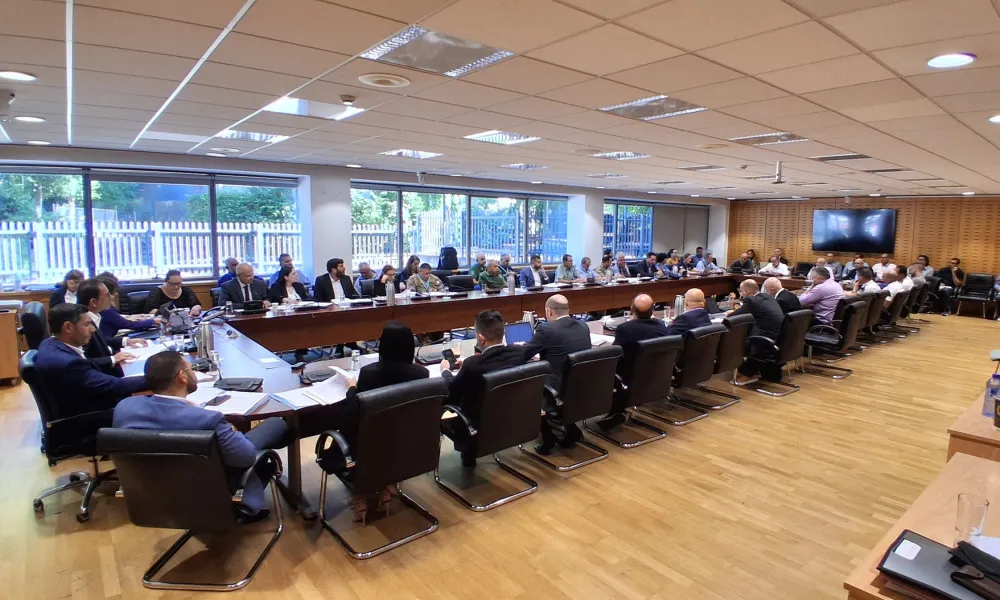
The creation of a National Civil Protection Mechanism in Cyprus is facing a series of challenges, following the first discussion of the relevant bills by the House of Representatives’ Interior Committee.
The proposed framework would establish a new General Directorate of Civil Protection within the Ministry of Interior and create the position of national coordinator, who would take responsibility for coordinating the response to civil protection crises, including natural and human-caused disasters.
However, a number of concerns and objections emerged during the committee’s initial, principle-level discussion, including a fundamental disagreement between the Ministries of Interior and Defence over how the new system should operate.
The issue was highlighted by Interior Committee chairman and AKEL MP Aristos Damianou, who called on the Ministry of Interior to clarify the matter at an early stage.
Defence Ministry calls for unified crisis management system
The Ministry of Defence has proposed a different approach, arguing that a central national crisis management mechanism should operate under the Council of Ministers and cover all types of crises.
Brigadier Iakovos Mikellides, director of the Central Emergency Planning Service (KYPSΕΑ), told the committee that the Ministry of Defence supports the creation of a central national civil protection or broader crisis management mechanism, but believes it should be placed under the Council of Ministers.
He proposed the creation of a National Crisis Management Centre that would deal not only with the civil protection emergencies covered by the proposed legislation, but also nuclear incidents, cybersecurity threats and wartime situations.
Mikellides said the Ministry of Defence had maintained this position since discussions with the Ministry of Interior began in March. He added that contacts with European countries, Israel and the United States had reinforced the view that Cyprus should move towards a unified crisis management system covering different types of emergencies.
He described the current arrangement, in which two or more systems or bodies deal with crises, as a “hybrid” system.
Ministries to seek agreement with President
The disagreement centres partly on the role of the armed forces under the proposed framework. Under the Interior Ministry’s plans, the national coordinator would coordinate the response of the Fire Service, Police, military and health authorities in cases of natural and human-caused disasters.
Interior Ministry Director General Elikkos Elia said the ministry’s intention was to establish Civil Protection without interfering with the responsibilities of KYPSΕΑ, while noting that the precise division of responsibilities would be clarified by the two ministers in consultation with the President of the Republic.
He said the ministries would seek convergence before the committee begins its detailed, article-by-article examination of the bills.
Damianou described the issue as a fundamental disagreement rather than a dispute over a specific provision, noting that the Defence Ministry was seeking a holistic approach covering both civil protection emergencies and crises falling under the responsibility of the Ministry of Defence and the General Staff of the National Guard.
Elia said the Ministry of Interior had already taken into account some of the Defence Ministry’s concerns and amended aspects of the proposed legislation. He added that further discussions would take place before the detailed examination in Parliament.
Future of Forestry Department firefighting remains unclear
A second area of disagreement concerns the possible transfer of the Forestry Department’s firefighting operations to the Ministry of Interior.
The proposal had prompted strong reactions from the Forestry Department and other stakeholders when the plan was first announced around a year ago.
Elia said the Ministry of Interior did not currently intend to transfer the Forestry Department, or part of it, to the new General Directorate of Civil Protection.
Instead, the ministry proposes initially placing the Fire Service under the Ministry of Interior, while maintaining the existing cooperation with the Forestry Department on forest firefighting.
He said the cooperation between the two services during the current year had demonstrated that an effective response to large-scale incidents could be achieved through the proposed national mechanism and under the direction of the national wildfire coordinator.
Elia added that the government would reassess the situation in the future and consider whether some responsibilities currently held by the Forestry Department, together with its firefighting personnel, should eventually be transferred.
Forestry firefighters voice concerns
A representative of the Pancyprian Committee of Forest Firefighters criticised the approach, saying that, in effect, “others decided for us”.
The representative said the committee would wait to see how the process develops, while also making clear that it supports the proposed legislation and considers the creation of the mechanism necessary.
Agricultural organisations also expressed opposition to the possibility of transferring part of the Forestry Department to the Ministry of Interior, with the Farmers’ Union of Cyprus (EKA) among those raising concerns.
Implementation could begin in 2027
The National Civil Protection Mechanism is expected to begin operating in 2027, although the precise timetable remains subject to preparations and budgetary requirements.
Elia referred to technical difficulties in incorporating the necessary provisions into the 2027 state budget. If the requirements cannot be included in time, he said implementation could instead be incorporated through a supplementary budget in June 2027.
The transition to the new system would not take place automatically once the relevant legislation is passed.
According to the position of the Minister of Interior, which Elia read to the committee at the start of the meeting, the start date for the new framework will be determined by a decision of the Council of Ministers.
The aim, according to the minister, is to allow sufficient time for preparations, staffing and a smooth transition to the new system.