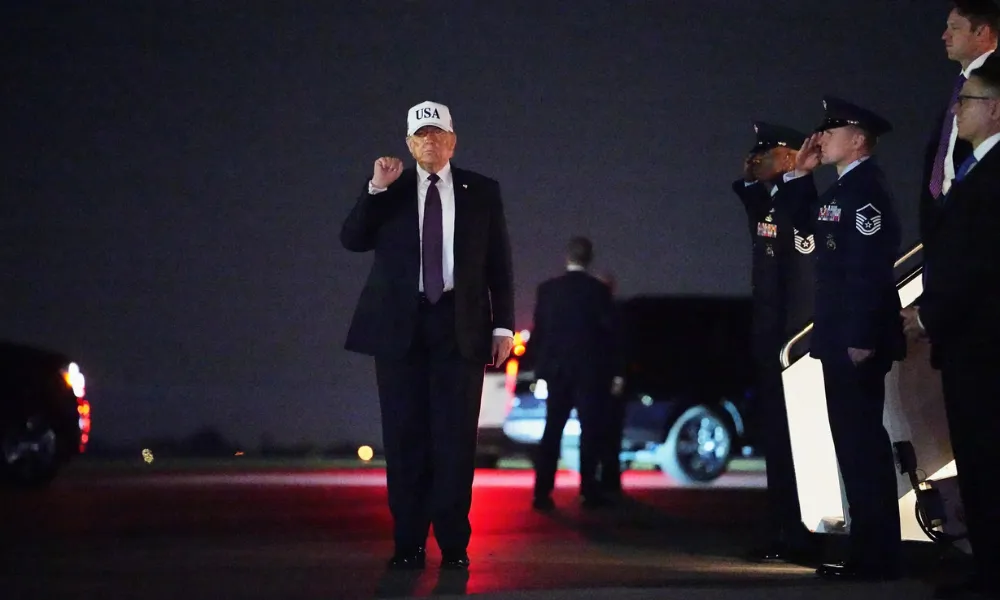


US President Donald Trump said an initial agreement to end the war between Iran on one side and the United States and Israel on the other is due to be signed today, June 14, though questions over both the timing and the substance of the deal remain unresolved.
The announcement follows a week marked by renewed exchanges of fire between the Islamic Republic, the US and Israel, which had stoked fears of a fresh escalation in the region. Both Washington and Tehran have signalled in recent days that they have made meaningful progress towards a settlement, yet the two sides continue to offer conflicting accounts of what a preliminary deal, intended to open the way for technical-level negotiations, would actually contain, and the timetable for signing it has shifted repeatedly.
Pakistani Prime Minister Shehbaz Sharif, whose country has played a mediating role in the dispute, said on Saturday that he expected the agreement to be finalised within 24 hours and that Islamabad was preparing for its "electronic signing" ahead of technical talks scheduled for next week, though he did not specify what the signing process would involve. Sharif said a peace deal between the US and Iran could be finalised "in the next 24 hours," adding that Pakistan was preparing for the electronic signing of the deal followed by technical-level talks next week.
Trump, who has announced an imminent breakthrough on several previous occasions without it materialising, said afterwards that the signing was scheduled for Sunday, his 80th birthday. Posting on Truth Social, Trump said the agreement was "scheduled to get signed tomorrow," a claim that contradicted an earlier statement from a spokesman for Iran's foreign ministry. He described the prospective deal as a "wall" against Iran ever acquiring a nuclear weapon, said the Strait of Hormuz would open to all shipping once it was signed, and stressed that, unlike the 2015 nuclear accord, no money would change hands. He added that Iran's stockpile of enriched uranium, which he referred to as "Nuclear Dust," would be dealt with "at the appropriate time, when all is calm."
Iranian officials have been notably more cautious. Foreign Minister Abbas Araghchi said on Iranian state television that any memorandum of understanding would only serve as a launch point for further negotiations over the future of Iran's nuclear programme, while a foreign ministry spokesman indicated Tehran had not yet reached a final decision and suggested any agreement was more likely in the coming days rather than on Sunday specifically. As of Thursday, the proposed text had reportedly been approved at senior levels on the Iranian side but had not yet been signed off by Supreme Leader Ayatollah Ali Khamenei, according to people familiar with the negotiations cited by Axios.
Some of the concessions reportedly under discussion have drawn criticism from conservative figures inside Iran. State media broadcast footage on Saturday evening showing protesters chanting slogans against Araghchi.
Trump and Starmer discuss the agreement
British Prime Minister Keir Starmer welcomed Trump's latest push to end the war during a phone call on Saturday afternoon, with Downing Street saying Britain stood ready to support the peace effort. A spokesperson for Starmer said the prime minister had expressed support for Trump's efforts to end the conflict with Iran, welcomed the progress made so far, and stressed the importance of ensuring that any agreement produced a durable peace, adding that the two leaders had agreed that freedom of navigation needed to be restored in order to ease the economic impact felt internationally.
Netanyahu convenes security cabinet amid concerns over deal's terms
Israeli Prime Minister Benjamin Netanyahu was due to convene a meeting of his security cabinet on Sunday evening, according to Israeli media reports, in response to the latest developments in the US-Iran talks. According to Kan, Netanyahu is concerned about at least two elements of the proposed arrangement: a requirement to end military operations against Lebanon and the postponement of substantive discussions regarding Iran's nuclear programme until a second phase of negotiations.
The reported draft memorandum would extend the existing ceasefire for 60 days. Under the proposed terms, Iran would be required to reopen the Strait of Hormuz while the United States ended its naval blockade, with Washington discussing the lifting of sanctions during the 60-day period and American troops remaining in the region until negotiations concluded. Fighting between Israel and Hezbollah would also be paused, although Israel would retain the ability to respond militarily if Hezbollah carried out attacks. Israel was reportedly not included in a "phone summit" involving the United States and other parties held on Saturday.
Citing Channel 12, several outlets reported that senior Israeli officials had voiced serious concern over the reported terms, with one report indicating they believed Washington had accepted core elements of Tehran's negotiating position, though no official details of the agreement have been confirmed by either the US or Iranian governments. A member of the security cabinet, speaking privately to the Israeli outlet Maariv, was reported to have described the terms, if accurate, as "very bad," with officials said to be most concerned that discussion of Iran's nuclear programme had been deferred behind the immediate goals of a ceasefire and the reopening of the strait.
Despite the unease reported within his security establishment, Netanyahu has not issued a public response rejecting the deal. On Sunday he shared an image of himself with Trump on social media, alongside a statement that Iran would never be permitted to obtain a nuclear weapon, while separate reports indicated Trump had personally assured him that any agreement would address Israel's concerns over Iran's nuclear programme, missile arsenal and support for Hezbollah.
Note for verification before publication: the deal has not been signed as of the time of writing, the exact terms remain unconfirmed by either government, and Trump has made similar announcements of an imminent signing on prior occasions that did not materialise. The Sharif and Trump statements regarding an "electronic signing" should also be clarified with a primary source, as no outlet has explained what this would involve in practice.
Sources: CNBC, Al Jazeera, Axios