

During the hours or days of a crisis, civil protection forces are not only fighting the consequences of natural or man made disasters. They are also up against the often relentless spread of disinformation, which can create serious obstacles to their work, significantly worsen an already difficult situation, and even endanger human life. The widespread use of social media has magnified this phenomenon in recent years, and one of the main tools now being promoted to address it is an upgraded approach to crisis communication, one that allows every civil protection service to respond immediately and correct dangerously naive or deliberately misleading claims.
'The fire was spreading, and so were the incidents'
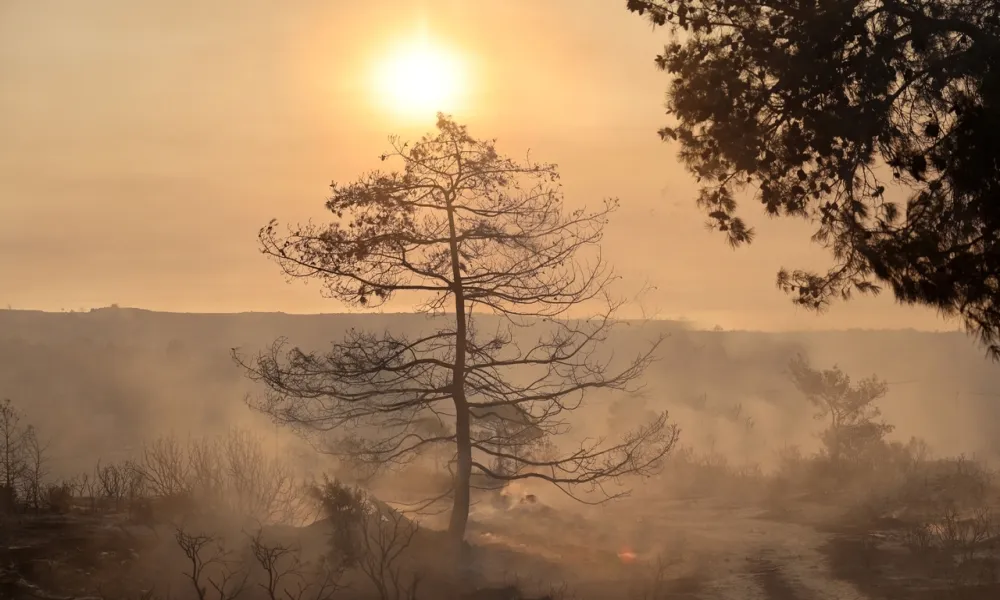
Cyprus Civil Defence is currently going through this process of upgrading as part of its broader restructuring. This was highlighted last Monday at a Civil Protection workshop on effective communication in emergency situations. Among other things, participants presented and discussed two striking examples of disinformation from the major fire in the Limassol mountains, drawn from the many cases gathered by Civil Defence during that crisis and others, with the aim of understanding how the service's communication with the public needs to improve.
In both cases, which went viral very quickly during the crisis, Civil Defence admits that it did not step in to correct the claims, allowing them to damage both its operational work and its credibility. According to officers from the service, similar disinformation incidents were arriving at lightning speed during those days, making it impossible to respond to all of them. "As the fire spread, so did the incidents," said Hara Lazarou, the force's deputy press officer. She added that press officers were also handling other duties at the same time.
First example: a demand for water
In the first case, a representative of a political group claimed on a radio programme that a group of Civil Defence volunteers had refused to hand him a hose connected to a water tank so that he could go down into a ravine and fight a large blaze. He said the volunteers had told him to leave, and shared a video showing them, in his telling, provocatively emptying water from the Civil Defence vehicle onto the ground.
In reality, Civil Defence was acting according to protocol. No unlicensed volunteer group has a role in firefighting operations, and the volunteers duly referred the man requesting the hose to the Fire Service, which was in charge of the operation. As for the emptying of the water, also raised by the political group's representative, this too followed protocol: after 14 consecutive hours fighting the flames, the volunteers had been instructed to leave, and the vehicle's tank needed to be empty for the journey for reasons of vehicle stability.
Second example: 600 meals thrown away
The second example concerned a public appeal by an influencer for 600 meals to be collected and distributed to those affected by the fire and to firefighting personnel. The appeal did not take into account that Civil Defence already had its own mechanism in place for exactly this purpose, working with companies approved by the Health Services under specific conditions and procedures designed to avoid the risk of food poisoning in the high temperatures of July.
The result was that, within minutes, as the appeal spread rapidly across social media, a long queue of cars formed at the fire's coordination centre, with people bringing as many meals as they could, moved by the emotional appeal made by the influencer. However, food left in temperatures of more than 40 degrees in July carried a real risk of food poisoning. Civil Defence officers were duty bound to turn the food away, and it was discarded, while valuable time was lost from their operational work.
The need for a change in policy
On the first incident, Hara Lazarou admitted that "our service was focused on the evacuations, which were the main issue at the time. We did not respond, and perhaps that was a mistake, because volunteers were being targeted. Maybe when it comes to volunteers, we need to be doubly careful."
On the second case, asked whether Civil Defence's communication policy needed to change given that influencers are like a Hydra, since for every one who makes an appeal like the call for 600 meals, another 20 or even 200 could appear, Lazarou stressed the need to create two separate communication channels: one with journalists, and another with the press offices of other services involved in civil protection, for the exchange of information and good practice. "Only this way will we build bridges, credibility and trust. Civil Defence has already improved since the Limassol fire, but there is still work to be done," she said.
Informing the public
The real question is whether the general public understands the responsibilities and procedures undertaken by Civil Defence, said Dr Christos Dimopoulos, associate professor at the European University Cyprus and scientific director of the Civil Protection sector at the CERIDES centre of excellence, in his intervention. He noted that informing the public about civil protection issues and the work of the services involved is more important than having a service constantly chase after every influencer to ask them to take down a popular but misleading post. He added that communicating with citizens before a disaster strikes is also among the recommendations the United Nations makes to such services.
Communication lessons from France's DGSCGC
The improvement of communication with citizens, now becoming a priority for Cyprus Civil Defence, was already a focus four and a half years ago for the Directorate General of Civil Protection and Crisis Management (DGSCGC) at the French interior ministry. "Seeing the multiplication of crises, alongside the growing need of the media for immediate and timely information, we made communication a strategic pillar of our work," said Sebti Khadimallah, head of the communication office at the DGSCGC. Following his address, he also offered some advice to Cyprus Civil Defence, stressing in particular the importance of services communicating directly with journalists themselves, rather than allowing third parties to do so on their behalf, since such intermediaries, he said, are neither responsible for nor as capable or accountable as Civil Defence officers.
Khadimallah is currently responsible for 250 journalists from major media outlets, ensuring they receive continuous and direct information during a crisis, and has set up dedicated social media teams. His service also has six press officers who, he said, are able to understand the concerns of the state, of a firefighter and of the public alike. They have received specialised training for these duties while remaining firefighters themselves, continuing to take part in operations on the ground. "In order to reassure citizens during a crisis, we need to make full and proper use of our actions while also providing a responsible flow of information," he said.