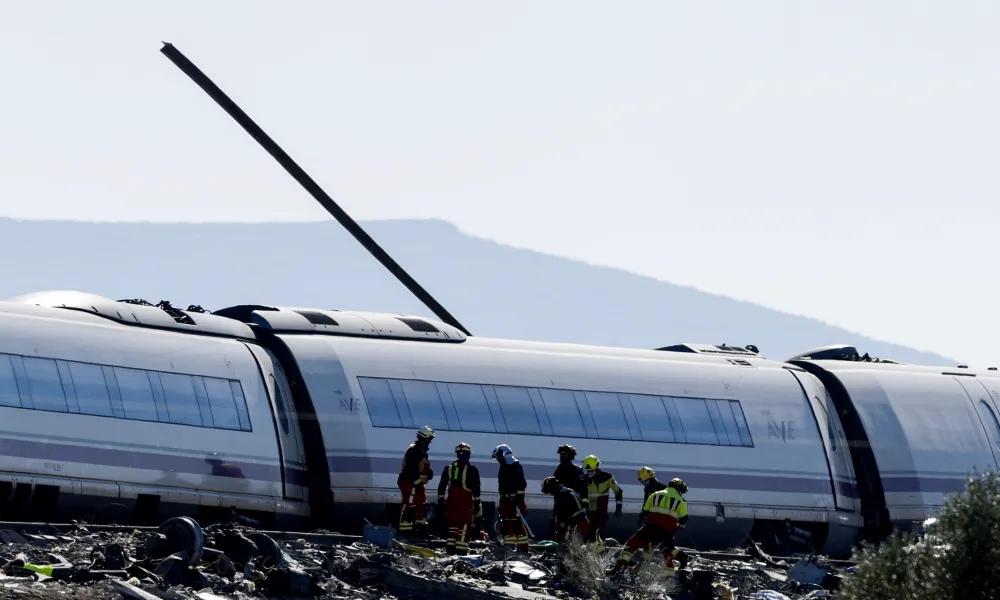

Spain has begun three days of national mourning following Wednesday's train collision in the region of Castile-La Mancha, which has claimed the lives of at least 68 people and left 108 others injured.
The tragedy is the deadliest rail accident in the country since 2013 and comes less than a year after another train crash that killed 46 people.
Prime Minister Pedro Sánchez declared national mourning from Thursday through Saturday as the death toll continued to rise. The latest figures were confirmed by Emiliano García-Page, president of the Castile-La Mancha regional government.
Authorities said 58 of the injured remain in hospital.
Questions over rail safety
The disaster has sparked renewed scrutiny of the safety of Spain's rail network after Transport Minister Óscar Puente described the collision as the result of a "failure" occurring under "inexplicable circumstances".
The crash happened on Wednesday morning when a high-speed train operated by Spain's national rail company Renfe collided with a stationary train belonging to private operator Iryo.
According to Puente, a fault in the signalling system initially triggered the automatic stoppage of six trains operating in the affected area, including the two trains later involved in the collision.
However, several minutes later, the control centre instructed the Renfe train to continue its journey, a decision the minister described as both "mistaken" and "inexplicable".
The train reportedly travelled approximately 25 kilometres within 15 minutes before crashing into the stationary Iryo train. Authorities have not yet disclosed the train's speed at the moment of impact.
"The control centre largely had the time needed to identify the error, but it was not corrected," Puente said.
Pressure on government as investigation continues
While investigators continue examining the causes of the accident, the Socialist government is facing mounting criticism over its management of the rail network.
Emergency crews worked through the night searching the wreckage for additional victims, using cranes to lift twisted sections of metal from the crash site.
Authorities are also continuing efforts to identify the dead.
The Spanish Civil Guard has established four centres in Madrid, Toledo, Córdoba and Seville, where relatives can provide DNA samples to assist with victim identification.
Blood donation centres have also been set up across Castile-La Mancha and Madrid.
Survivors recount horror
Among the survivors was Josimar Medina, a 31-year-old Peruvian tourist travelling with his partner.
He told AFP that he was asleep aboard the Renfe train when he suddenly woke up and realised he was "in the air".
Another passenger, Pablo Mejía, 42, said a last-minute decision to change seats may have saved his life.
"There was a very violent collision," he told AFP.
"There were people on the floor, on top of one another, seats torn out and complete confusion inside the carriages."
Families await answers
A school in the nearby village of Urda, around 130 kilometres south of Madrid, has been receiving relatives searching for information about loved ones who were on board the trains.
Red Cross teams have been providing psychological support to grieving families, while police officers and journalists remain stationed nearby.
According to Carmen Garcay, a psychologist with the Red Cross, many families are facing an extremely difficult period.
"We have people in shock who have not yet understood what happened, people who are angry, sad and anxious. The grieving process will be complex," she said.
The parish priest of Urda, José Miguel Fernández, also visited the scene to support victims and relatives.
"The important thing is to be close to the families of the victims and let them feel that support," he said. "Words are of little use at a moment like this."
Source: AFP