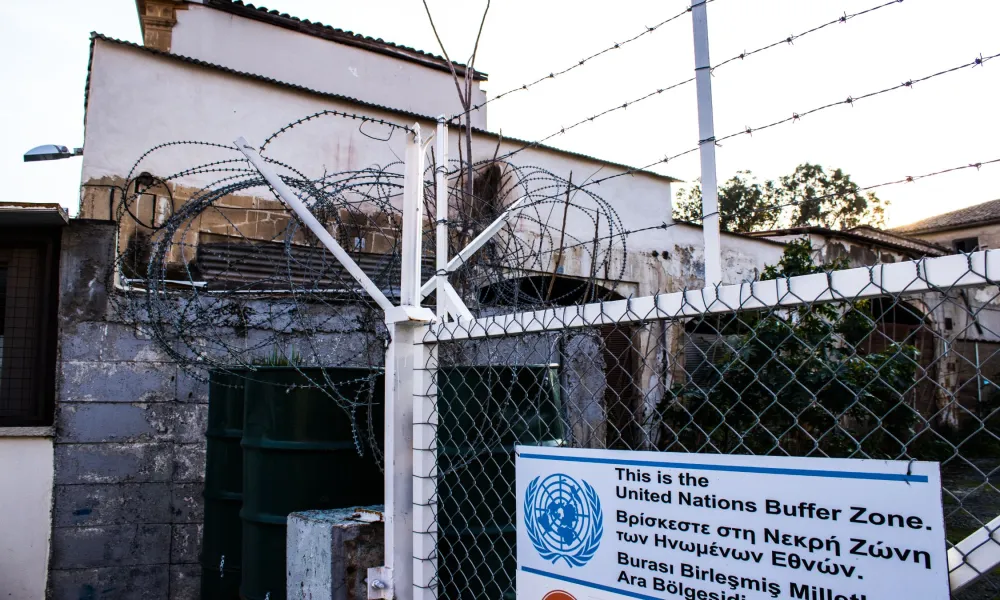

Cyprus does not need another negotiation that collapses over the same arguments. It needs the courage to confront two fundamental but distinct questions: How can Turkish Cypriots and Greek Cypriots establish a sustainable partnership based on political equality, and how can both peoples feel genuinely secure within it?
The first concerns the constitutional foundations of a future state. The second concerns the painful history of the island, the fears that history has produced and the guarantees needed to prevent its repetition.
Confusing the two has contributed to the failure of successive peace initiatives. Treating either as a bargaining chip for concessions on the other would be equally destructive.
As UN envoy María Ángela Holguín prepares another diplomatic push, it is time to abandon the familiar confrontation between demands for zero troops and zero guarantees and expectations that the existing security arrangements can continue indefinitely.
Neither extreme provides a credible foundation for lasting peace.
No fantasies about zero troops or unchanged guarantees
Nobody should entertain the fantasy that Türkiye will accept a settlement requiring the complete withdrawal of its forces while leaving Turkish Cypriot security suspended in thin air, dependent on goodwill or vague international assurances.
The collapse of the 1960 partnership, the intercommunal violence that followed and the events of 1974 remain deeply etched in Turkish Cypriot collective memory. Whatever the competing interpretations of that history, the insecurity and suffering experienced by Turkish Cypriots cannot simply be disregarded in designing a future settlement. To demand the complete withdrawal of Turkish troops without offering credible, enforceable alternatives for Turkish Cypriot security is neither a constructive nor a sincere approach to peacemaking. It is fundamentally inconsistent with a professed commitment to achieving a viable and lasting settlement.
But nobody should harbour the equally unrealistic expectation that the 1960 Treaty of Guarantee can survive untouched forever.
Greek Cypriots have legitimate security concerns of their own. The consequences of 1974, displacement, the continued presence of Turkish troops and the prospect of unilateral military intervention remain profound sources of fear.
Neither community’s historical suffering should be used to invalidate the other’s.
The task is not to decide whose fears are more legitimate. It is to construct arrangements under which neither people must depend on the goodwill of the other for its security.
That requires something considerably more imaginative, out of box ideas than repeating positions formulated decades ago.
Could a Turkish military base provide an answer?
One possibility deserves serious consideration: a geographically limited Turkish military base with an internationally agreed status, accompanied by substantial reductions in Turkish forces elsewhere on the island. After all, Türkiye, with its extensive Mediterranean coastline, centuries of historical presence and enduring strategic interests in the region, has legitimate security concerns that cannot be considered less consequential than those invoked to justify the military presence of Britain, France, the United States or Israel. A carefully negotiated Turkish base could therefore serve not only as a credible safeguard for Turkish Cypriot security but also as recognition of Türkiye’s legitimate strategic interests in the Eastern Mediterranean, provided its status and operation form part of a mutually acceptable settlement.
The idea is not entirely new. In 1964, former US Secretary of State Dean Acheson explored proposals involving a sovereign Turkish military base in the Karpas Peninsula. A revised approach envisaged a smaller installation under a long-term lease rather than a transfer of sovereignty.
Those proposals belonged to a very different political environment and were associated with arrangements that cannot serve as models for a contemporary Cyprus settlement.
Nevertheless, the underlying security question remains relevant.
Could a limited, internationally recognised Turkish military presence provide sufficient reassurance to Turkish Cypriots while allowing the withdrawal of most Turkish forces from the rest of the island?
A sovereign base would be one possibility. A long-term treaty-based installation, with guaranteed operating rights but without transferring territorial sovereignty, would be another.
These are legally and politically different arrangements. Each would require careful consideration of territorial jurisdiction, operational authority, civilian rights, environmental responsibilities and the relationship between the installation and the future partnership state.
Neither should be regarded as a ready-made solution. Greek Cypriot consent would be indispensable, and a military base alone could not replace a comprehensive security framework.
Yet the British Sovereign Base Areas demonstrate that exceptional military jurisdictions already exist on the island. Their existence does not make a Turkish base automatically acceptable, but it challenges the assumption that unconventional arrangements are inherently impossible.
The question deserves examination rather than dismissal.
Designing security for both peoples
A modern security architecture could combine a limited Turkish military presence with phased, verified troop reductions, revised guarantees and binding mechanisms protecting both communities.
The status, size, armaments and operational mandate of any Turkish installation would have to be clearly defined. Its purpose should be defensive reassurance, not unrestricted military intervention.
Equally important would be mechanisms addressing Greek Cypriot concerns about external military pressure and the sovereignty of the future partnership state.
The existing guarantee system could be substantially revised through a new international treaty, specifying the responsibilities of the guarantor powers, the conditions under which protective measures could be taken and the procedures governing their implementation.
Independent verification, joint crisis-management arrangements and enforceable dispute-resolution mechanisms would be essential.
But there is a question that cannot be avoided: what happens if the agreed system fails?
A guarantee that cannot be implemented offers little reassurance. A guarantee that permits unrestricted unilateral action may itself become a source of insecurity.
The challenge is to establish a framework with credible enforcement, clearly defined limits and safeguards against abuse.
Such arrangements would require difficult negotiations among the two communities, Türkiye, Greece, the United Kingdom and potentially other agreed international participants.
They would also require political honesty. Turkish Cypriots cannot be expected to surrender meaningful security protections, while Greek Cypriots cannot be expected to accept an indefinite military presence without clear limitations and credible assurances.
Security must become a shared objective rather than a competition between historical grievances.
Political equality is the foundation of the partnership
Political equality and security are both indispensable, but they serve different purposes and must not be confused.
Political equality is the constitutional foundation of the partnership state to be established. Effective participation in decision-making, including at least one positive Turkish Cypriot vote in agreed common institutions, and rotation of the presidency, or preferably the chairmanship of a presidential council, are not security concessions.
They are essential safeguards for the sustainability of a state founded on the partnership of two politically equal constituent communities.
This is precisely why Turkish Cypriot leader Tufan Erhürman insists that political equality must be accepted in principle before substantive negotiations begin.
It is one of his four parameters for launching a credible process, alongside a time-bound negotiating framework, preservation of previous convergences and protection against an automatic return to the status quo if negotiations collapse through no fault of the Turkish Cypriot side.
Political equality cannot be postponed until the final stages of negotiations or exchanged for territorial adjustments, troop reductions or changes to guarantees.
Without an agreed understanding of how power will be shared, there can be no confidence that the proposed partnership will function.
Security, however, is a separate and equally fundamental dimension, shaped by the island’s painful history and the enduring fears of both peoples.
Political equality must make the partnership sustainable. Security arrangements must make it safe.
Neither can substitute for the other. Both must be addressed seriously, but through distinct negotiating frameworks that recognise their different purposes.
Europe must confront its own contradiction
The European Union cannot indefinitely avoid the institutional imbalance created by Cyprus’s accession in 2004.
Turkish Cypriots supported the Annan Plan, while Greek Cypriots rejected it. Yet the internationally recognised, Greek Cypriot-run Republic of Cyprus entered the Union, leaving Turkish Cypriots outside the effective application of EU law and without equivalent representation in European institutions.
That imbalance continues to shape the negotiating environment.
Brussels regularly urges Türkiye to contribute constructively to a settlement while allowing the Cyprus dispute to constrain the wider Türkiye–EU relationship.
But Europe must decide whether it wants to help overcome the division or merely continue administering its consequences.
A meaningful European contribution would include steps facilitating direct trade, direct contacts and fuller Turkish Cypriot participation in European economic life, without prejudging the final constitutional settlement.
It would also require recognising that Turkish Cypriot political equality cannot be replaced by financial assistance and that legitimate security concerns cannot be dismissed through declarations of European solidarity.
Türkiye, for its part, must acknowledge that a sustainable settlement requires credible reassurance for Greek Cypriots as well.
Europe’s strategic relationship with Ankara and progress toward a Cyprus settlement need not be mutually exclusive objectives. But reconciling them requires a more balanced and imaginative approach.
Regional diplomacy offers a lesson
Ankara’s evolving relations with Libya illustrate how political relationships once defined by confrontation can change.
Türkiye has maintained its partnership with the Tripoli authorities while developing increasingly substantive contacts with eastern Libya, including the Haftar camp and Saddam Haftar.
Eastern Libya’s endorsement of the 2019 Türkiye–Libya maritime memorandum has reinforced Ankara’s diplomatic position, although the agreement remains contested by Greece and other regional actors.
Parliamentary endorsement does not resolve the international legal questions surrounding maritime delimitation. Nevertheless, Ankara’s ability to cultivate relations across Libya’s political divide demonstrates that pragmatic diplomacy can overcome seemingly entrenched hostilities.
Cyprus cannot simply replicate Libya’s experience. Its constitutional, historical and security circumstances are fundamentally different.
Yet there is a lesson worth considering: political disagreements need not prevent cooperation when mutual interests are recognised.
The island still struggles to agree on additional crossing points, even as regional governments reconsider relationships previously regarded as irreconcilable.
Cooperation should begin before a constitution is written
The Great Sea Interconnector, intended to connect Cyprus with Greece and eventually Israel, illustrates how infrastructure can become entangled in geopolitical competition.
For the Greek Cypriot administration, the project promises greater electricity security and integration with European markets. Türkiye questions its economic rationale and has offered to supply electricity to both communities through a potentially shorter mainland connection.
These alternatives should be examined through independent assessments of costs, technical feasibility, supply security and political risks.
A diversified electricity network incorporating connections to Türkiye and European markets could potentially benefit the entire island.
Why should cooperation be confined by existing political divisions?
The same principle applies to crossing points, humanitarian issues, environmental protection, cultural heritage and problems affecting children of mixed marriages.
None requires abandoning fundamental political positions. All could help demonstrate that cooperation produces tangible benefits.
Varosha, or Maraş, requires greater caution. Greek Cypriot property rights and relevant UN resolutions must be respected, but territorial arrangements with potentially irreversible consequences cannot simply be exchanged for commercial permissions that might later be withdrawn.
Such sensitive questions belong within a credible comprehensive settlement framework.
Time to think beyond failed formulas
The forthcoming UN initiative should not become another contest over which side can defend its traditional positions more forcefully.
Political equality must be established as a foundational principle before substantive negotiations begin. Security must then receive the separate, comprehensive attention its historical and strategic importance demands.
Nobody should expect Türkiye to abandon Turkish Cypriot security. Nobody should expect Greek Cypriots to accept the unchanged continuation of the 1960 guarantee system.
Between these positions lies a difficult but potentially negotiable space.
Could a limited sovereign Turkish base provide the necessary reassurance? Would a long-term treaty-based installation achieve the same objective with fewer sovereignty concerns? Could either arrangement be combined with substantial troop reductions, revised guarantees, international verification and binding safeguards for both communities?
These are not rhetorical questions. They require detailed legal, military and political examination, with the consent of both peoples.
The objective is not to preserve the past under a different name. It is to construct a security framework suited to a future partnership.
Cyprus needs political equality to sustain its common institutions and a modern security architecture to protect both peoples. One is the foundation of the partnership; the other is the guarantee that neither community will again have reason to fear for its future.
It is high time to consider solutions beyond the formulas that have repeatedly failed.
Otherwise, another peace initiative will produce another diplomatic record, another collection of carefully negotiated statements and another lost opportunity.