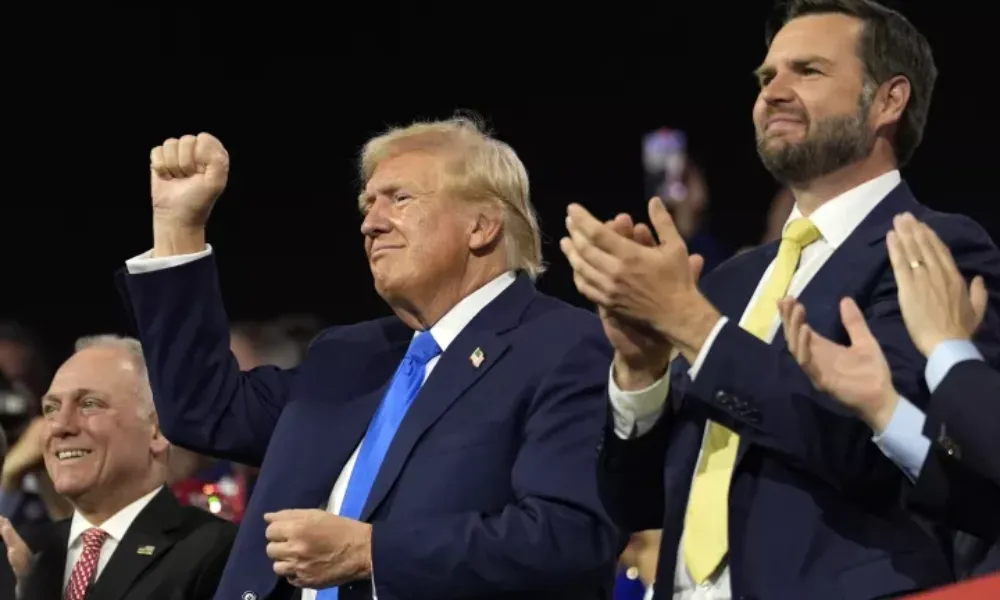

The Republicans' sweeping defeat in the US midterm elections appears to be accelerating the battle over the future of Trumpism, with Vice President JD Vance making his first significant attempts to distinguish himself from Donald Trump.
Without directly challenging the president, Vance has begun distancing himself from some of the administration's most controversial decisions, particularly as discussion intensifies about a possible run for the White House in 2028.
According to Reuters and Associated Press, the first major sign of divergence came on Wednesday when Vance attributed the Republican defeat primarily to the war with Iran, questioning the political cost of a military intervention that Trump continues to defend.
In a post on X, Vance argued that the real reason for the defeat was obvious to almost everyone: the war.
He also challenged supporters of the conflict to explain whether it had been worth losing control of the Senate for the next six years.
The statement carried particular weight because it came from the second most powerful figure in the US administration, who until now had publicly defended the president's core policies.
Diverging views on Iran
The distance between the two men is reflected in their differing interpretations of the election result.
Trump acknowledged that the war with Iran had negatively affected Republican candidates but insisted the military intervention had been the correct decision and one he would repeat under the same circumstances.
Vance, by contrast, adopted a more critical tone, arguing that warnings about the consequences of the conflict had proved justified.
According to Reuters, he endorsed earlier calls for the war to be brought to an end.
The disagreement goes beyond election analysis and touches on one of the central ideological pillars of the MAGA movement: opposition to prolonged US military interventions abroad.
Vance has previously advocated a more restrained foreign policy and criticised American military involvement overseas.
However, after the conflict with Iran began, he avoided public confrontation with Trump and at times defended the operation.
That previous position now presents one of the biggest challenges to his effort to establish distance from the president.
Four pillars of a new strategy
A particularly revealing analysis published by French newspaper Le Monde suggests Vance faces a difficult political balancing act.
According to Washington correspondent Piotr Smolar, Vance must separate himself from unpopular administration decisions without alienating Trump's electoral base, which he would likely need if he seeks the Republican nomination in 2028.
The analysis identifies four key themes emerging from Vance's post-election message:
- Ending the war with Iran.
- Tackling the cost-of-living crisis.
- Returning to the principles of "America First".
- Reassessing the US relationship with Israel.
The final issue is particularly sensitive because it reflects a growing debate within the MAGA movement about how much US foreign policy should be influenced by Israeli strategic priorities.
Le Monde notes that Vance maintains political ties with conservative figures who opposed the war, including former Fox News host Tucker Carlson.
According to the newspaper, the emphasis on these issues signals an effort to reclaim the original promise of "America First", focusing more heavily on domestic concerns and less on foreign military engagements.
Differences also emerging on immigration
Vance's efforts to establish a distinct political identity extend beyond foreign policy.
According to the Associated Press, he has indicated openness to modifying the way immigration policy is enforced, suggesting greater emphasis on employers who hire undocumented migrants.
The position is viewed as an attempt to differentiate himself from the administration's hard-line enforcement approach without abandoning his broader immigration views.
Vance has nevertheless reiterated his opposition to proposals that would legalise undocumented migrants already living in the United States.
Le Monde links this shift to efforts by Vance to put some distance between himself and Stephen Miller, one of the principal architects of the White House's strict immigration policies.
Looking ahead to 2028
Le Monde also reports that efforts to present Vance as a more cautious voice on Iran had begun before the midterm elections.
According to the newspaper, media leaks highlighting internal disagreements within the White House before and after the decision to intervene militarily helped create the impression that Vance held reservations despite publicly supporting the administration.
During the campaign, he also refrained from fully embracing Trump's optimistic rhetoric about a new American "golden age", instead acknowledging voter concerns about living costs and arguing that economic recovery would take time.
The newspaper views these moves as part of a broader effort to prepare for a presidential run in 2028.
However, the path to the Republican nomination is far from clear.
Le Monde points to Ron DeSantis, governor of Florida, as a potential rival, while also noting the continued influence of Secretary of State Marco Rubio, despite no public indication that he intends to run.
The challenge facing Vance
Vance's political strategy carries considerable risks.
He is not an outside critic of the administration but one of its most prominent representatives.
He played an active role in the Republican campaign and is closely associated with many of the decisions that contributed to the election defeat.
Democrats have already accused him of attempting to distance himself from policies he once supported.
Le Monde also notes that his post-election criticism avoided addressing several other factors widely cited as contributing to Republican losses, including tariffs, allegations of corruption and controversial candidate selections.
That selective criticism highlights the limits of his political repositioning.
At the same time, Reuters reports that the election defeat has intensified pressure within Republican ranks for a change in direction, cabinet reshuffles and a reassessment of policies blamed for the loss of Congress.
Trump, however, has so far shown little sign of altering course.
A battle over the future of Trumpism
The central question is whether Vance is merely protecting his political future or beginning to shape a genuinely different vision for the Republican Party after Trump.
Based on reporting by Reuters, Associated Press and Le Monde, the early signs point more toward a carefully calculated political repositioning than an open break with the president.
Vance appears determined to retain MAGA support while also highlighting disagreements with policies that proved electorally damaging.
Whether he can successfully balance those goals may help determine not only his own political future but also the direction of the Republican Party once Trump leaves the White House.
Sources: Le Monde, Reuters, Associated Press