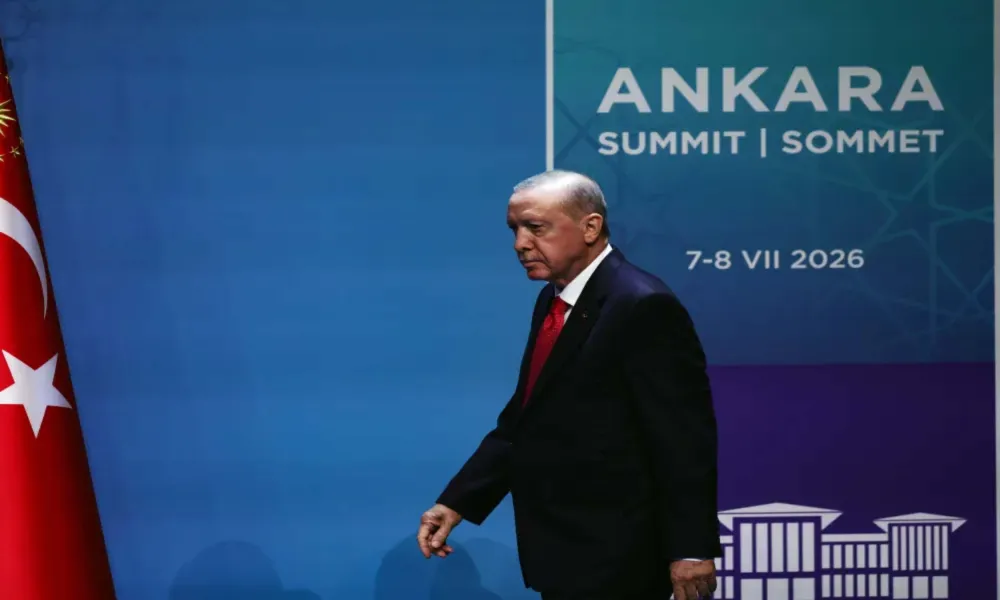

Turkish President Recep Tayyip Erdoğan sought to lower tensions with Greece while highlighting Ankara's push to rejoin the F‑35 fighter jet programme and revive its EU accession prospects during a lengthy press conference following the NATO summit in Ankara.
Erdoğan upbeat on F‑35 prospects
Erdoğan said US President Donald Trump has taken a positive stance towards Turkey regarding the long-running F‑35 issue.
“The most important issue, as mentioned earlier, is the F‑35. Mr Trump actually has a positive approach towards Turkey on the F‑35 matter,” Erdoğan said.
He added that Turkey hopes the eventual delivery of the aircraft will demonstrate that the United States has honoured its commitments.
“We hope that when the F‑35s are delivered to Turkey, the whole world will say that America kept its promise,” he said.
The Turkish president also stressed the importance of strengthening economic ties with Washington, saying deeper economic cooperation was in Turkey's national interest and was also supported by the United States.
Renewed push for EU membership
Erdoğan said Turkey's relationship with the European Union would feature prominently in discussions with EU leaders, including European Commission President Ursula von der Leyen.
Referring to Turkey's decades-long accession bid, he criticised the bloc for keeping Ankara waiting.
“Turkey has had this expectation for 53 years. This is an injustice,” Erdoğan said.
“We will tell them: relieve Turkey of this injustice. Hopefully they will finally open the door.”
The comments reflected Ankara's continuing effort to link Turkey's role in European security and defence to renewed momentum in its EU membership process.
‘Almost nobody knows what casus belli is’
Asked whether the Turkish parliament's 1995 casus belli declaration remains a threat of war against Greece in the event that Athens extends its territorial waters, Erdoğan attempted to de-escalate the issue.
He argued that most people in Turkey are unfamiliar with the term.
“Almost my entire people do not know what casus belli is,” he said.
“We do not need to occupy either our own people or the Greek people with these issues.”
He also issued another call for dialogue with Athens.
“We tell our Greek friends: let us sit down, talk and bring this matter to an end. This is our approach, and every time the issue comes onto the table, this is what we tell them,” Erdoğan said.
“The casus belli is one of these issues.”
Agrees disputes should be resolved through talks
Responding to comments by Greek Prime Minister Kyriakos Mitsotakis that Greece and Turkey should resolve their maritime disputes, Erdoğan said he shared that view.
“I also agree with the view that the problems in the Aegean need to be resolved,” he said.
“First our foreign ministers can discuss the matter and then, if necessary, we can also sit at the table and discuss it.”
He added that resolving maritime disputes was primarily the responsibility of political leaders.
Dismisses criticism over possible F‑35 sale
Erdoğan also rejected objections from Greek and Israeli officials regarding a potential sale of F‑35s to Turkey.
“Neither of those statements has any place in my world,” he said.
Referring to Mitsotakis, Erdoğan suggested Greece had no grounds to object.
“Have we ever asked Greece why it buys certain defence systems? No. Yet it is our neighbour. We could have asked, but there is no need,” he said.
According to Erdoğan, both Greece and Turkey have the right to purchase and develop defence equipment.
‘Blue Homeland’ remains central policy concept
The Turkish president was also asked about the future of the Blue Homeland doctrine and possible legislation related to it.
While declining to provide a timetable, Erdoğan stressed that the concept remains important for Turkey.
“Blue Homeland is a very important issue for us,” he said.
He added that Ankara intends to use the term not only in reference to maritime areas but more broadly when appropriate.
Halki Seminary not discussed with Trump
Asked whether the reopening of the Halki Theological School had been discussed during his meeting with Trump, Erdoğan replied briefly:
“No, it was not on the agenda.”
Erdoğan hails NATO summit as ‘historic’
In his opening remarks, Erdoğan described the NATO summit as a historic gathering, noting that it was the second NATO summit hosted by Turkey in 22 years and the first held in Ankara.
“At a time when Euro-Atlantic security is being tested, this historic summit took place in a way that will guide our common future,” he said.
He argued that the summit laid the foundations for a stronger NATO, with European allies assuming greater responsibility and burden-sharing becoming more balanced.
Erdoğan also highlighted Trump's presence at the summit, saying the US president had indicated that Turkey's hosting of the event had been an important factor in his decision to attend.
“The fact that he also underlined our personal friendship is particularly important and valuable for us,” Erdoğan said.
Calls for greater Turkish role in European defence
The Turkish leader stressed that EU defence initiatives should complement NATO rather than duplicate it.
He argued that excluding non-EU NATO allies such as Turkey from European defence projects would weaken their effectiveness.
“When allies that are not members of the European Union, such as Turkey, are not fully integrated into the EU's defence initiatives, the effectiveness of those initiatives will be very limited,” he said.
Erdoğan also renewed calls for the removal of restrictions affecting defence trade among allies, saying such obstacles should be lifted “without any ifs or buts.”
Source: CNA