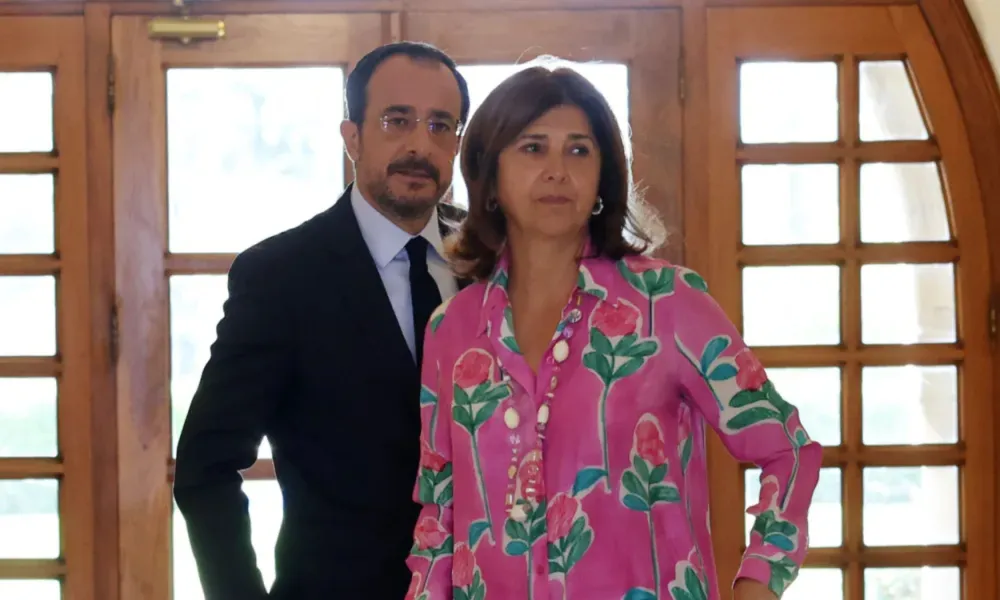

The interview given by María Ángela Holguín, the Personal Envoy of the UN Secretary-General, to Politis goes a long way towards clarifying a discussion that the government of Nikos Christodoulides had recently tried to present as more or less settled.
Specifically, it clarifies whether the next informal enlarged conference is guaranteed and whether its convening depends on specific preconditions.
Her messages also touch on Tufan Erhürman, who, instead of being productive, appears to be operating more within a framework of assigning blame.
A clear answer
The response from the UN Secretary-General's Personal Envoy is much clearer than the Presidential Palace might have wished.
There are preconditions for an enlarged five-party meeting.
And they are neither procedural nor insignificant.
Holguín outlines three things that must come first.
First, the two leaders must meet directly and regularly.
Second, they must identify and advance Confidence-Building Measures (CBMs), a condition she describes as indispensable.
Third, both sides must work on the substance of the Cyprus issue and on the methodology of the new process.
Perhaps most importantly, she makes it clear that the United Nations will not proceed to another "5+1" meeting that risks failure.
The Presidential Palace was saying something else
This is where the political contradiction with the government's narrative emerges.
On 29 July, after Antonio Guterres departed Cyprus, Nikos Christodoulides was asked directly whether progress on CBMs was a prerequisite for convening the enlarged conference.
He replied that CBMs were a positive development but were "not a prerequisite" for convening it.
He also portrayed the acceptance by all parties of an enlarged conference as a significant achievement.
Holguín says something markedly different.
The parties' consent exists, but it is not sufficient.
It does not mean that Guterres has already decided to issue invitations and that all that remains is to find a date on the calendar.
On the contrary, the "5+1" is the next step only if work is first done in Nicosia and it is demonstrated that the new process has prospects of leading somewhere.
After all, Guterres himself spoke about adequate preparation on CBMs, methodology and substance before any new enlarged meeting.
He did not set a date, nor did he announce that the conference would take place in September.
Therefore, the President's political desire to see an enlarged conference held as soon as possible is one thing, while the actual position of the United Nations is another.
And what happened to the 'hard work' of August?
There is also a second contradiction, this time not in words but in the calendar.
Following Guterres' visit, the impression was created that August would be a month of intensive preparation.
The President himself went so far as to say that he would not go on holiday and that the government would work throughout the month on developments regarding the Cyprus problem.
Instead, what have we seen?
The President has been occupied with cabinet reshuffle issues, appointments to semi-governmental organisations, participation in memorial events and increasingly raising the political temperature as part of what the columnist describes as his 2028 re-election campaign, adopting rhetoric and criticism directed at the so-called "DISY-AKEL" axis.
If he genuinely seeks a solution to the Cyprus problem, the article asks, who will stand by his side other than DISY and AKEL? ELAM?
Meanwhile, instead of fostering a climate focused on a settlement, public debate has revolved around whether Fidias Panayiotou should have attended the Isaac and Solomou memorial event wearing shorts.
In short, one might have expected Christodoulides and Erhürman to begin direct contacts immediately.
This is especially true given that Erhürman had stated he was ready even for weekly meetings throughout August.
Yet the first meeting between the two leaders was scheduled for 26 August, almost a month after Guterres' visit.
The question is obvious: if three serious preconditions must be fulfilled before an enlarged conference can take place, and time is pressing, how much "hard work" can be done when the first substantive meeting between the two leaders is taking place just five days before the end of August?
It is not a question of whether the President is on holiday.
Nor does it matter whether he is at the Presidential Palace or his holiday home.
What matters is whether there is political movement.
So far, the calendar does not support the sense of urgency that has been projected.
Holguín also points towards Erhürman
It would, however, be a mistake to read Holguín's interview solely as a rebuke of Nikos Christodoulides.
Her message is directed equally at Tufan Erhürman.
The Personal Envoy reiterates that responsibility lies in the hands of both leaders and that what is needed is continuous direct contact and a "visible indication" that they are determined to move forward rather than merely exchange views.
At the same time, she identifies a lack of political will "from all actors involved" as a major obstacle and warns of the damage caused by public rhetoric and leaks to the task of building trust.
In this respect, Erhürman is not helping either.
While declaring himself willing to hold weekly meetings and calling for meaningful preparation, he has simultaneously opted to conduct a public debate about assigning blame and has made inflammatory statements at Kokkina, adopting similarly hardline rhetoric.
He accused Christodoulides of rejecting a proposal for demining and, regarding crossing points, publicly explained what he himself accepted, what he did not reject and where, in his view, the Greek Cypriot side was responsible.
This is precisely the logic from which the UN is trying to move the Cyprus issue away.
If every CBM becomes an opportunity to demonstrate who said "yes" and who said "no", then Confidence-Building Measures ultimately become measures for building arguments for the next round of blame.
The five-party meeting is the result, not the starting point
This is perhaps the most important message from Holguín's interview.
The five-party conference is not the starting point of the process.
It is the result of preparatory work that must first be completed.
Guterres does not want another conference simply to have the two sides, the three guarantor powers and himself photographed around the same table.
He wants to know that when he invites them there will be something meaningful to announce, namely the resumption of a genuine negotiating process.
That changes the picture completely.
September is not a fixed appointment.
The enlarged conference is not guaranteed.
CBMs are not unrelated to its convening.
And goodwill is not demonstrated through statements or by cancelling presidential holidays.
It is demonstrated at the negotiating table.
The problem is that Christodoulides and Erhürman have so far scheduled themselves to sit at that table on 26 August.
The time given to them by Guterres, however, has already started running.