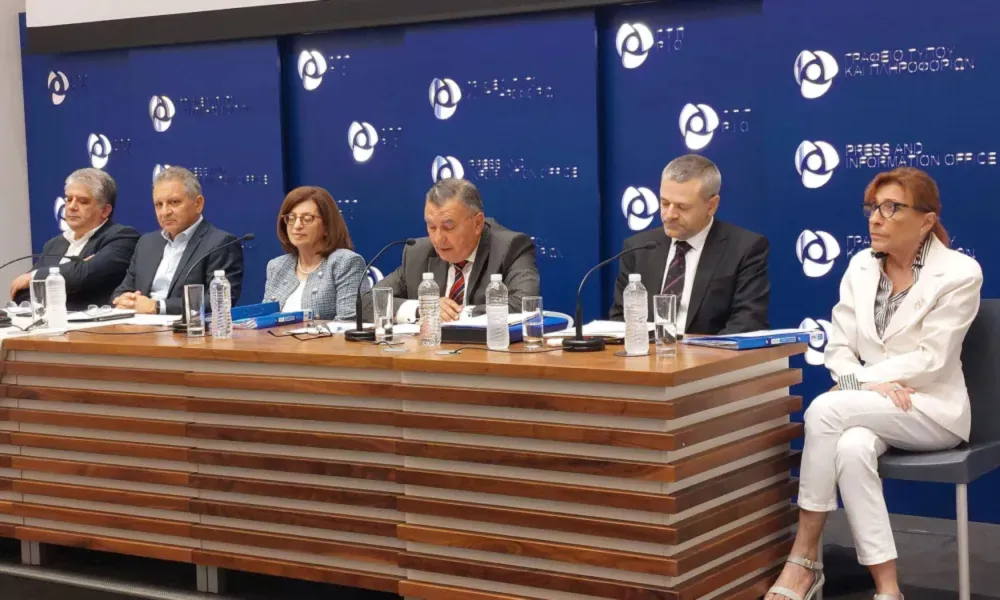

In June 2023, the establishment of the Advisory Council for Appointments to Public Law Bodies, following a Cabinet decision, was presented as a major reform aimed at modernising the state and promoting participatory democracy.
One of the council's biggest tests, namely the appointment of new boards to semi-government organisations, has instead sparked significant debate about its role and its relationship with appointments perceived to be based on party recommendations.
The criticism has become so intense that the issue is expected to come before the House Institutions Committee in the coming weeks, with both DISY and AKEL sharply criticising the government and some voices even questioning whether the Advisory Council should continue to exist.
Tensions between the government and the two largest parties escalated over the weekend, with both sides exchanging political accusations and criticism.
What the president and government said at the time
On 20 June 2023, President Nikos Christodoulides, during a press conference marking the first 100 days of his presidency, referred to the planned establishment of the Advisory Council, which was due to be approved by Cabinet within days.
Asked under what formula appointments to semi-government organisations would be made, he said the Advisory Council would initially deal with appointments to those organisations.
"Yes, the Advisory Council will be announced very soon and will concern, in the first phase, appointments to semi-government organisations."
He explained that the council would make recommendations to the executive branch, which would not be legally binding, citing constitutional considerations discussed with the Law Office.
However, the President also made a clarification that has now returned to the spotlight:
"If certain recommendations are not followed by the executive branch, they will have to be publicly justified."
Then, on 28 June 2023, Government Spokesman Konstantinos Letymbiotis, following Cabinet's decision to establish the Advisory Council, stated that the body would be responsible for preparing a shortlist of recommendations for the relevant minister within 30 days.
He explained that the list would contain three times the number of candidates required to fill vacant board positions.
A five-member subcommittee of the Advisory Council, whose composition would depend on the nature of each organisation, would submit recommendations to the minister, who would then make recommendations to Cabinet.
Letymbiotis also stressed that if Cabinet chose to appoint individuals not included on the list, the decision would have to be fully justified.
Were the decisions justified?
Based on those statements by both President Christodoulides and the Government Spokesman, the question that now arises is whether appointment decisions involving semi-government organisations were adequately justified, particularly in cases involving individuals who did not express interest through the prescribed procedure and whose names did not appear on Advisory Council lists.
In recent comments to the Cyprus News Agency, Deputy Government Spokesman Yiannis Antoniou noted that the Advisory Council is an advisory body.
He said that of the 95 individuals appointed, 74 had been recommended by the Advisory Council, meaning its recommendations were adopted in 78 per cent of cases.
He also noted that 1,282 applications had been submitted, with some applicants expressing interest in two or three organisations.
The question that remains, however, is on what criteria and through what process the remaining 21 individuals were appointed to the boards of semi-government organisations.
Tensions ease, but debate continues
Following the political confrontation that intensified after President Christodoulides referred to what he described as convergence between DISY and AKEL, and the reactions that followed, tensions appeared to ease on Monday, with no further escalation.
Nevertheless, it is widely expected that the issue of appointments to semi-government organisations will return to the forefront of political debate, particularly when Parliament resumes its work and the matter comes up for discussion in the House.