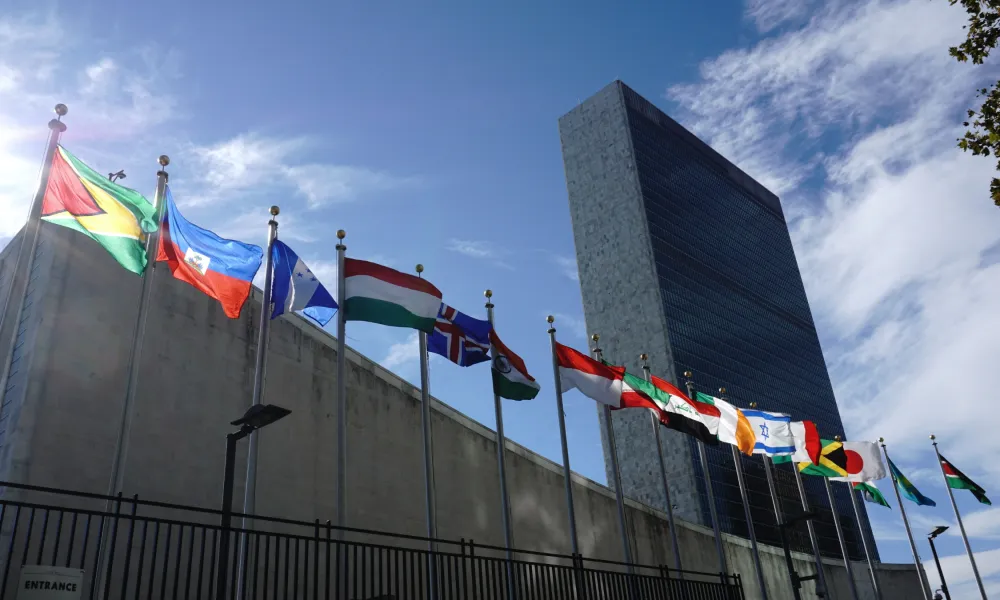

The Cyprus leaders will travel to New York, but there will be no common negotiating table waiting for them. United Nations Secretary-General António Guterres has made clear that he sees no basis, at least for now, for either a trilateral meeting with Greek Cypriot leader Nikos Christodoulides and Turkish Cypriot leader Tufan Erhürman or an informal 5+1 gathering with Türkiye, Greece and Britain, the three guarantor powers. The leaders can hold separate contacts, present their positions and try to influence the next stage, but the UN will not manufacture the appearance of a process where the political groundwork remains incomplete.
That decision sharply lowers the ceiling of expectation. New York will not deliver a formal resumption of negotiations, a new mandate or even the familiar diplomatic theatre of a family photograph. Christodoulides has disclosed that he will meet Guterres on Sept. 24. Erhürman is also expected to have his own contact with the Secretary-General, while María Ángela Holguín Cuéllar may take part in consultations if her health permits her to travel. Yet the value of these meetings will not be measured by access or choreography. It will depend on whether the two sides can offer compatible commitments that lead to action.
The maximum realistic outcome is therefore modest: measurable progress on confidence-building measures. A balanced step on crossing points, demining or emergency cooperation would not solve the Cyprus problem, but it could create the minimum political space required for a trilateral or 5+1 meeting later. Failure to achieve even that would confirm that the process remains abundant in declarations and deficient in joint decisions.
Why Guterres is withholding the table
Guterres is not closing the Cyprus file. He is protecting what remains of the UN's diplomatic credibility. During his July engagement on the island, he linked any future expanded meeting to adequate preparation in three parallel areas: confidence-building measures, methodology and substance. The sequence matters. Progress in one area cannot be used indefinitely to disguise paralysis in the others.
The intervening weeks have brought more frequent meetings and closer contact between the negotiators, but not a shared political direction. Christodoulides speaks as though the sides are nearly aligned on methodology and ready to continue from Crans-Montana. Erhürman is more cautious, warning that confidence is being eroded even while the leaders discuss how to restore it. Their accounts of the same encounters often sound as if they emerged from different rooms.
Under those conditions, convening a high-profile meeting would allow procedure to substitute for progress. Guterres has chosen the more credible course. Before supplying a table, he wants the leaders to show that they are capable of placing something on it.
Confidence building as a test of political capacity
Confidence-building measures are often treated as the easier, secondary part of Cyprus diplomacy, useful mainly for occupying the sides while the difficult constitutional questions wait. That view is no longer persuasive. Today, these measures test whether a negotiating process would possess even the elementary political capacity to function.
The dispute over new crossing points is the clearest example. The Turkish Cypriot side supports simultaneous movement on Mia Milia-Haspolat and Pyroi-Athienou, while retaining Louroujina-Akıncılar and Kokkina-Erenköy within a wider package. The Greek Cypriot side treats the Athienou-Pyroi-Aglantzia route as a single corridor and resists additions it regards as strategically or politically separate. Behind the technical language lie familiar anxieties over access, territory, security and recognition.
A practical compromise does not require every proposed crossing to open at once. It could begin with simultaneous progress on Mia Milia-Haspolat and Pyroi-Athienou, accompanied by an agreed timetable for examining the remaining routes. Reciprocity is essential. A piecemeal arrangement that satisfies one side while indefinitely shelving the other's concerns would deepen mistrust rather than reduce it.
Demining and emergency cooperation offer further opportunities. Wildfires, the Kyrenia ferry disaster and the continuing risk of earthquakes or maritime accidents have shown how artificial the division becomes when lives are at stake. A permanent emergency communications channel and a joint civil-protection mechanism would alter neither side's constitutional position. They would demonstrate that cooperation can precede a settlement and perhaps help make one imaginable.
The asymmetry behind the loss of trust
Confidence is being eroded not only by disagreements inside the negotiating room but also by deliberate efforts to restrict Turkish Cypriot contact with the outside world. FC Barcelona withdrew two Barça Academy football camps planned for September at Near East University in northern Nicosia for children aged 6 to 18 after the Cyprus Football Association asked its Spanish counterpart to press the club to cancel or relocate them and referred the matter to UEFA. Around the same time, the Serbian company EXIT withdrew from the NEXUS electronic music festival scheduled for Sept. 18 near Kyrenia Castle following Greek Cypriot political and diplomatic interventions, including appeals to Serbian President Aleksandar Vučić. These were not isolated cancellations. They demonstrated that, even as the two leaders were being urged to rebuild confidence, internationally recognised sporting and cultural organisations were being pressured to avoid engagement with the Turkish Cypriot community. The message received in the north was unmistakable: Turkish Cypriots are invited to believe in a common future, but their ability to participate openly in international cultural and sporting life today continues to be treated as a threat.
The contradiction is reinforced by property prosecutions, campaigns against academic recognition and regional arrangements that claim to represent the whole island while excluding the Turkish Cypriot community. The Greek Cypriot leadership presents many of these steps as a defence of legality and of the Republic of Cyprus. Turkish Cypriots experience them as a tightening of isolation at the very moment they are asked to place renewed faith in a future partnership.
This does not mean that Greek Cypriot concerns are illegitimate. Developments in Varosha, property sales in the north and rhetoric about two sovereign states deepen fears that partition is becoming permanent. But mutual grievance cannot become an alibi for policies that steadily make cooperation less credible.
The structural imbalance must also be acknowledged. Greek Cypriots have demographic predominance on the island and the advantages of exclusive international recognition; Türkiye has the greater external strategic weight. The Republic of Cyprus's accession to the European Union further altered that balance. A viable settlement must reassure Greek Cypriots that they will not be dominated by Türkiye, while guaranteeing that Turkish Cypriots cannot be reduced by majoritarianism and international asymmetry to the status of a protected minority.
Two leaders and two different credibility tests
Erhürman has demonstrated a willingness to pursue a negotiated settlement despite criticism from those for whom the absence of an agreement has become a political destination in itself. His four requirements are clear: political equality and effective participation, a time-bound process, preservation of earlier convergences, and an assurance that another collapse not caused by the Turkish Cypriot side will not simply restore the same status quo.
These requirements should be tested for workability rather than dismissed as obstruction. Political equality must be translated into functioning arrangements, including rotating leadership and a Turkish Cypriot affirmative vote in defined fields. A timetable should compel decisions without becoming an artificial ultimatum. Any consequence attached to failure should make it possible to assess responsibility and impose a political cost for deliberate obstruction, without predetermining partition before negotiations begin.
Christodoulides faces a different test. He says he accepts political equality, the preservation of convergences and a process that cannot continue indefinitely. He also says he is ready to resume from Crans-Montana. His challenge is no longer to repeat these principles but to reconcile them with policies that reinforce Turkish Cypriot invisibility and with a domestic political environment in which almost every compromise risks being portrayed as surrender.
No leader can prepare society for compromise by repeatedly assuring nationalist constituencies that nothing fundamental will change. Nor can Turkish Cypriots be asked to invest in partnership while the privileges flowing from the Republic of Cyprus's internationally recognised status are treated as untouchable in practice. The credibility gap comes not from language alone but from the distance between declared readiness and political conduct.
What would qualify as progress
The UN's inventory of earlier convergences may soon clarify how much of the previous negotiating record can be preserved. It cannot make the political choices for the leaders. They must still agree on which convergences constitute the baseline, whether changes require mutual consent and how understandings in one chapter relate to compromises expected in another.
New York is unlikely to resolve those methodological questions, but it can define the next assignment. If the separate meetings with Guterres produce matching commitments to complete the convergences exercise, continue work on methodology and implement a balanced confidence-building package, the absence of a summit will not amount to failure.
The standard must be practical and visible. Two crossings advancing together would count. A limited demining agreement with locations and dates would count. A permanent emergency hotline and a joint civil-protection arrangement would count. Another promise to continue discussing these matters would not.
Confidence-building measures cannot replace a comprehensive settlement. They can reveal whether the leaders possess the political discipline required to negotiate one. If the sides cannot cooperate over fires, accidents, crossings and humanitarian questions, it is difficult to believe they are ready to operate common institutions dealing with executive authority, security, property and territory.
New York can still serve a purpose
Time is narrowing the available space. Guterres is approaching the end of his term, and there is no guarantee that his successor will devote comparable attention to Cyprus. Nor is there any assurance that a future secretary-general will retain a personal envoy with Holguín's realism about the positions, expectations and psychological barriers of both communities.
This makes the temptation to inflate the New York contacts understandable but dangerous. A premature trilateral or 5+1 meeting would not compensate for missing common ground. It could consume another diplomatic opportunity, generate another ambiguous statement and leave the island still more cynical.
The limited objective is therefore the appropriate one. Christodoulides and Erhürman should use their separate meetings not simply to explain why the other side is responsible, but to give Guterres commitments that can be matched and implemented. Reciprocal progress on crossings, demining or emergency cooperation would give the Secretary-General a reason to bring them together later, potentially with the guarantor powers.
New York will not launch a new Cyprus process. At best, it can establish whether the minimum foundation for one still exists. That is less than many hoped for, but it is more consequential than another photograph. The issue is no longer whether the leaders can obtain a meeting. It is whether they can create a reason for one.