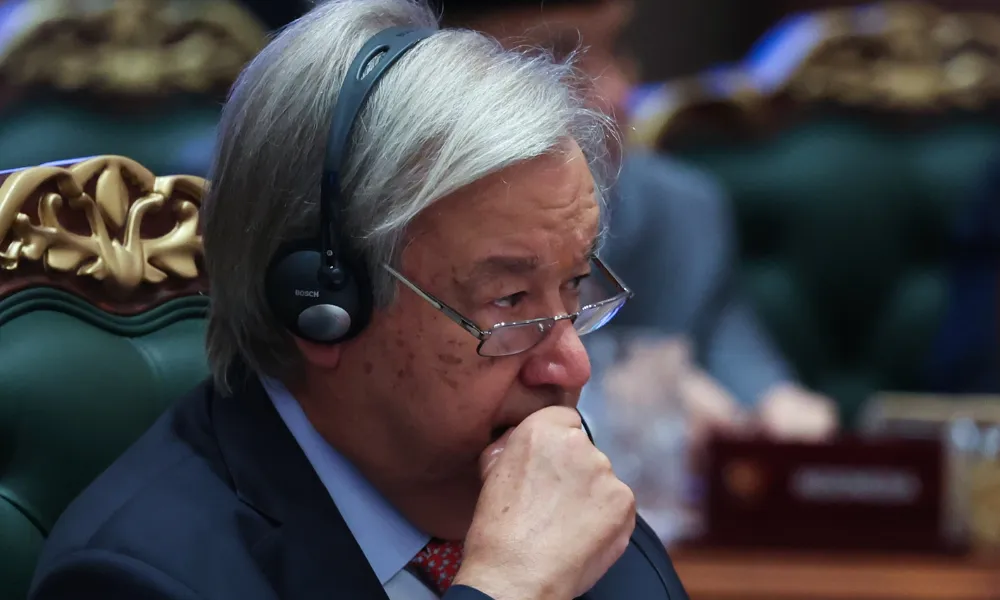

UN Secretary-General António Guterres stated publicly on 16 September that on the Cyprus problem "we cannot repeat the mistakes of the past." He expects to meet the two Cypriot leaders separately in New York, on the sidelines of the General Assembly, but is not giving them a joint appointment for a trilateral meeting, because he judges that "there is still a great deal of work to be done."
On the same day, in Strasbourg, European Commission President Ursula von der Leyen made no mention whatsoever of Cyprus in her customary annual State of the Union address. This drew the anger of Cypriot MEPs, but their objections went unanswered.
The two events, in New York and in Strasbourg, are connected. The Cyprus problem remains on the margins of the international agenda, as it has for nearly a decade now. The dynamics surrounding the problem have not only failed to change, but, as Guterres's term draws to a close, risk being further worsened by geopolitical rivalries in the Middle East.
This reality raises serious questions about Christodoulides's policy. Last March, the Cypriot President came out to announce a "Guterres initiative" to resolve the Cyprus problem. He even did not rule out submitting a settlement plan by the end of this year (interview on Alpha, 12/05). Von der Leyen found not a word to say about European involvement in the Cyprus problem. She acknowledges the "primary responsibility" that the UN holds, and states she is "ready to play an active role" (April 2024), but Guterres has not given the green light. What, exactly, would she work on?
Declarations and reality
These events highlight the gap between what is said and what is actually happening. In late July, Guterres set out specific conditions in Nicosia, substance, methodology and confidence-building measures, for convening a successful expanded "5+1" conference, but the parties were "not sufficiently prepared," in his words. In the three meetings that followed in Nicosia between President Christodoulides and Turkish Cypriot leader Tufan Erhürman, no progress was made, not even on confidence-building measures. As a result, Guterres also ruled out the possibility of a joint meeting of the three of them in New York.
Guterres's remark that "there is still a great deal of work to be done" relates to the minimal goal he has set: drawing up a document recording the convergences reached up to Crans-Montana. This will be the "legacy" he leaves to his successor. For weeks now, Canadian constitutional expert John McGarry has been tasked with recording these convergences, but even this effort is running into serious difficulties. The UN does, of course, have the convergences on record, but it has not secured the two sides' agreement for them to be turned into a binding document. The parties' position, however paradoxical it may seem, remains: "nothing is agreed and nothing is put down on paper unless there is agreement on everything together, as a package."
The UN does not want to repeat this mistake of the past either. In its own report to the Security Council, in September 2017, Guterres noted that "the substance of a comprehensive settlement of the Cyprus problem was (at the time) practically there" and that "the parties had come close to a strategic common understanding on all core outstanding issues." Today the UN rejects the position that working on the convergences requires their "word for word" reformulation. "The document being prepared will reflect what the UN has on file as convergences on every issue," said María Ángela Holguín.
A convergences document
It is President Nikos Christodoulides himself who now speaks of "disagreements" and "divergences" (statements, 04/09). Paradoxically, reservations about recording the convergences have also been voiced by the man who was negotiator at the time, Andreas Mavroyiannis, AKEL's candidate in the 2023 presidential election. "It is an unfortunate choice on the UN's part to insist on recording the convergences," he said in an interview on Alpha (15/09), arguing this will spark endless disputes over whether each convergence "was this way or that way."
The Greek Cypriot leadership carries an extremely burdened record before the UN when it comes to what was actually agreed. But it also faces a glaring contradiction. Both Christodoulides and Mavroyiannis, who has declared his readiness to run again in 2028, have at various points admitted that in 2017 the Cyprus problem came very close to being resolved: "by a hair's breadth," in Mavroyiannis's words, "at the eleventh hour," in Christodoulides's.
At the same time, they dispute the UN's own records, even when these concern proposals submitted by the Secretary-General himself or by his then special adviser, Espen Barth Eide, today Norway's Foreign Minister.
Legal hair-splitting
Against these records, they set up their own versions. The same logic was used to defend the handling of former President Nicos Anastasiades after Crans-Montana, who claimed there were "two Guterres frameworks," dated 30 June and 4 July 2017. It was through this same kind of diplomatic hair-splitting that the proposal of then Turkish Cypriot leader Mustafa Akıncı (30/04/2018) for "acceptance without modification" of the 30 June framework as a strategic agreement was also rejected.
Guterres finds himself dealing with interlocutors who cling to the same contradictions, complicating the Canadian constitutional expert's effort to arrive at a commonly accepted record. The cost of Christodoulides's handling of the issue is now visible: the Secretary-General is keeping his distance and, shortly before completing his term, is making increasingly pointed public remarks. In practice, nothing will move again unless the UN is convinced that the parties are ready for "serious negotiations," as his spokesman put it.
An empty file
Nor does the EU appear willing to become active unless the UN first confirms that the parties have made an explicit and irreversible commitment. Following his appointment (13/07) as the Commission's special representative on the Cyprus problem, Raffaele Fitto has made only a single, few-hours-long visit to Cyprus. The Cyprus problem file at the European Commission has, in essence, been empty since 2017, after the Greek Cypriot leadership suspended the work of the technical committee on aligning the Turkish Cypriot community with the European acquis. The same applies to the work produced at the time by Peter Van Nuffel, who worked alongside the UN team as personal representative of then Commission President Jean-Claude Juncker, on the subject of "the compatibility of a settlement with the European acquis."
Even during Cyprus's presidency of the Council of the EU, the Cypriot government did not put forward for discussion the funding of the economic needs of a possible settlement from the new European budget. Instead, the Commission took the initiative itself and proposed increasing funding to the Turkish Cypriot community from €240 million to €440 million for the 2028-2034 period.