
On the other side of the Green Line, Turkish Cypriots face rising living costs, persistent inflation and growing inequality. At the same time, Northern Cyprus is becoming increasingly reliant on real estate, casinos and foreign investment, developments that carry implications not only for the economy but also for the future of the Cyprus problem.
On the other side of the Green Line, everyday life is becoming increasingly difficult for Turkish Cypriots. Salaries are struggling to keep pace with inflation, food and rental prices continue to rise, and thousands of families are living close to the poverty line, according to local statistics.
At the same time, studies on income and living standards point to a widening gap between a small number of affluent individuals and the large majority struggling to meet basic needs, while the middle class continues to erode.
The statistics authority in the north announced annual inflation of 40.22 per cent for February. Categories such as restaurants and hotels, education, recreation and housing rents recorded increases well above the average, confirming the severe pressure on the cost of living faced by Turkish Cypriots.
Against this backdrop, one of the most visible developments has been the increase in crossings by Turkish Cypriots into the government-controlled areas, not only for leisure or visits, but increasingly for shopping.
Increase in crossings
According to 2025 Green Line crossing figures published by the European Commission last week, Cyprus Police recorded 1,453,135 crossings by Greek Cypriots into the north, up from 1,346,121 in 2024, and 833,786 vehicle crossings, up from 822,443.
During the same period, there were 1,983,610 crossings by Turkish Cypriots into the government-controlled areas, up from 1,814,647, and 748,061 vehicle crossings, compared with 705,532 previously.
The figures confirm what is visible on a daily basis, particularly in Nicosia: Turkish Cypriots visiting shopping centres and supermarkets to buy goods.
Inflation pressures
Chronic inflation, dependence on the euro and pound sterling for transactions, and increasing reliance on sectors such as real estate and casinos are creating new realities with political implications for the Cyprus issue, economist and academic Alexandros Apostolides told Politis.
According to Apostolides, the challenges now facing the north are not new but rather the continuation of long-standing inflationary pressures and economic distortions.
The minimum wage has gradually approached the level of the minimum wage in the government-controlled areas, creating further cost pressures and fuelling inflation.
Price comparisons show that many goods, especially staples such as meat, are now more expensive in the north than in the south. At the same time, competitiveness remains weak, partly due to intense activity in the property market and increasing demand for land investments.
Those benefiting most
Apostolides notes that those benefiting most are, on one hand, individuals exploiting land, in many cases property belonging to Greek Cypriots, and on the other hand those avoiding the use of the Turkish lira because of its chronic inflationary instability.
He also highlights the banking sector, which relies heavily on foreign currencies to avoid exchange-rate risks, effectively transferring those risks to customers.
In practice, property purchases and rentals are usually conducted in pounds sterling, while vehicle purchases are often priced in euros.
Not as isolated as many think
Despite political and institutional isolation, the Turkish Cypriot economy is not nearly as disconnected as many assume, Apostolides argues. The same applies to its banking sector.
As for Turkey, he notes that financial support remains substantial, although it is gradually declining. Ankara continues to directly fund structures such as the police, the military presence and major infrastructure projects, including the water pipeline project.
Beyond direct funding, Turkey also provides loans to the north, which are recorded as debts of the self-declared Turkish Republic of Northern Cyprus.
According to Apostolides, Ankara expects these loans to be repaid eventually.
Part of the funding resembles a programme similar to those implemented by international lenders, with conditions and reform requirements attached. This requires a stable relationship between the Turkish government and the administration in the north.
For now, he says, that cooperation is facilitated by the close ties between President Recep Tayyip Erdoğan's AKP and the ruling National Unity Party (UBP).
Changing sources of economic activity
For many years, the economy in Northern Cyprus relied heavily on private higher education, a sector that did not necessarily discourage the prospect of a future settlement of the Cyprus problem.
Today, however, that sector faces serious challenges.
The Eastern Mediterranean University, the largest university in the north, is experiencing financial difficulties, while universities more broadly face accusations resembling a "degree-selling industry."
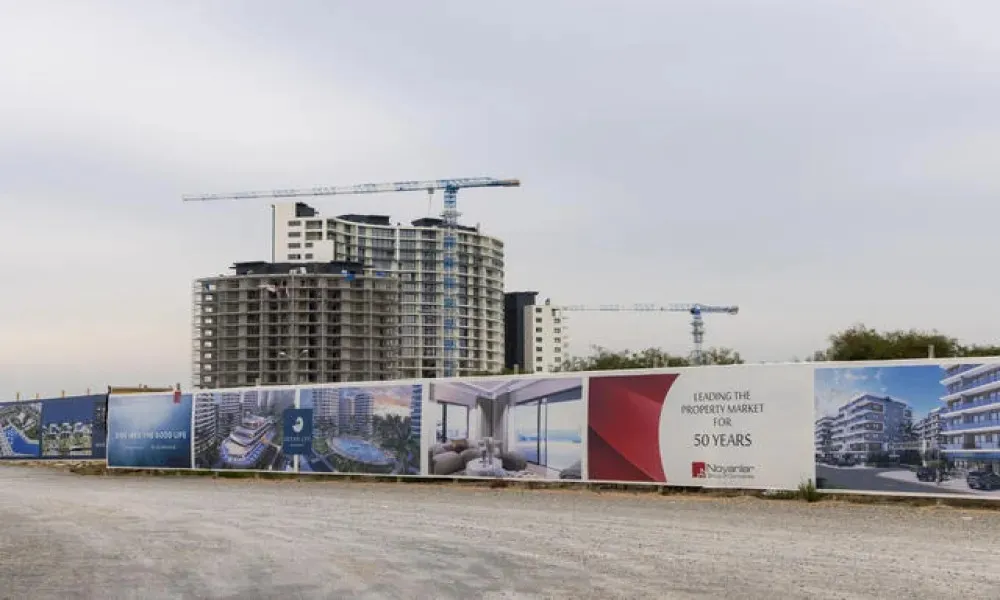
As a result, economic activity is increasingly shifting toward real estate and casinos, sectors that Apostolides expects to expand further in the coming years.
Foreign investment with political implications
Another significant factor is the growing purchase of land and property by foreign investors, particularly from Russia, Ukraine and Israel.
According to Apostolides, investors from these countries inevitably become stakeholders with an interest in developments relating to Cyprus.
In a small economy such as Northern Cyprus, these investments carry substantial significance, both economically and politically.
Growing dependence on Turkey
Apostolides argues that the economy in the north is becoming increasingly tied to Turkey, a trend that is influenced not only by Turkish policy but also by actions taken by the Republic of Cyprus.
He cites halloumi as an example.
When the Republic moves to prevent exports of halloumi produced in the north to Arab markets, the product is redirected toward Turkey instead. This deepens economic dependence on Ankara.
Similarly, products exported from Northern Cyprus to Europe must generally pass through Mersin in Turkey, reinforcing Turkish influence and control over trade.
The Cyprus issue and economics
Apostolides believes economic considerations do not receive the attention they deserve in discussions concerning the Cyprus problem.
He suggests several immediate measures that the Republic of Cyprus could pursue.
First, he advocates opening additional crossing points, including Mia Milia, to boost Green Line trade and enhance economic interaction between the two communities.
Currently, Green Line trade amounts to approximately €16 million, representing just 0.01 per cent of the Republic's total imports.
Second, he argues that restrictions on food products originating in the north should be eased. He notes that President Nikos Christodoulides recently added six products to the approved list but believes more should be included.
Removing what he describes as a unilateral economic blockade would support trade and reduce dependence on Turkey.
Third, he proposes lifting restrictions on payments across the Green Line. Such a move, he says, would facilitate economic activity and assist displaced persons.
The cost of non-solution
Apostolides stresses that the Republic of Cyprus is missing out on significant economic opportunities because of the unresolved Cyprus issue.
Citing existing studies, he estimates that a settlement could generate income gains of up to €20 billion.
Beyond economics, a different relationship between the two communities could improve cooperation on energy, environmental protection, public health and livestock management issues, including diseases such as foot-and-mouth disease.
His conclusion is that the economy in Northern Cyprus should not be viewed as a secondary issue. It affects daily life, dependence on Turkey, prospects for reunification and ultimately the strategic choices available to the Republic of Cyprus.
A snapshot of the Turkish Cypriot economy
With an estimated GDP of approximately €3.62 billion at the end of 2023, the economy in Northern Cyprus remains relatively small, roughly one-fifth the size of the Republic of Cyprus economy.
The 2023 figures are the latest reviewed by an international body, namely the World Bank.
Following the shock of the pandemic, the economy rebounded strongly. According to World Bank estimates, GDP grew by 13.3 per cent in 2022 and by more than 5 per cent in 2023, returning to pre-pandemic levels.
Available data indicate that GDP reached 132.35 billion Turkish lira in 2023, approximately €2.47 billion at current exchange rates, with real growth of 7.3 per cent.
The World Bank nevertheless warns that growth is likely to slow because of high inflation, pressures on public finances and weak competitiveness.
The economy is overwhelmingly services-based. Public administration, trade, tourism and higher education account for more than 60 per cent of total output.
Inequality and poverty
A series of World Bank reports produced under the EU-funded programme Supporting Economic Convergence and Integration in Cyprus found a decline in living standards between 2014 and 2021, accompanied by rising poverty and inequality.
Poverty increased from 11.2 per cent to 13.9 per cent, while the World Bank recommended more frequent income surveys and population censuses to improve policymaking.
Meanwhile, a 2021-2022 household budget survey conducted by the Turkish Cypriot statistics authority found that roughly 15 per cent of the population lives below the local poverty line. Using EU methodology, the figure rises to 22.8 per cent.
The burden of the Turkish lira
The depreciation of the Turkish lira and persistently high inflation remain a constant burden on the economy.
World Bank reports note that the rising cost of food, energy and housing continues to erode purchasing power and push vulnerable households closer to poverty.
Trade unions report that families of four living on the minimum wage are not only below the poverty line but also below the so-called "hunger threshold," the minimum amount required to secure an adequate diet.
By Filip Polo and Yannis Seitanidis