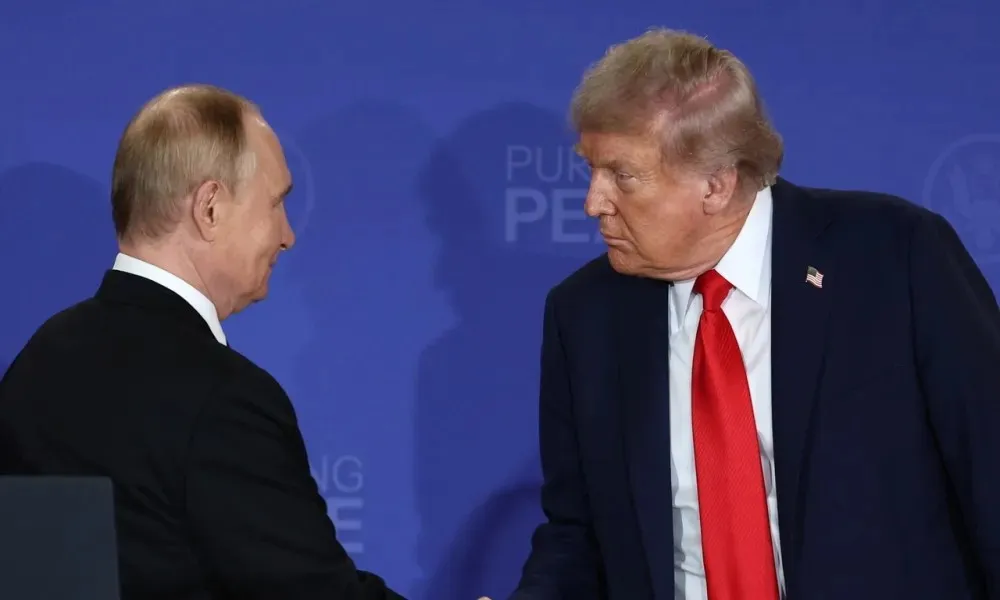

Russian President Vladimir Putin spoke by phone with US President Donald Trump on Saturday on the occasion of the United States' 250th anniversary, the Kremlin announced early Sunday, adding that the conversation centred largely on developments in Ukraine ahead of the NATO summit in Ankara.
"The presidents naturally discussed the issue of a settlement in Ukraine, particularly in light of Donald Trump's upcoming participation in the NATO summit in Turkey on July 7 and 8," Yuri Ushakov, a foreign policy adviser to the Russian president, told Russia's RIA news agency.
According to Ushakov, the call lasted one hour and 25 minutes and also covered other international issues, including Iran and the Middle East.
Earlier on Saturday, Ukrainian President Volodymyr Zelenskyy announced that he too had held a telephone conversation with Trump.
"Of course, President Trump and I discussed the current situation on the frontline as well as our diplomatic efforts. There is a real prospect to put an end to this war, and America’s resolve is decisive," Zelenskyy wrote on X.
I have congratulated President Trump @POTUS and all Americans on the Independence Day. We’ve had a very good phone call.
— Volodymyr Zelenskyy / Володимир Зеленський (@ZelenskyyUa) July 4, 2026
We are grateful to the United States for all the assistance we have received – from Javelins and Patriots to political support – and we deeply value that… pic.twitter.com/FKAPdpvnSN
"We have agreed to continue these discussions during the NATO summit in Ankara," he added.
Leaders and delegations from 32 countries, including Trump, are expected to attend the summit in the Turkish capital beginning on Tuesday.
Putin "described the real situation on the battlefield in Ukraine, where Russian armed forces are advancing steadily," Ushakov said.
On Friday, Moscow announced the capture of the Ukrainian city of Kostiantynivka, a key Kyiv stronghold in the eastern Donetsk region, full control of which remains one of the Kremlin's main objectives.
Kyiv rejected the claim, insisting its forces still control the city and that fighting is ongoing.
On the battlefield, Russian forces have continued to make gradual advances in recent months, as the widespread use of drones has made the movement of vehicles, particularly heavy equipment, increasingly difficult.
Diplomatically, negotiations remain deadlocked.
Moscow continues to demand the withdrawal of Ukrainian forces from Donetsk and other regions it claims to have annexed, despite not fully controlling them.
Kyiv has rejected those demands.