
Cyprus’s Interior Ministry plans to introduce a new lifeguard certification system next year, arguing that the current model has left beaches without enough eligible candidates despite the availability of sufficient approved posts.
The overhaul will be accompanied by €1.5 million in spending on lifeguard equipment and towers between 2026 and 2028. Seasonal employment, operating hours and gaps in legislation governing water sports will also be examined.
Why certification is being overhauled
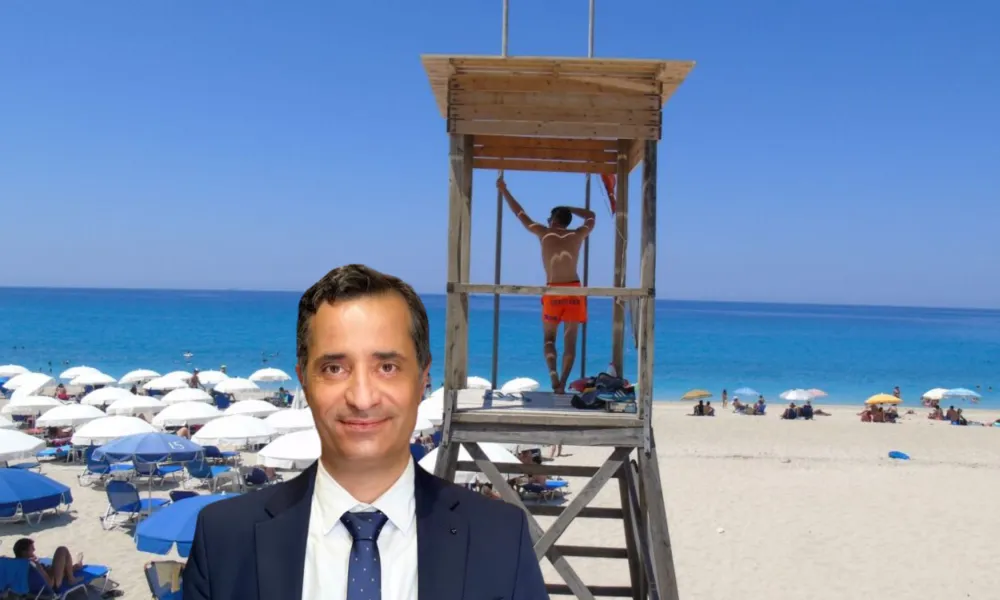
Director of Local Government Antonis Oikonomides told the Cyprus News Agency on Monday that the shortage was not caused by the number of approved lifeguard posts or the level of pay, but by the lack of certified candidates available to staff beaches.
“The problem is not the number of approved lifeguards, which is more than sufficient, nor their pay. The problem is that there are not enough candidates to staff the beaches,” he said.
Lifeguard coverage at organised beaches is governed by the Salamis Plan, which was approved by the Council of Ministers in 2018 and sets out requirements including the location of lifeguard towers, staffing levels and operating hours. Oikonomides said a revised version of the plan, containing improvements and other changes, had recently been approved.
He explained that although several lifeguard associations provide training and issue qualifications, the existing plan requires lifeguards to hold a certificate approved by the Cyprus Lifesaving Federation, known by its Greek initials KON.
According to Oikonomides, personal disputes or disagreements between lifeguard associations and the federation have resulted in an insufficient number of certified lifeguards to cover the needs of the island’s beaches.
He also said KON, which had previously been registered, does not currently hold a registration certificate from the Nicosia Registrar of Associations and Foundations following changes to the relevant legislation.
Lifeguard associations have also been lodging complaints for some time, alleging that they face difficulties in securing certification for the lifeguards they train.
“This is why we want the system to change,” Oikonomides said, describing the existing model as “problematic”.
The ministry has been consulting the Human Resource Development Authority for several months on a system under which approved organisations would be certified by the authority and subsequently authorised to issue beach lifeguard qualifications.
Applications have already been submitted, while organisations including SEK and PEO have received certification from the authority. New lifeguarding standards are also being prepared, with qualifications divided into two categories covering beaches and swimming pools.
“We want to have a new system in place with the new year, and we believe there will no longer be a shortage of lifeguards,” he said.
Seasonal work and operating hours
Oikonomides identified seasonal employment as a second major issue. Some lifeguards employed by district administrations hold permanent positions, while others work for ten, eight or as few as four months, depending on the beach and area.
“It is not easy to attract someone to work for four months,” he said, adding that the issue would be reviewed after the end of this year’s lifeguard season.
Operating hours vary according to visitor numbers and other factors, with shifts ending at 17:00, 18:00 or 19:00 depending on the beach.
“It is not simply a solution to keep them there until 8pm to cover every possibility,” Oikonomides said, noting that lifeguards already work long hours in a particularly demanding profession.
Asked about the drowning of a woman in Larnaca on 15 August, who had been in the sea with her two young children, he said the information available to him indicated that the sea was rough at the time.
“There must also be personal responsibility among members of the public, particularly parents,” he said, adding that people should not enter the sea with young children during rough conditions.
The lifeguards had completed their shift at 18:00, approximately 20 minutes before the incident, he said.
Oikonomides also referred to an earlier incident in which women who entered the sea fully clothed at around 19:30 drowned near the breakwaters.
“At some point, lifeguards have to finish work,” he said, adding that it was not possible to provide lifeguard coverage 24 hours a day.
€1.5 million for equipment and towers
The government has allocated €500,000 for lifeguard equipment this year, with the same amount budgeted for each of the following two years.
An island-wide inventory has been completed covering equipment at every lifeguard tower and identifying shortages involving defibrillators, jet skis, radios and other items.
Procurement procedures are already under way for ten jet skis and additional equipment.
A separate tender is being prepared for new lifeguard towers. The aim is to gradually replace older wooden structures with modern, more durable towers, including aluminium units that could be relocated where necessary.
Gaps in water sports legislation
Referring to the serious jet ski accident in the Pernera area on 15 August, Oikonomides said the matter did not fall entirely within the Interior Ministry’s responsibilities, although gaps existed in the current regulatory framework.
Local authorities designate specific coastal locations for water sports operations, after which the relevant licensing process is followed.
“There are no clear provisions covering every issue, such as who may operate a jet ski and under what conditions,” he said, adding that such matters fell more directly within the responsibilities of the Port and Marine Police.
He said the legislation remained unclear, citing as an example the possibility of a foreign visitor renting a boat or another type of watercraft in Cyprus while a Cypriot citizen may be required to hold a specific speedboat operator’s licence.
“These are issues that must be clarified in the legislation,” Oikonomides concluded.
Source: CNA.