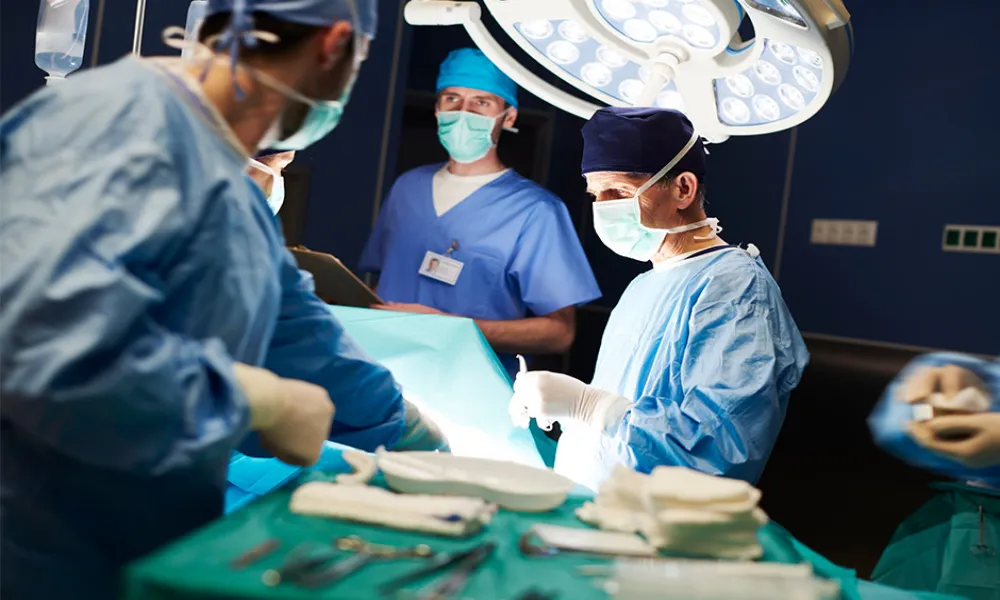

Four surgical teams across three countries took part in a recent operation involving organs donated by a young Cypriot woman who died in a road collision.
Her two kidneys were transplanted in Cyprus, her lungs and liver in Greece, and her heart in Israel. All five recipients are reported to be in very good health.
Dr Andreas Soloukidis, Assistant Director of Nephrology and Head of the Transplant Clinic at Nicosia General Hospital, highlighted the close cooperation between Cyprus, Greece and Israel in organ transplantation.
Dr Soloukidis, who is also Vice-President of the Cyprus Transplant Council, told the Cyprus News Agency that the procedures required what he described as an enormous coordination effort involving surgical teams from all three countries.
How organs are allocated abroad
Asked about the recent transplant of the young Cypriot donor’s heart into a 45-year-old woman in Israel, Dr Soloukidis said it was made possible through longstanding agreements signed by the Ministry of Health with the national transplant organisations of Greece and Israel.
Under the agreements, organs that cannot be used in Cyprus because of the country’s small population and the absence of heart, lung and liver transplant programmes are offered abroad.
“Organs that remain unused in Cyprus are offered to these countries, with priority given to Greece’s National Transplant Organisation,” he said.
If an organ is declined by Greece, it is then offered to Israel as a priority. If no suitable recipient is available in either country, the organ is made available through a platform to another European country.
Cooperation with Greece and Israel
Dr Soloukidis said cooperation with Greece and Israel had expanded in recent years following the activation of the Cyprus Transplant Council.
Israel has received a heart graft from Cyprus on at least two occasions during the past two years, including the most recent case. It also received a lung last year after the organ was declined by Greece.
Approximately 50% of liver grafts not accepted by Greece for various reasons are subsequently transferred to Israel, he added.
“We have excellent cooperation both with Greece’s National Transplant Organisation and with Israel,” Dr Soloukidis said, noting that surgical teams undertake an “enormous coordination effort” whenever organs become available.
Four surgical teams involved
The latest donation involved four separate surgical teams.
A team from Onassis Hospital in Athens handled the lungs, a team from a hospital in Israel received the heart, a team from Hippocrateio Hospital in Thessaloniki handled the liver, and a Cypriot team received the two kidneys.
“All the organs have been transplanted. The two Cypriot kidney recipients, like the other recipients, are in excellent condition. The organs began functioning immediately, and these five people have been given a second chance at life,” he said.
Arrangements also support Cypriot patients
Dr Soloukidis stressed that the cooperation works in both directions.
Under the agreements, Cypriot patients requiring heart or lung transplants can be placed on waiting lists in Greece.
Cyprus also works with Israel on paired kidney exchanges. These involve donor-recipient pairs in which the willing donor is not compatible with the intended recipient because of blood type or other factors.
The pairs are entered into software operated by Israel, which runs matching simulations to enable kidneys to be exchanged between compatible pairs.
Through the programme, seven Cypriot donor-recipient pairs have been helped over the past three years. Each had a willing donor but could not proceed with a direct transplant because they were incompatible.
Paediatric kidney transplants are also carried out in cooperation with Israel and Greece.
“The cooperation is therefore reciprocal. Organs that are available but cannot be used in Cyprus are offered abroad so that they do not go to waste. At the same time, Cypriot patients who need these organs are usually placed on the waiting lists of those countries,” Dr Soloukidis said.
Speaking on behalf of the President of the Cyprus Transplant Council and the Ministry of Health, he thanked the national transplant authorities in Greece and Israel for their cooperation.
“All of this is done so that we can help as many people as possible following the loss of another human life,” he said.
Nineteen kidney transplants this year
A total of 19 kidney transplants have been carried out in Cyprus so far this year, including two procedures performed on Saturday. Further transplants are scheduled before the end of the year.
Cyprus usually records around 10 deceased organ donors annually, placing it approximately in the middle of the EU rankings.
Dr Soloukidis said the Cyprus Transplant Council was working to increase the number of potential donors and move the country higher in the European rankings.
Cyprus already ranks very highly in Europe for living organ donations, he added, with further initiatives planned to improve its position in both living and deceased donation.
Figures covering transplants of other organs will be available at the end of the year.
Source: CNA