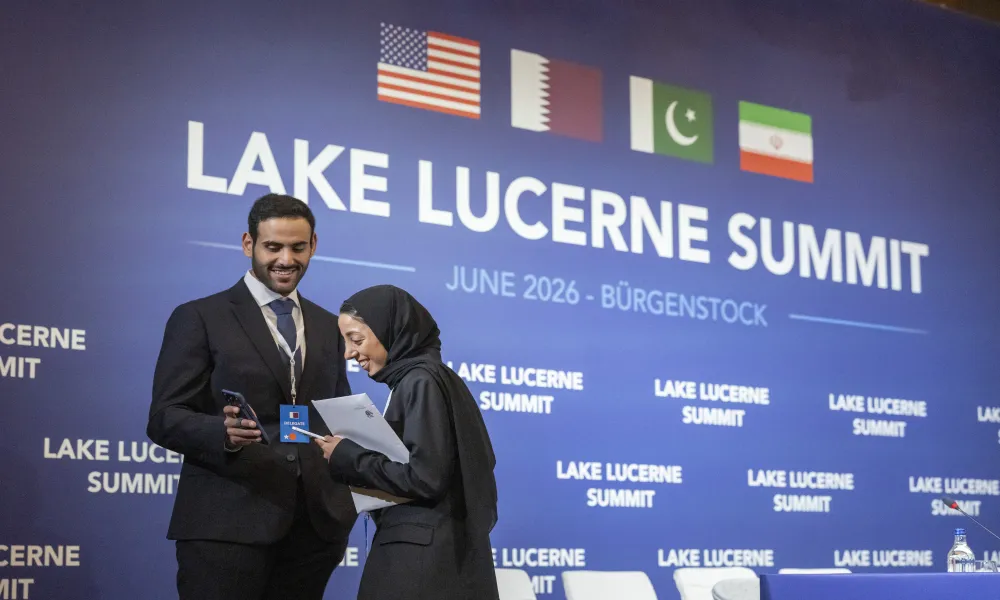



On 17 June 2026, at the Palace of Versailles, where Donald Trump was dining with French President Emmanuel Macron on the sidelines of the G7 summit, the American president signed a 14-point memorandum of understanding with Iran. Iranian President Masoud Pezeshkian signed the same document simultaneously in Tehran. Pakistan's Prime Minister Shehbaz Sharif, who served alongside Qatar as a key mediator, witnessed both signatures. "The Deal with the Islamic Republic of Iran is now complete," Trump wrote on social media that evening. "Congratulations to all!"
The MoU commits both sides to an immediate and permanent termination of military operations on all fronts, including in Lebanon. It requires the US to begin lifting its naval blockade on Iran within 30 days and to remove its forces from the proximity of Iran within 30 days of any final deal. Iran, for its part, committed to arrangements for the safe passage of commercial vessels through the Strait of Hormuz, toll-free for 60 days, and pledged not to procure or develop nuclear weapons. The US Treasury issued a 60-day sanctions waiver allowing Iran to export crude oil, with the sale of petroleum products and associated banking services included.
Iran's nuclear programme, the stated reason the war was launched, is mentioned only in the vaguest terms. Tehran committed to "maintaining the current status quo" of its nuclear programme and to not developing weapons, a promise Iran has made repeatedly over the years without it proving durable. The fate of Iran's enriched uranium stockpiles, the question of whether Iran retains any enrichment capacity at all, and the terms under which IAEA inspectors could re-enter bombed nuclear sites are all deferred to the 60-day negotiation period. Iran's ballistic missile programme is not mentioned in the text at all. Neither is Iran's funding of armed groups across the region, a central demand from Arab Gulf states and Israel throughout the war. The document explicitly leaves these for the "final Deal."
A rocky first week
The ink on the memorandum was barely dry before the agreement came under strain. Israel, which was not a party to the MoU and publicly stated it was not bound by it, continued strikes against Hezbollah positions in Lebanon throughout the days following the signing. Iran, which had insisted that a halt to all hostilities in Lebanon was a condition of any deal, announced it was closing the Strait of Hormuz again in response. The US military denied Iran had done so, stating the waterway remained open. Trump posted on social media threatening to "hit Iran very hard again, just like we did last week, only harder" if Iran's proxies in Lebanon did not stand down, doing so while US Vice President JD Vance was sitting at the negotiating table in Switzerland attempting to save the agreement.
The high-level talks at the Bürgenstock resort in Switzerland on 21 June, with Vance leading the American delegation alongside special envoy Steve Witkoff and Jared Kushner, produced a joint statement from Qatar and Pakistan describing "encouraging progress" and a "positive and constructive atmosphere." Working groups were established covering nuclear monitoring, sanctions relief, reconstruction and a "de-confliction cell" for Lebanon. Iran's Foreign Minister Abbas Araghchi called the progress "major." A fragile ceasefire between Israel and Hezbollah took hold, with UN peacekeepers in Lebanon reporting for the first time since March that neither side had carried out an attack.
But a public dispute immediately clouded even those gains. Vance told reporters that Iran had agreed to invite IAEA inspectors back into the country to examine bombed nuclear sites, calling it "a major milestone." The following day, Iran's Foreign Ministry spokesman flatly denied that any such visit had been scheduled, describing the nuclear programme as a matter on which Iran had made no new commitments. Trump responded on Truth Social insisting Iran had agreed to inspections "long into the future" and warned there could be "no further negotiations" without this concession. The IAEA declined to comment. The public contradiction between the two delegations on a central point of the agreement was a reminder of how fragile the diplomatic architecture remains.
The Strait of Hormuz is open, but on whose terms
The question of who controls the Strait of Hormuz has emerged as one of the most consequential unresolved issues. Before the war, approximately 100 ships transited the strait daily, carrying roughly a fifth of the world's oil and gas. As of this week, shipping traffic has been recovering, with 39 vessels recorded crossing on Monday, rising to a record since the war began, though still only about a third of pre-war levels. Some vessels are believed to be transiting with their location transponders switched off, making tracking incomplete.
Iran has moved quickly to assert permanent sovereign authority over the waterway. Its chief negotiator, parliament speaker Mohammad Bagher Ghalibaf, stated publicly that the Strait of Hormuz "will never return to its pre-war conditions" and will be administered by Iran. Tehran and Oman announced they are forming a joint committee to manage commercial shipping through the strait, with costs for services to be charged to vessels, an arrangement Iran's newly created Persian Gulf Strait Authority has been promoting. Secretary of State Marco Rubio, meeting with Gulf Cooperation Council members in Bahrain on 25 June, was direct: there is "zero support among the Gulf countries for any sort of toll or fees or anything that charges for the use of international waters." Trump told the same message to Iran directly, warning that any effort to impose charges on vessels could derail negotiations. The IMO, the UN maritime agency, stated it does not recognise Iran's new requirements for vessels to carry Iran-approved insurance before transit. The gap between Iran's position and the international community's expectations for the strait has not been bridged.
The conflict in Lebanon
The single greatest threat to the agreement is the conflict in Lebanon, which involves actors not party to the memorandum. Israel has stated publicly that it is not bound by the US-Iran ceasefire, and its defence minister and prime minister both affirmed that Israeli forces would remain in southern Lebanon "for as long as necessary." A de-confliction mechanism is being built, but it was not yet operational as of this week. Israeli and Lebanese delegations held separate talks in Washington from 23 to 25 June, hosted by the State Department, which Rubio described as the first time sovereign governments of Lebanon and Israel have spoken directly in 30 years.
Iran has made it a consistent and non-negotiable demand that Israeli forces withdraw from Lebanon as part of any final agreement. Israel has made it equally clear it will not do so unilaterally. Neither the US nor Iran has a mechanism to resolve this independently: Israel answers to neither party and has its own red lines regarding Hezbollah's continued armed presence along its northern border. The de-confliction cell agreed in Switzerland is an attempt to manage tensions rather than resolve the underlying dispute. Whether it holds long enough for the 60-day negotiation window to produce a final agreement is the central unknown.
What may come next
Technical negotiations are continuing. Working groups on nuclear monitoring, sanctions, and reconstruction are meeting in parallel, and Iran's president and foreign minister travelled to Pakistan on 23 June for further discussions with mediators. The 60-day window began on 17 June, meaning the current framework expires around 16 August unless both sides agree to extend it. Trump himself has left little ambiguity about his fall-back position: "If I don't like it, if they don't behave, we'll go right back to dropping bombs right smack in the middle of their head."
The economic incentives for both sides to reach a final agreement are substantial. Iran exported an estimated 40 million barrels of oil in the first weeks following the sanction waiver, generating around three billion dollars in a 60-day window if projections hold. A government poll conducted inside Iran as of 20 June found that nearly 60% of Iranians said they could no longer sustain their financial lives, and 70% demanded government changes. The domestic pressure on Iran's leadership to deliver economic relief is acute. On the US side, gasoline prices and inflation were sliding Trump's approval ratings before the deal; Trump acknowledged at a news conference that he had signed the agreement because he "didn't want to see an economic catastrophe."
The unresolved core issues, Iran's enrichment capacity and uranium stockpiles, the future of its missile programme, the question of its regional proxies, and the status of Lebanon, are the same issues that have defined US-Iran relations for decades. The memorandum of understanding has created a 60-day window and a set of working structures through which those issues might, for the first time, be addressed comprehensively. Whether the window is long enough, the structures strong enough, and the political will on all sides sufficient is what the coming weeks will answer.
Sources: Reuters, NPR, CBS News, CNN, CNBC, Al Jazeera