
By Andreas Paraschos
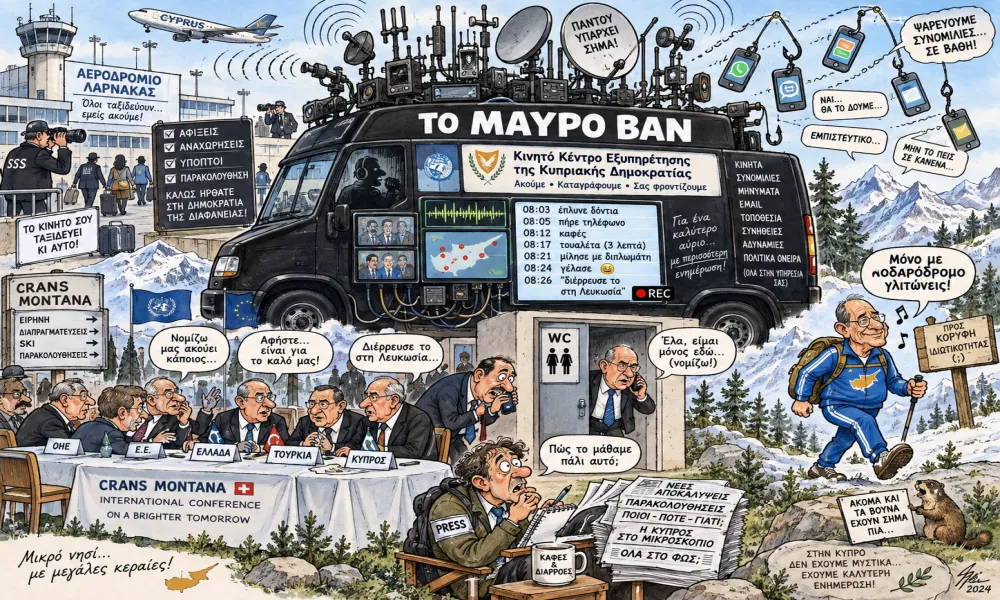
There is a phrase in diplomatic language that describes a negotiating tactic exceptionally well: “Moving the goalposts”. In other words, just as a specific framework appears to be taking shape within which a result must be produced, new conditions, new ideas and new issues are introduced, ultimately shifting once again the point that must be reached. Assessments that something similar risks happening in the Cyprus problem are now acquiring a concrete basis.
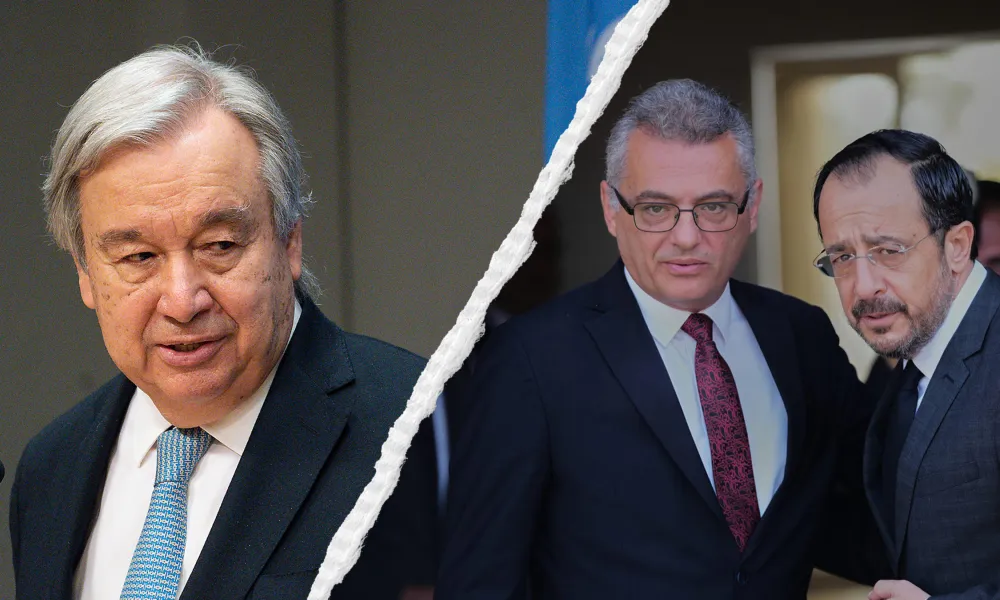
A few hours after Antonio Guterres’ clear statement that neither a trilateral nor an expanded meeting would take place in New York because “there is still a lot of work to be done”, Nikos Christodoulides attended his final meeting with Tufan Erhurman before departing for New York carrying with him not one, not two, but 19 very specific points. Nineteen. On substance, methodology and Confidence-Building Measures.
The question is simple: Why now?
According to the President himself, the two leaders had already held 11 meetings, while their negotiators had met 16 times. If there were 19 specific proposals capable of changing the situation, why were they not submitted in good time in Nicosia so they could be discussed, negotiated and, where possible, brought closer to convergence? Because that is precisely what the United Nations appears to be asking for.
Guterres did not say that he lacks time because of a busy schedule. He said something much more substantial: that the conditions for a meeting capable of achieving something have not yet been created. And he added that the mistakes of the past cannot be repeated.
This is where the major contradiction in the presidential narrative lies.
Responding to the absence of a meeting in New York, Nikos Christodoulides cited, among other things, the heavy schedule of the Secretary-General and argued that the necessary conditions for an expanded conference exist and that what is lacking is “political will”.
Yet the Secretary-General himself is effectively saying the opposite: the conditions have not yet matured.
And that matters.
Because New York is not a place where you arrive with a suitcase full of “new ideas” and begin negotiations between the two communities there.
Ideas must first be tested around the table in Nicosia. They must be examined by the other side. Clarified. Negotiated. It must be determined where agreement exists and where disagreement remains. And once sufficient common ground has been established, only then do the two leaders go to the Secretary-General for the next step.
This, moreover, is consistent with the position expressed by Erhurman: that a “5+1” meeting should not take place simply for the sake of taking place, but requires substantive preparation and progress in Cyprus beforehand.
The latest meeting was held in a better atmosphere, but no significant progress was recorded.
So what exactly are we taking to New York?
There is also a second issue.
The President speaks of “new ideas”, yet their content remains unknown to the public.
We do not know which are genuinely new, which are reformulations of previous positions and, most importantly, which can genuinely bridge differences.
The writer comes from the era of the Ghali Ideas, during the Vassiliou-Denktash period.
The “Ghali Ideas” entered history because they had specific written content.
Are we now going to speak of “Christodoulides Ideas” without even knowing what they are?
The Cyprus problem does not suffer from a lack of ideas.
It has been drowned in ideas, frameworks, convergences, documents, proposals and reformulated proposals.
What it lacks is the political capacity to turn all this material into a real negotiation.
And that is why the 19 points raise the reasonable question of whether, instead of bringing us closer to the goal, they are once again moving the goalposts.
There is, however, something even more worrying.
Every time an initiative fails to produce the expected result, the discussion shifts to the next initiative.
From the prospect of Guterres’ arrival in Nicosia, we moved to the expectation of New York.
From New York we have now moved to the “19 ideas” and from those, perhaps, to a new expanded conference.
In this way, however, we create mobility without movement.
The process constantly appears alive, while the essential question remains unanswered: Where exactly has convergence been recorded that did not exist yesterday?
Because in the Cyprus problem we do not measure initiatives, meetings and statements.
We measure the distance travelled towards the resumption of substantive negotiations.
And to this day, that distance remains dangerously small.
Guterres, in any case, drew the line with unusual clarity:
First work, then preparation, and afterwards a meeting that has a chance of producing a result.
Therefore, New York does not need more suitcases full of “new ideas”.
What is needed is proof of what was agreed in Nicosia.
Because after half a century of the Cyprus problem, the issue is not that we lack goalposts.
It is that every time we get close to them, we discover they are a little further away.