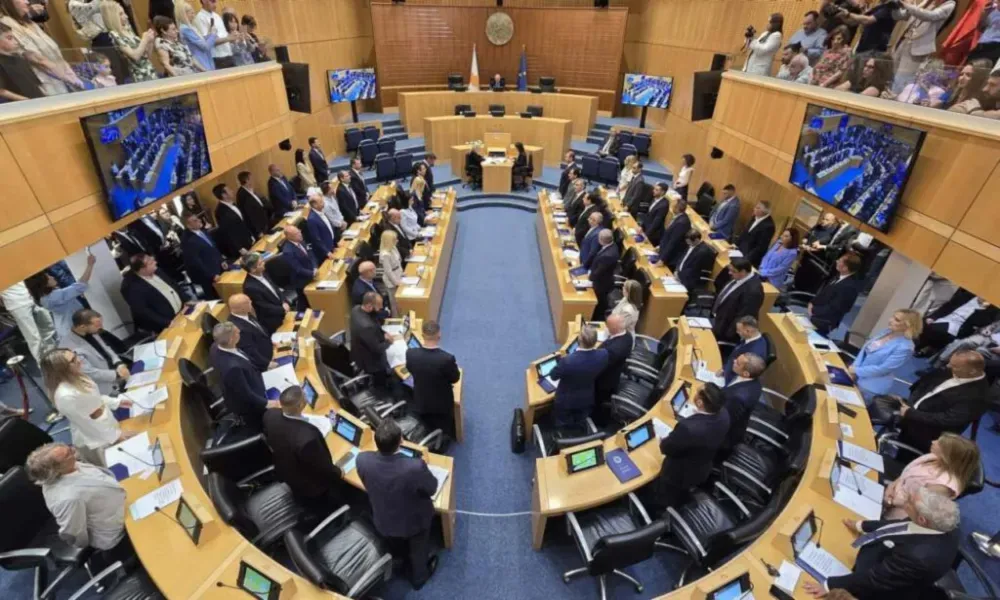

House Committee on Human Rights is moving forward with plans to develop a comprehensive framework on digital human rights, with a draft declaration expected to be presented for public consultation in the autumn before being submitted to the House plenary for adoption.
The committee continued discussions on the issue on Monday in the presence of Education Minister Athena Michaelidou and Deputy Minister for Research, Innovation and Digital Policy Nicodemos Damianou.
Committee chairman and AKEL MP Christos Christofides said an informal ad hoc working group would be appointed to prepare the first draft of a Declaration of Digital Human Rights.
"Our aim is to help Cyprus establish a modern framework of principles that safeguards human rights in the digital age and serves as the basis for public policy and future legislative initiatives," Christofides said.
He stressed that artificial intelligence (AI), algorithms and data are already transforming the way people work, learn, access information, communicate, conduct transactions and participate in public life.
"The question is not whether technology will affect our rights, but whether our democracy will manage to protect them in time," he said.
Christofides added that digital rights are not abstract concepts but issues that directly affect citizens' everyday lives. He also described digital literacy as a fundamental requirement for equality, freedom and active democratic participation.
The committee intends to review the draft declaration in the autumn through consultations with all relevant stakeholders before submitting it to the House plenary for approval.
The discussion also included a proposal to examine a constitutional amendment that would explicitly recognise the need to protect digital human rights.
Digital literacy from an early age
Education Minister Athena Michaelidou said education would play a central role in safeguarding digital rights, with efforts beginning from pre-primary education through the development of digital literacy.
She said the Ministry of Education is focusing on teacher training and curriculum reform, noting that digital skills have been integrated across subjects with support from European Union funding.
The minister said particular emphasis has been placed on AI, with practical AI applications to be introduced from September in both primary and secondary education.
She described professional development for teachers as "the key to any change" and said the ministry had produced guidance outlining the principles for the ethical use of AI and digital technologies in schools.
AI-related modules have already been incorporated into secondary school information technology courses, while separate AI lessons are not recommended for primary or pre-primary pupils in line with European practice, she added.
"Our priority is for children to develop critical thinking and the necessary skills," Michaelidou said.
Addressing online safety, the minister highlighted the operation of the free 1480 helpline, where psychologists provide anonymous advice to children around the clock.
She also said restrictions on mobile phone use in primary schools had contributed to an improvement in bullying incidents during break times.
Following the meeting, Michaelidou said more than 95% of EU funding allocated for digital skills had been invested in school infrastructure.
She argued that the response to emerging technologies should be neither fear nor unrestricted use, but "a balanced approach" based on critical thinking, responsibility and ethical use.
The minister also said Cyprus was among the first countries in Europe to issue guidance for schools on the ethical use of AI.
AI regulation and digital safeguards
Deputy Minister Nicodemos Damianou outlined government priorities in three areas: digital infrastructure and accessibility, digital skills, and protection from risks associated with new technologies, particularly AI.
He said AI is already being used in Cyprus to forecast extreme weather events, manage traffic and accelerate the processing of planning permits through the Hippodamos system.
Damianou also confirmed that authorities are examining the creation of an age verification mechanism for access to digital platforms.
Diamantis Zafeiriadis, head of the Digital Security Authority, said a technical and economic study is underway, in cooperation with the Deputy Ministry and the Commissioner for Personal Data Protection, to determine the organisational, technical and human resources required for the effective implementation of the EU AI Act.
He added that authorities are also monitoring the regulation's phased implementation.
Stakeholders seek involvement
Representatives of the Office of the Commissioner for the Protection of Children's Rights emphasised the importance of protecting children's rights in the digital environment, arguing that early education is essential for prevention and protection.
The Cyprus Bar Association said it regarded digital rights as a matter of significant importance and requested additional time to submit its memorandum, while expressing its intention to participate in the ad hoc working group.
The Law Office of the Republic noted that it had already prepared an indicative list of legislation that may require amendments as part of the wider digital rights framework.
Following the meeting, Christofides said the committee's immediate objective was to move beyond general discussion and produce a concrete charter of digital rights that could ultimately become a formal declaration adopted by Parliament.
He said the issues under discussion might appear distant but were already affecting people's daily lives through AI, algorithms, personal data protection and other emerging technologies.
DISY MP Dimos Georgiades also stressed the need to establish a legal framework to ensure that the rapid development of AI does not undermine citizens' human rights.
"If AI systems are implemented in a problematic way, there is a strong possibility that some groups of people will be treated unfairly," he said.
"It is Parliament's responsibility to legislate in a way that safeguards these rights, and we must examine this without delay."
Source: CNA