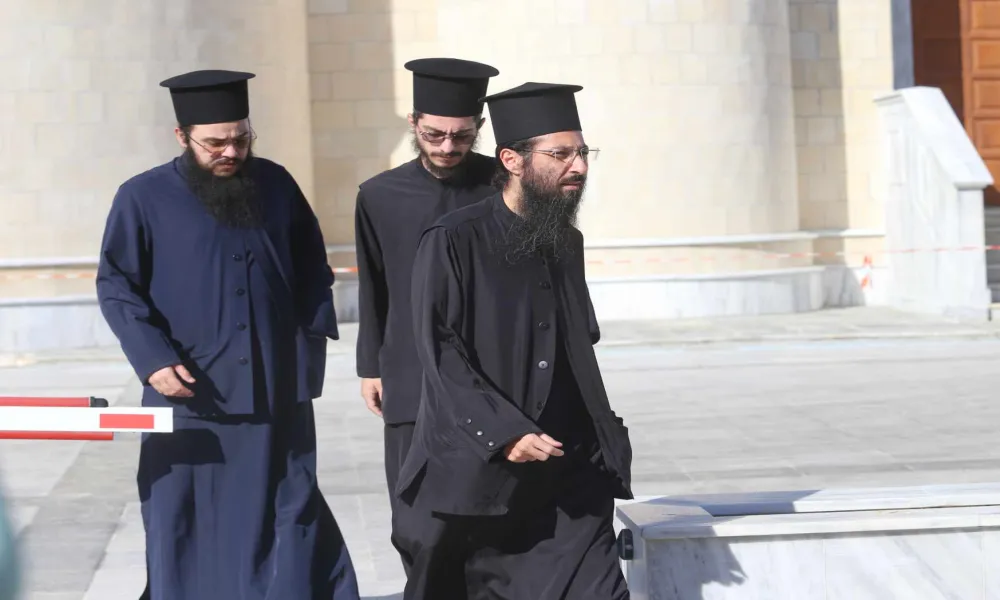

Nicosia criminal court on Monday reserved its decision on a defence objection concerning the admissibility of evidence in the Avvakoum Monastery case, with its ruling scheduled for 20 July.
The objection centres on the legality of the acquisition of specific exhibits and whether the prosecution has established an unbroken chain of custody before they were handed to police.
Evidence
The hearing opened with testimony from Police Constable A.H., who told the court that, acting on instructions, she received the exhibits intended for submission to the court from one of the case investigators on 13 July and kept them in her custody.
During the presentation of a large number of exhibits, defence lawyers objected to the admissibility of some of the evidence.
Counsel for the first defendant, Costas Efstathiou, argued that the witness could testify only to receiving and safeguarding the exhibits, but not to the circumstances surrounding their acquisition before they came into her possession.
Legality in question
He maintained that the prosecution had failed to establish the legality of the evidence's acquisition or demonstrate an unbroken chain of custody up to the point at which it was handed over to police.
According to the defence, no evidence has been presented identifying who discovered the items, who collected them, where they were stored, who had access to them or how they were transferred before reaching police custody. These details, counsel argued, are essential in determining whether the exhibits may have been altered or tampered with.
Efstathiou further submitted that admitting the evidence at this stage would deprive the defence of the opportunity to cross-examine those involved in its acquisition and handling, amounting to a breach of the right to a fair trial as protected under the European Convention on Human Rights and relevant case law.
Unlawful entry
He also reiterated the defence's position that some of the exhibits were obtained following an unlawful entry into Avvakoum Monastery and the removal of property, arguing that this raises issues under Article 35 of the Constitution, which requires state authorities to act in accordance with the law.
Counsel for the second defendant, Efstathios Efstathiou, adopted the same arguments, stressing that the objection relates solely to the legality of the acquisition, transfer and storage of the disputed exhibits.
He argued that where evidence originates from the monastery or from private, personal or religious premises, it cannot be assumed that a third party had lawful authority to remove the items and hand them over to police.
He said the prosecution must establish who found the items, where they were located, who took possession of them, under what authority they were removed and how their integrity was preserved until they came into police custody.
Constitutional rights
The defence also referred to Article 110 of the Constitution, concerning the self-governance of the Church of Cyprus, as well as constitutional protections relating to privacy, the home and freedom of religion.
Responding on behalf of the prosecution, Vassilis Bissas argued that the defence's submissions were general in nature and largely repeated issues on which the court had already ruled in its interim decision of 1 July.
He said that, under the Evidence Law, the police witness was entitled to produce exhibits in her possession that she could identify, while questions relating to the chain of custody, the manner in which the evidence was obtained and its reliability would be assessed during the substantive hearing of the case.
Bissas rejected the defence's argument that it had been deprived of its right to cross-examination, noting that the current witness had appeared solely to submit the exhibits and that all individuals involved in receiving the evidence are included on the prosecution's witness list and will testify during the trial.
Plead not guilty
He also argued that the defendants could not claim breaches of constitutional rights belonging to third parties, in response to the defence's submissions concerning Article 110 of the Constitution and rights relating to the monastery.
The Permanent Criminal Court adjourned the proceedings until 20 July, when it will deliver its ruling on the objection before continuing the trial. A further hearing has also been scheduled for 22 July.
The defendants, monks Nektarios and Porfyrios, face multiple charges, including conspiracy to defraud, forgery and the use of forged documents, theft by an agent, unlawful possession of property valued at more than €63,000, money laundering, interference with judicial proceedings and submitting a false tax return.
Both defendants deny all allegations and have pleaded not guilty to every charge.
Source: CNA