
One year after the devastating wildfire that swept through the Limassol district, the village of Lofou is still grappling with the aftermath, from barren hillsides and rebuilding delays to unresolved compensation claims.
Speaking to Politis FM, community leader Yiannis Neophytou said restoration efforts are progressing unevenly and that the landscape remains a stark reminder of the disaster.
Burnt landscape slow to recover
Neophytou said hundreds of mature trees and around 2,000 saplings have been planted since the wildfire.
However, most of the new trees remain small and will take years to replace the mature pine forest and dense vegetation destroyed by the blaze.
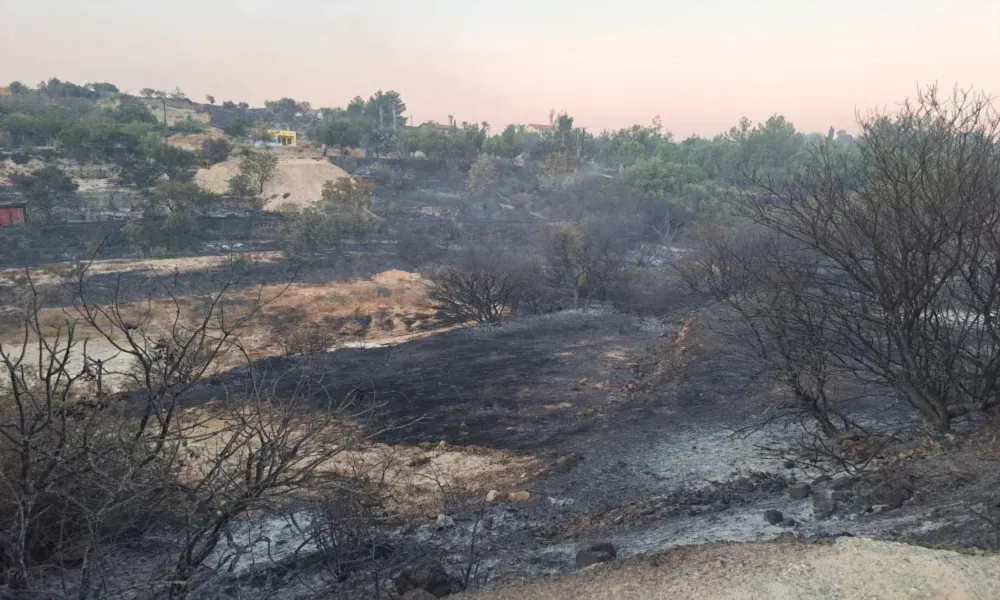
The situation remains particularly severe on the northern side of the village, where extensive pine-covered hills once stood.
According to Neophytou, some areas have yet to show even low-level vegetation growth, leaving entire slopes resembling barren land.
Compensation delays continue
Recovery efforts have also varied among homeowners.
Residents with the financial means to undertake repairs have generally progressed more quickly, particularly where damage was partial rather than total.
While reconstruction of completely destroyed homes is advancing, some owners are still waiting for building permits, while others remain locked in lengthy discussions with insurance companies.
Neophytou criticised the complexity of the compensation process for insured property owners, arguing that some have faced greater delays because of arrangements under which the state covers the difference between its own damage assessment and insurance payouts.
"People are suffering through the process," he said.
Some homeowners know they will receive compensation but still do not know when payments will be made or what the final amounts will be.
Prevention efforts stepped up
Lofou has also focused heavily on wildfire prevention ahead of this summer.
Extensive clearing operations have been undertaken on fields, unused plots, riverbeds and difficult-to-access areas surrounding the community.
Large quantities of dry vegetation have been removed, including from locations that, according to Neophytou, had never previously been cleared.
He stressed that such work should become a routine annual measure rather than an emergency response after disaster strikes.
'We still do not want to learn'
Security analyst Nicos Kamakiotis argued that the most important lesson from last year's wildfire is that Cyprus has still failed to properly examine what went wrong.
Speaking on the same programme, he criticised the absence of an independent and comprehensive review of the disaster.
"The most important thing we should take away is that we do not want to learn," he said.
Kamakiotis argued that reviews produced after the wildfire were prepared by the same agencies involved in the response and within a very limited period of time, making an objective assessment difficult.
According to him, the reports focused largely on staffing and equipment shortages without adequately addressing whether the firefighting operation itself was effective or which decisions contributed to the fire's rapid spread.
Questions over preparedness
Kamakiotis also pointed to what he described as contradictory messaging from authorities.
Before last year's fire season, he said, the public had been assured that firefighting services were fully prepared. After the disaster, however, officials cited staffing shortages and operational limitations.
"We cannot tell the public everything is perfect and then afterwards say we have deficiencies. There is something seriously wrong with that mentality," he said.
He argued that public debate has focused heavily on how the fire started, whether through arson, negligence or extreme weather, rather than examining how an initial blaze developed into a major catastrophe.
Air support decision criticised
Kamakiotis reserved particular criticism for the management of aerial firefighting assets on the day of the wildfire.
He said the critical opportunity to contain the fire came during its early stages but that two aircraft conducting patrols were redirected to tackle another, smaller fire and were not replaced.
According to Kamakiotis, this left the area without aerial surveillance on a day when fire danger levels were at their highest.
He described the decision as evidence of poor risk assessment, arguing that patrol aircraft should remain focused on detecting new ignitions rather than being diverted to every incident.
The most worrying aspect, he said, is that the same practice appears to continue during the current wildfire season despite widespread criticism following last year's disaster.