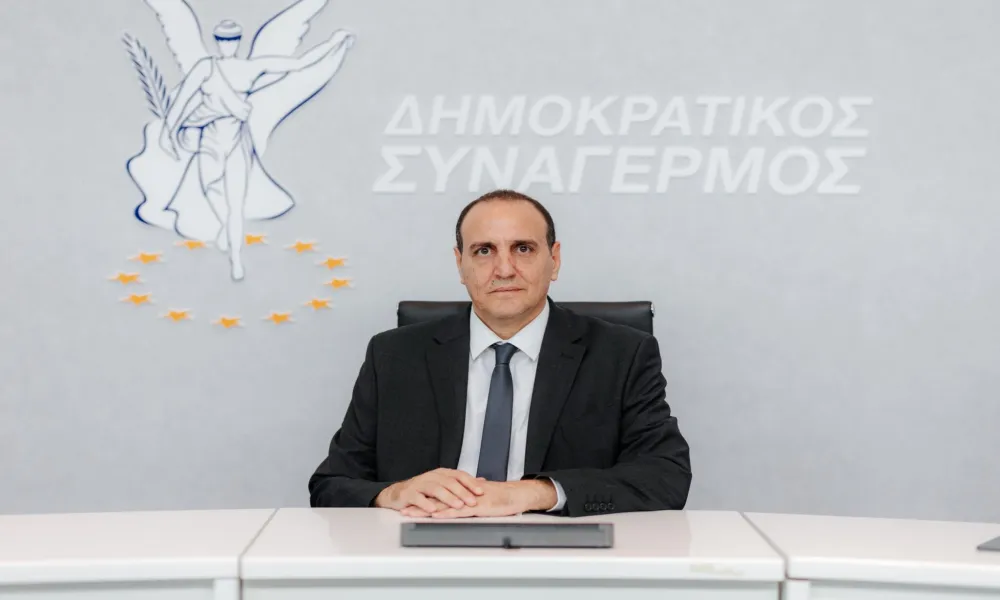

Disy spokesman Onoufrios Koullas has called on former party leader Averof Neofytou to clarify as soon as possible whether he intends to run for president outside the party. "It is inconceivable to me that the former leader of our party means that his candidacy could be outside Disy," Koullas told Politis in an interview. Leaving such a possibility hanging in the air was "deeply problematic", he said, warning that "such a serious open question will disappoint first and foremost all of us who passionately supported Averof Neofytou in 2023, in very difficult circumstances, showing faith in the principles and rules of our party." Koullas said he did not favour premature announcements, which he argued limit the chances of consensus and sound assessments, but acknowledged that every party official has the right to announce a candidacy whenever they wish, "and that is entirely respected." "Personal ambitions are reasonable and entirely legitimate, when they take place within the party's procedures," he said.
When Disy will choose its candidate
Koullas said no final decisions on Disy's internal procedure for the presidential elections were taken at last Monday's extraordinary leadership meeting, as only the Political Bureau can take them. He described what took place as a first, informal discussion, since the meeting had not been called to discuss the presidential elections. After members of the leadership raised the issue, he said, various views were heard and it was decided to wait for the UN General Assembly to finish before any formal discussion. The matter was referred to a later session of the leadership, to be followed by a discussion in the Executive Bureau before the Political Bureau decides. Koullas confirmed that some members of the leadership proposed speeding up the process and completing it before the end of the year, while another view, which he said he personally shares, holds that it can be completed in February or March.
He also confirmed that some members of the leadership urged party leader Annita Demetriou to announce her candidacy as soon as possible. According to Koullas, Demetriou said the timeline of the procedure should be decided first, and that time should be given for efforts towards consensus, consultation and a better assessment of the situation on the Cyprus problem. "Premature announcements, in my view, create self-imposed commitments and push away efforts at consensus," Koullas said, adding that a little more time would help everyone assess electability and the chances of success more accurately.
Koullas took part in Demetriou's meetings with Neofytou and Giorgos Pamboridis. Asked whether there was room for a consensus solution, he said there always was, and that his personal view was that polls, scientific surveys and other tools could be used first, which might prompt second thoughts. "What matters is to increase our party's chances of success. The issues are not personal," he said, adding that neither a consensus solution nor internal elections were an end in themselves. A consensus solution has advantages if it rests on objective and measurable data, he said, but internal elections would fully express the will of the party's tens of thousands of members. "The members are our strength. We are proud of our democratic procedures," Koullas said. He argued that a candidate who wins the nomination through such a broad democratic process would already have covered a great distance and would go on to build momentum, and that such a process would be unprecedented in Cyprus.
Asked whether Disy would seek to postpone its procedures if there were serious developments on the Cyprus problem, Koullas said the party's sense of responsibility on the issue was self-evident. "We do not need to be told," he said. "We say it and we mean it: the liberation and reunification of our homeland is our highest priority." "And yes, if there are dramatic developments, we will propose postponing the presidential elections," he said. In the meantime, however, Disy must follow its procedures and be ready for every eventuality.
No expulsions over Tornaritis
The leadership meeting also discussed the appointment of Nikos Tornaritis by the Council of Ministers. Koullas said the party had sought a common and unified stance that went beyond Tornaritis' case alone, and that "there is no question of expulsions". Disy's charter bars those who exercise executive power from membership, he said, but that does not apply in this case. However, once the party has an official candidate, its collective bodies will become campaign teams, and people who support any other candidate will not be able to take part in them. "We know the motives behind such appointments. But we must act institutionally. We do not drive out any Disy member, unless they themselves make a different choice," he said. Asked about claims by Giannis Karousos that some party officials spend the morning at the Presidential Palace and the afternoon at Disy's Pindarou Street headquarters, Koullas said he was not aware of this, at least among senior figures. He noted that Disy has more than 4,000 officials on its wider collective bodies and said the party should not panic if some of them make a different choice. "Our job is to persuade," he said.
Differences with the Christodoulides government
Koullas rejected the view that Disy has no real differences with the Christodoulides government. He said the president does not always describe himself as a Disy supporter: sometimes he calls himself independent, sometimes politically orphaned, and at times he refers to "Disakel", a term used for Disy and Akel acting together. "We understand the motives each time. Disy is not a flag of convenience," he said. What counts, he said, is not what a person declares but whether they work systematically towards the party's broader goals rather than personal ambitions. Koullas said Disy's biggest ideological differences are with Akel, not the government, but that the party believes in a government with "more boldness and decisiveness, and less procrastination". He said Disy had disagreed with the government's priorities on the cost of living, the increase in fixed spending, poorly targeted measures, across-the-board increases and uncontrolled hiring. These, he said, limited the state's ability to make necessary investments to address traffic, housing, the low birth rate and support for families and students. Disy had also argued that defence and security should rank higher among the government's priorities, and would set out all its differences in detail in the coming period.
Koullas declined to comment on the complaints of coalition partners Diko and Dipa about their relations with the government, but said Disy had converged with them on many bills and policy issues and that it would be natural to talk to them and other political forces once its internal procedures are complete. Asked whether Disy's support for Diko against Finance Minister Makis Keravnos last week was political flirting ahead of the presidential elections, he said there was a real issue. Diko's disagreement with the minister, while being in government, proved the contradictions Disy had long pointed to, he said, adding that the government should take its decisions as a whole, set aside its internal disagreements and decisively back a project concerning Cyprus' geopolitical role for decades to come. "As on many other issues, on the GSI we have the same political stance as Diko," he said, referring to the Great Sea Interconnector electricity cable project.