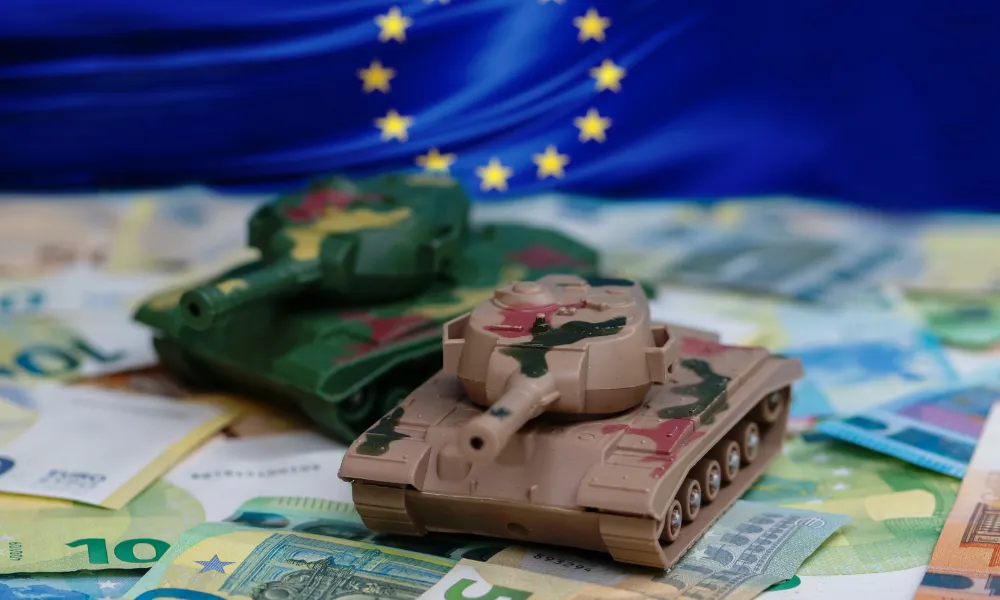

Europe’s defence spending boom is reshaping parts of the continent’s industrial base, as governments move to rebuild military capacity after years of underinvestment.
Russia’s full-scale invasion of Ukraine in 2022 accelerated a shift that had already begun to take shape. According to the European Defence Agency, EU defence spending rose from €218 billion in 2021 to an estimated €381 billion in 2025, an increase of around 75% in four years.
The wider global trend is also significant. Military spending worldwide reached a record $2.9 trillion in 2025, with Europe among the main drivers, according to the Stockholm International Peace Research Institute. Germany also exceeded NATO’s 2% of GDP defence spending target for the first time since 1990, reaching 2.3%.
The EU is now trying to turn that shift into a long-term industrial strategy. Its ReArm Europe Plan, formally known as Readiness 2030, aims to mobilise up to €800 billion in defence investment. The European Commission also plans to raise up to €150 billion through SAFE, the Security Action for Europe instrument.
Defence manufacturing
Traditional defence contractors are among the most obvious beneficiaries. Companies such as Rheinmetall, Leonardo and Saab are seeing renewed political and investor interest, after years in which defence stocks were often treated as difficult or unfashionable investments.
Ammunition production is one of the clearest examples of the shift. EU production capacity rose from about 300,000 rounds a year in 2022 to an estimated 2 million by the end of 2025.
In Germany, domestic orders linked to defence industries rose by more than 50% in late 2025 compared with already high post-invasion levels.
The European Commission is also directing funds towards expanding production lines and reducing delivery times, particularly in areas such as air defence systems, where waiting periods can still stretch to several years.
However, Europe’s defence market remains fragmented. Historically, only a small share of tendered contracts has gone to suppliers from other EU member states, while domestic firms have dominated national procurement.
Drones
The war in Ukraine has made drones central to European defence planning. Their relatively low cost, speed of production and battlefield impact have pushed governments to invest heavily in both drone systems and counter-drone technology.
France has committed €8.5 billion to expand ammunition and drone stockpiles under its updated military planning law, including a sharp increase in explosive drone stocks before 2030.
Germany and Ukraine also signed a €4 billion defence package in April 2026, including agreements on joint drone production.
At EU level, the European Drone Defence Initiative was launched in early 2026, with the aim of creating a multi-layered counter-drone shield across member states by 2027.
Cybersecurity
Cybersecurity is another sector being pulled into the defence spending cycle, as governments treat digital infrastructure as part of national security.
The EU allocated €145.5 million in 2025 to strengthen cybersecurity for small and medium-sized businesses, public administrations and healthcare providers.
In January 2026, the European Commission proposed a new cybersecurity package, including changes to the NIS2 directive, designed to simplify compliance and strengthen supply chains against risks linked to third countries.
The European Investment Bank also lists cybersecurity among its defence and security financing priorities.
The sector’s dual-use nature means defence spending is also supporting wider commercial demand, especially in areas such as identity and access management, which are central to protecting government and military systems.
Industrial metals
Europe’s rearmament drive is also expected to lift demand for industrial metals.
Military hardware is heavily dependent on steel, copper, nickel and other metals used in ships, armoured vehicles, artillery, missile launchers, power systems and communications networks.
Goldman Sachs estimates that around 40% of Europe’s defence spending increase will go into metals-heavy equipment, compared with NATO’s typical procurement norm of around 20%.
The bank projects that Europe’s rearmament could lift regional demand for industrial metals by 6% by 2027. Copper is expected to be among the clearest beneficiaries, given its role in vehicles, wiring, communications systems and power infrastructure.
Semiconductors
Semiconductors are also becoming a defence priority, as Europe tries to reduce its dependence on external suppliers for critical technologies.
Modern military systems rely on advanced processors for missile guidance, intelligence, surveillance and reconnaissance systems, secure communications, radar and electronic warfare.
For years, Europe depended heavily on US suppliers for defence-grade chips while much manufacturing was outsourced to Asian foundries. That model was efficient in stable conditions but exposed vulnerabilities in times of geopolitical tension.
The European Defence Industry Programme, a €1.5 billion cross-border procurement vehicle launched in 2026, includes funding for gallium nitride semiconductors used in radar and electronic warfare systems.
Although Europe has strengths in parts of the global semiconductor supply chain, building sovereign defence-grade chip production remains a longer-term challenge.
Source: Euronews