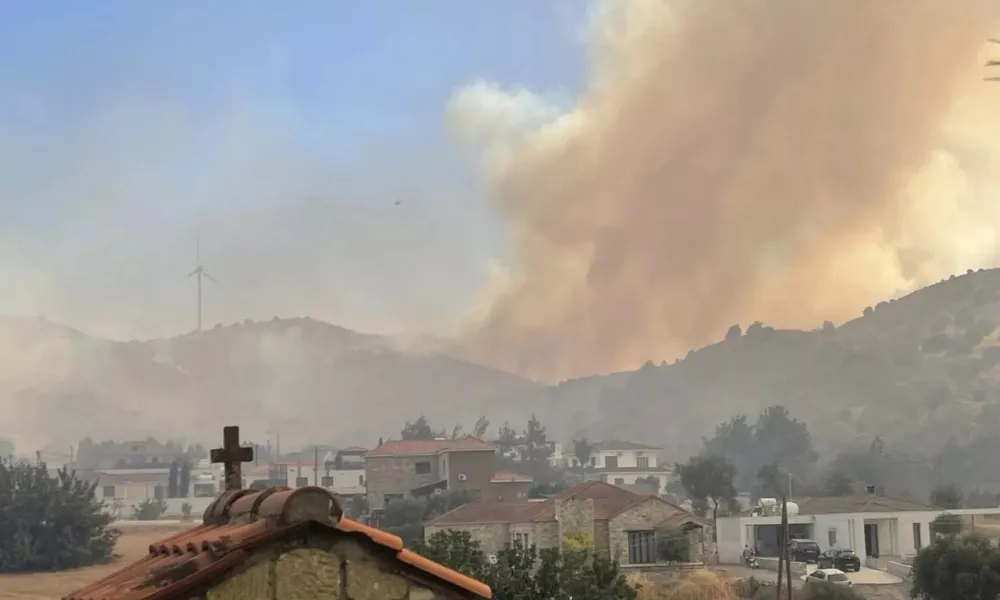

The wildfire that broke out at Kalo Chorio in Larnaca district last Monday, after what authorities describe as serious mistakes by the National Guard during the destruction of munitions at a military firing range, eventually spread as far as Agia Anna and Psevdas.
Yet while the incident exposed significant failings, it also served as the first major test of Cyprus' upgraded firefighting system, with newly introduced technology and response plans deployed to protect lives and property.
Many of the reforms discussed following last year's deadly Limassol wildfire were put into practice for the first time and, according to officials, proved effective.
The National Guard's actions, together with the failure of the CY ALERT early warning system, overshadowed what was effectively a crash test of the country's wildfire response mechanism during the first major blaze of this year's fire season.
Although weaknesses were still identified, particularly in prevention measures such as vegetation clearance and the presence of citizens who ignored instructions near the fire front, the overall assessment was positive.
An appreciation dinner hosted by the community leader of Psevdas for firefighters and volunteers in the village square on Monday evening reflected what many residents described as deep gratitude for the coordinated response.
New technology
New equipment and operational tools requested from the state by National Fire Coordinator and Fire Service Chief Fire Officer Nikos Longinos functioned effectively during the incident, he told Politis.
He expressed confidence that the new capabilities would continue to support firefighting efforts throughout the remainder of the fire season and help reduce the risk of loss of life and property during future emergencies, as they did during the Kalo Chorio wildfire.
Among the measures deployed were:
- New surveillance cameras that allowed the fire to be monitored both from the Zenon Centre at the Joint Rescue Coordination Centre in Larnaca and from the Fire Service's new operations centre in Nicosia.
- Unmanned aerial vehicles (drones), which operated when firefighting aircraft were grounded, providing a clear picture of the fire's extent and identifying any flare-ups during the night.
- GPS tracking systems enabling authorities to monitor and direct in real time all Fire Service, Forestry Department, Police and Ambulance Service vehicles.
Longinos said newly leased bulldozer units stationed in the Larnaca area were also deployed. They created firebreaks that helped prevent the blaze from advancing towards nearby communities.
"Everything we requested from the state this year, and received, was used to help us bring the fire under control," he said.
Volunteers played a key role
Longinos also praised the contribution of certified volunteer firefighting groups, which were granted a stronger and more structured operational framework through legislation adopted last March.
"We must not forget the volunteer groups. We trained 400 people, we use them every day and they were present during the Kalo Chorio crisis until late at night. They fought alongside us to help us. They deserve congratulations," the national coordinator said.
Challenging conditions
"The mechanism was activated immediately. All services were present at the coordination centre and in the operational field. We are satisfied," Longinos said.
Ground and aerial crews, however, faced particularly difficult conditions due to the terrain, the presence of wind turbines and strong winds.
According to Longinos, operational instructions were issued from the Joint Rescue Coordination Centre to agency representatives deployed in the field.
Ravines and wind turbines complicated aerial operations, particularly for fixed-wing aircraft.
"That is why helicopters operated in the difficult areas and we allowed the aircraft, under our instructions, to carry out drops ahead of the fire front, using special foam to cut off its path and prevent it from advancing uncontrollably towards populated areas, which we succeeded in doing," he said.
Eight aircraft and helicopters were deployed continuously from a total fleet of 13 available assets.
Fire spread rapidly in strong winds
Strong winds created an additional challenge.
After the munitions destruction incident, multiple fire fronts developed and spread rapidly as flames were carried across the area.
The wind, combined with surrounding vegetation, continuously pushed the fire outward.
"It is something I often say, that within fractions of a second a fire can 'take flight' and move away," the chief fire officer said.
He acknowledged that under more severe fire-weather conditions the flames could have spread through nearby communities.
He again urged the public to exercise extreme caution to avoid igniting any new fires.
Longinos said one of the most persistent problems remained the large embers that can be carried 700 to 800 metres ahead of the main fire front, creating new outbreaks.
"While you are at the fire front trying to cut off the fire, other fronts break out ahead of you. They are dangerous because they can trap and burn you. There are certain phenomena that are unpredictable," he explained.
Vegetation and non-compliant citizens
Regarding vegetation management, Longinos acknowledged that while clearance work had been carried out in the area, it had not been possible to clear the entire site.
The Forestry Department, which is responsible for the area, had cleared firebreaks beforehand, enabling firefighting vehicles to move freely through them.
Without those firebreaks, he said, access would have been impossible.
The national fire coordinator also said instructions had been issued from the outset to keep citizens away from the danger zone and to evacuate residents under police escort.
However, those instructions were not always followed.
"In such situations problems arise because some citizens do not follow instructions and attempt to reach the fire front on their own. We need to develop a culture of compliance. When clear instructions are given, we must follow them. Everyone cannot simply take their tractor or car and head towards the fire on their own," he said.
Massive operation
According to an official statement from the Forestry Department, the wildfire burned approximately 120 hectares, consisting mainly of low wild vegetation.
A large-scale operation was launched to bring the blaze under control, with authorities activating the national "Ikaros II" emergency plan.
Eleven aerial assets, including six aircraft and five helicopters, were deployed alongside more than 220 personnel on the ground.
Those involved included staff from the Forestry Department, Fire Service, Police, National Guard, Civil Defence, district administration, Game and Fauna Service, as well as numerous volunteers and local residents.