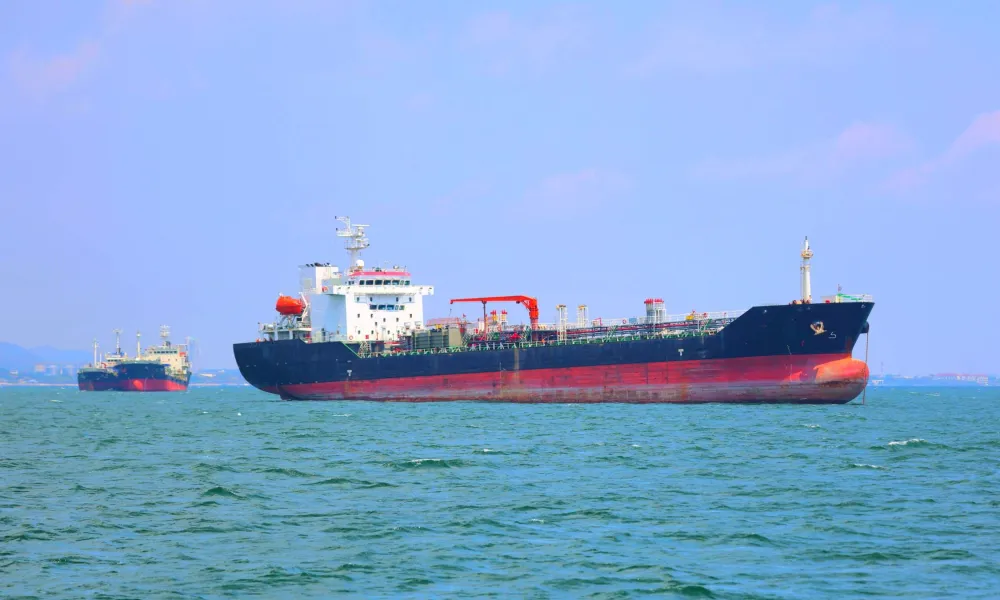

Disruptions to commercial shipping through the Strait of Hormuz caused by the war are prompting Gulf oil producers to accelerate efforts to secure alternative export routes, with several pipeline projects being announced or revived.
A total of 14.95 million barrels of crude oil per day were exported through the Strait of Hormuz in 2025, according to the International Energy Agency (IEA).
Iran to continue exports unhindered
Iran exported around 1.69 million barrels per day and is expected to continue relying on the strategic waterway in the long term, having effective control over the passage, Andrew Wilson, director of maritime research firm BRS, told AFP.
Tehran will produce as much as it can and export as much as it can to China, he said, predicting that this would not really be a problem for Iran.
Focus on pipelines
Of the remaining 13.26 million barrels per day exported by other producers, as much as 11.5 million barrels could eventually be redirected if pipeline capacities are expanded and ongoing projects completed, according to official statements and industry experts.
Before the outbreak of war on Feb. 28, following US-Israeli strikes on Iran, Saudi Arabia was transporting about 2 million barrels per day through its East-West pipeline, which links Abqaiq on the Gulf coast to the Red Sea port of Yanbu, according to the IEA.
Oil giant Aramco announced in March 2025 that it had increased the pipeline's capacity to 7 million barrels per day, leaving an additional 5 million barrels of capacity available for crude previously exported through Hormuz.
Riyadh is planning a further increase of up to 2 million barrels per day, according to the US-based Institute for Energy Research (IER), although it remains unclear whether this would involve upgrading the existing line or constructing a parallel pipeline.
Wilson estimates that project could be completed by 2030-2031.
Prior to the conflict, the United Arab Emirates exported about 1.1 million barrels per day through a pipeline linking the Habshan oil fields with the port of Fujairah on the Gulf of Oman, south of the Strait of Hormuz.
The IEA estimates the pipeline's capacity at 1.8 million barrels per day, leaving room for an additional 700,000 barrels.
In May, the UAE announced plans to accelerate construction of a second pipeline running parallel to the existing route before diverting towards the northern coast.
According to authorities in Abu Dhabi, the project would both bypass the Strait of Hormuz and double crude export capacity through Fujairah if it becomes operational in 2027.
The US State Department announced in late July that Iraq and Syria had agreed to reopen a pipeline linking the two countries that has been closed for decades. The route would allow Iraqi oil exports to reach Mediterranean ports.
The United States said it would lead an international consortium responsible for the technical and financial implementation of the project. The pipeline would have an initial capacity of 2 million barrels per day.
However, no timetable has been announced and the project could face political and financial obstacles that may delay its completion, Wilson told AFP.
Neither Kuwait nor Bahrain currently has pipeline infrastructure that would allow exports to bypass the Strait of Hormuz.
However, both Gulf monarchies have recently held discussions with Saudi Arabia about connecting to its pipeline network, according to the IER.
Sources: CNA, AFP