
If Christ were to decide on a surprise inspection of Cyprus today and cross the threshold of certain churches, we are fairly certain he would be holding the familiar whip in his hand. What we are less certain about is whether he would manage to complete the scene we all remember from the New Testament.
For those unfamiliar with it, Christ entered the temple in Jerusalem holding a whip and began striking left and right, overturning the merchants’ tables. What did Jesus say to them? “My house shall be called a house of prayer, but you have made it a den of thieves,” according to the Gospel of Matthew (21:13), as well as Mark (11:17) and Luke (19:46). In John’s Gospel, it is recorded that he made a whip from cords: “So he made a whip of cords and drove all from the temple…” (John 2:15).
Back then, in Jerusalem, the Pharisees bowed their heads and allowed Christ to perform his act, but they kept a grudge. A week later, they crucified him. Today, of course, things are different. If Christ were to go to the Limassol Metropolis and tell Athanasios and Ephraim that this was not the belt worn by his mother, the Virgin Mary, what would they really say to him? Ephraim would foam at the mouth, and it is quite likely that Protosyncellus Isaac, security personnel, management committees and perhaps even a lawyer with injunctions – say, Hartsiotis – would descend on him for obstruction of commercial activity. Let us be honest. From the house of the Lord, we have gradually moved to the franchise of faith.
Specialisation
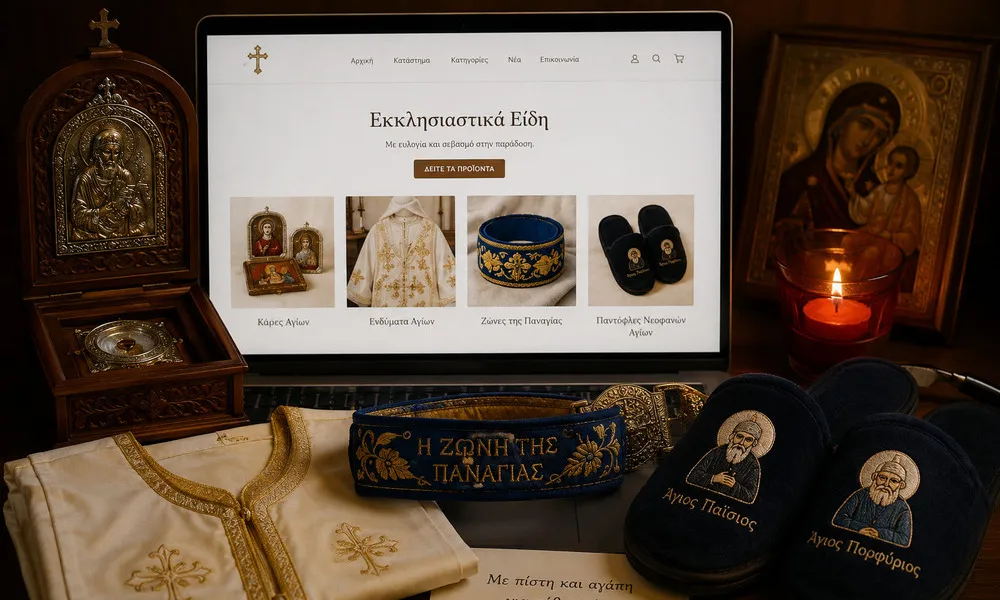
And because in Cyprus we do nothing half‑heartedly, we specialised as well. We are not just anything. Here we have premium spiritual retail. Saints’ skulls. Saints’ garments. The Virgin Mary’s belts. Slippers of newly canonised saints. Little shoes not with the aura of a foul‑smelling ascetic’s foot, but perfumed and endowed with miraculous properties. All that’s missing is a loyalty programme: “Make five pilgrimages and win a bottle of travel holy water,” because some godless people did not allow Necktarios of Avvakoum to truly flourish.
In any case, the basics are in place, since the modern believer, as a person of convenience, now has access to religious packaging. We are talking about ISO standards for Holy Communion packaging, kollyva, kourabiedes – and perhaps tomorrow we will even move on to certified antimicrobial incense. Yes, we believe – but with quality control.
Kyriakou
The case involving the video about the icon of the Virgin Mary of Hozoviotissa, which circulated claims of healing and spiritual ‘rebirth’ for those who venerate it, highlights a problem that is not new, but appears to be taking on new dimensions in the age of social media. When faith is dressed up with promises of miraculous outcomes and advertising exaggeration, it ceases to serve the spiritual element and begins to resemble a commercial practice.
The theologian Theodoros Kyriakou’s description of the situation as ‘unthinkable’ does not seem excessive. Because the issue is not whether someone believes in miracles – that is a personal and deeply existential matter. The issue is whether it is permissible to cultivate expectations, especially among people who may be psychologically or physically vulnerable, through dubious or unchecked claims. This phenomenon appears to be exploited by certain priests, not without financial gain, judging by the absurdities we witnessed at the monastery of Saint Avvakoum, starring Necktarios and his followers. Some hierarchs from Greece, who still appear to be living in the Middle Ages, rushed to attack theologian Kyriakou, calling him a Tholo-logist (Editor’s note: play on Greek word ‘tholo’ meaning ‘blurry’).
Tychikos’ imprint
The climax, however, is ecclesiastical intervention in food delivery, with the blessings of former Paphos bishop Tychikos, whose confessor and spiritual father is Neophytos of Morphou. Tychikos formulated the religious doctrine that if a person can order a burger at eleven at night, why should they not also require spiritual guidance on how the chips are transported.
Just when we thought theology concerned itself with the mystery of existence, it turned out to have an opinion on the mystery box of fast food. The former bishop of Paphos, Tychikos, also introduced yet another parameter. If the food is delivered by a Muslim delivery driver, then it cannot be eaten. Upon receiving the food, the believer must immediately call the parish priest to come to the house to ‘read’ the food – and above all to taste it, take a portion for the priest’s wife, and then bless it. Otherwise, it cannot be eaten.
Faith
No one questions people’s faith. If your faith makes you a better and stronger person, good for you. Faith is a personal matter – deep and often comforting. Where satirical interest begins is when faith attempts to impose itself on others, and especially when it acquires a commercial department, accounting, branding and possibly seasonal offers.
I only wonder whether, in a few years, we will see an app. ‘MySaint’. You book a digital pilgrimage, watch live the skull of your favourite saint and receive a push notification: ‘Your blessing expires in 24 hours. Renew now.’
And then, perhaps, even the most sceptical will admit that the miracles of the marketplace are ultimately inexhaustible – provided, of course, that intellectual property rights and certificates of authenticity are secured. For example, there cannot be two skulls of Saint Lazarus being advertised, one in Larnaca and one in Marseille. Nor four right hands of Saint Onouphria and three left hands of Saint Gennadios. All the more so when the matter concerns Jesus Christ, the only‑begotten Son of God.
On the market circulate relics of the Holy Prepuce – that is, the foreskin of Jesus’ circumcision. Medieval and later sources report that at various times as many as twelve to eighteen different churches or monasteries in Europe claimed to possess this relic. It is one of the strangest cases of medieval relic worship. Christ’s circumcision was considered a theologically significant event (formerly celebrated on 1 January in the Western Church), and the existence of such a relic became an object of intense veneration as well as sarcasm. We do not know whether any of these foreskins made it to Cyprus or are kept in Greece.
We are certain, however, that Neophytos of Morphou and Athanasios of Limassol will have something to tell us about it in one of their upcoming sermons.