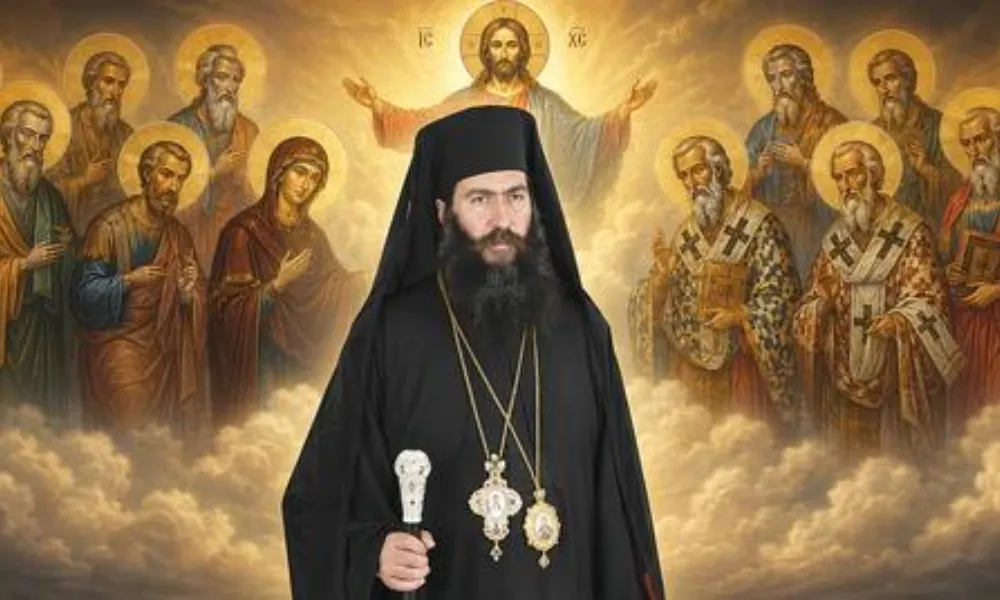

There are politicians who invoke the people. There are leaders who invoke their conscience. And then there are those who, when things get tight, invoke higher powers. And then there is the Cypriot ecclesiastical reality, where, on the eve of the election of a new Metropolitan of Paphos, the deposed hierarch Tychikos decided to inform us that he had received a nocturnal visit from the Apostle Paul himself.
What the Apostle said to him was not disclosed. Paul ‘came down’, as the elders used to say, via a vision, generally and vaguely. Not holding a symbol – a dove, for example – nor seated on a cloud scented with incense. We are talking about a proper visit during sleep. A VIP appearance. A spiritual appearance by appointment.
What we unfortunately did not learn is what exactly was said, and that is a pity. You can imagine that if we had reached the point of securing an exclusive interview with the co‑founder of the Church of Cyprus, we might have learned many things. He might have told us, for example, what happened when he visited Paphos in AD 45.
If we remember our Religious Education classes correctly, Paul went there with Barnabas to preach Christianity to the Jews, only to be intercepted by Elymas the magician, who beat him soundly. More precisely, he received forty lashes minus one – that is, thirty‑nine – in the central square of Paphos, leaving him unable to sit for days.
In other words, the Apostle Paul did not visit Tychikos in his sleep by chance. At some point, therefore, the former Metropolitan of Paphos will have to open his mouth and speak. For now, we can only speculate. That Paul probably came to express his solidarity, using the well‑known Christian phrase “Take heart, beloved child in the Lord”, accompanied by more specialised remarks along the lines of “don’t take it personally – I too was stoned and flogged three times”.
What else can one say? The Apostle to the Gentiles is known for such sensitivities.
Details, of course, matter, and Tychikos owes them to us – just as Neophytos of Morphou does when he speaks of Saint Galaktia, who visits him and converses with him about matters of faith, but also about the quality of milk, halloumi and unsalted anari, especially at a time when the industry has taken a downturn due to foot‑and‑mouth disease.
He should tell us, for instance, whether the Apostle Paul appeared comforting and supportive. Whether, after expressing compassion, he became stern – given that Tychikos is said to have a loose tongue, that is, he lets it wander freely – perhaps Paul came to issue admonitions. Or whether he appeared perplexed, wondering how exactly he had become posthumously involved in an internal Cypriot ecclesiastical affair, and more broadly, where the Church of Cyprus is heading.
Irony
Poetically speaking, a tragic irony permeates all this. If you recall, the first major clash between this same hierarch, Tychikos, and Archbishop Georgios was precisely over the skull of the Apostle Paul.
At the time, Paul was not accepted as a relic in Cyprus because of a dispute over who would hold his skull. Tychikos believed it unacceptable for the skull to be brought to Cyprus by a Catholic – that is, a heretical – bishop, with the result that Paul’s skull (that is, his kkele) never arrived.
In short, from filioque we moved to kkeleoque.
A step forward
A few months have passed, and today Paul appears to have been accepted as a nocturnal visitor. One might say the relationship has been restored. From “you don’t just walk into Paphos like that” we moved to “come by anytime, but in my dream”.
That is what relationship‑building looks like.
But Tychikos did not stop with Paul. Even more interesting is that the deposed hierarch described three successive Gospel passages relating to the trial and condemnation of Christ. Here, the symbolism is not even subtle. It is lit up with a red neon sign.
Because when someone says “my conscience is clear”, “I am innocent”, “the accusations are defamatory”, and at the same time invokes the trial of Jesus, the message is about as subtle as the bell of a metropolitan cathedral at six in the morning.
It requires no decoding. It is like someone saying, “I’m not comparing myself to Napoleon, but I have been reading a lot lately about his exile” – in Corsica and on Saint Helena.
Theology, Cypriot‑style
Let us pause for a moment on the theological dimension of Cypriot everyday life. In other eras, spiritual revelations led to the founding of monasteries, the writing of epistles, or at most an apostolic journey.
In modern Cyprus, they appear to have been incorporated into the communication strategy.
We may soon see more structured announcements:
a) “Following extensive consultation with metaphysical stakeholders…”
b) “After a constructive meeting with God‑bearing saints…”
c) “The vision was confirmed at a second reading…”
Why not?
After all, our public life has advanced considerably. We have political leaks, non‑papers, spin doctors. Why not celestial briefings as well?
The apology statement itself was a masterpiece. “I apologised,” said Tychikos, “but the apology was not an admission of guilt.” This is a statement worthy of instruction. It is the metaphysical version of “if I upset you, I’m sorry you’re an idiot and took it that way”.
The real problem
The problem facing Tychikos – which we fully understand – is that some fellow archbishops are trying to destroy the great legacy he leaves behind, and we are not referring only to ecclesiastical matters.
We are talking about the major, unfulfilled reforms he attempted to introduce. After his removal, the Paphos district is left in limbo on critical issues:
- What will happen to Coca‑Cola consumption in the district?
- Who will manage the spiritual damage caused by foreign delivery drivers transporting food unchecked, without the blessing of the parish priest?
- Who will defend local tradition against the burger arriving by motorbike?
- Who will stand as a barrier against the cosmopolitan souvlaki of decline?
- And most importantly: who will ensure proper packaging so that kollyva after funerals and memorials are consumed with moderation and reverence?
Let us not laugh.
Societies are judged by small things. Rome had its roads. Britain had its Parliament. Paphos had an ongoing battle for the proper management of kollyva. And now? Who will guarantee continuity? Will we return to the lawlessness of cheap plastic? Will uncontrolled bagging prevail?
These are questions that demand answers. Perhaps, by removing Tychikos, we deprived ourselves of the opportunity to hear him speak on all these important matters – which, incidentally, he may well have discussed with the Apostle Paul in his dream.
Presence
At this point, perhaps we should acknowledge something else. That the presence of the Apostle Paul – always within Tychikos’s dream – might deserve broader utilisation, because there are other open issues.
He could advise us on traffic, on urban planning, on dangerous buildings in the city, on the cathedral and the Public Garden. With the election of a new Metropolitan, we may lose the Apostle’s consultancy services altogether.
For that, of course, the Archbishop and the Synod will be to blame, consigning matters to the outer darkness under a regime of eternal punishment. Neophytos of Morphou, through the intercession of Saint Galaktia, might just escape.