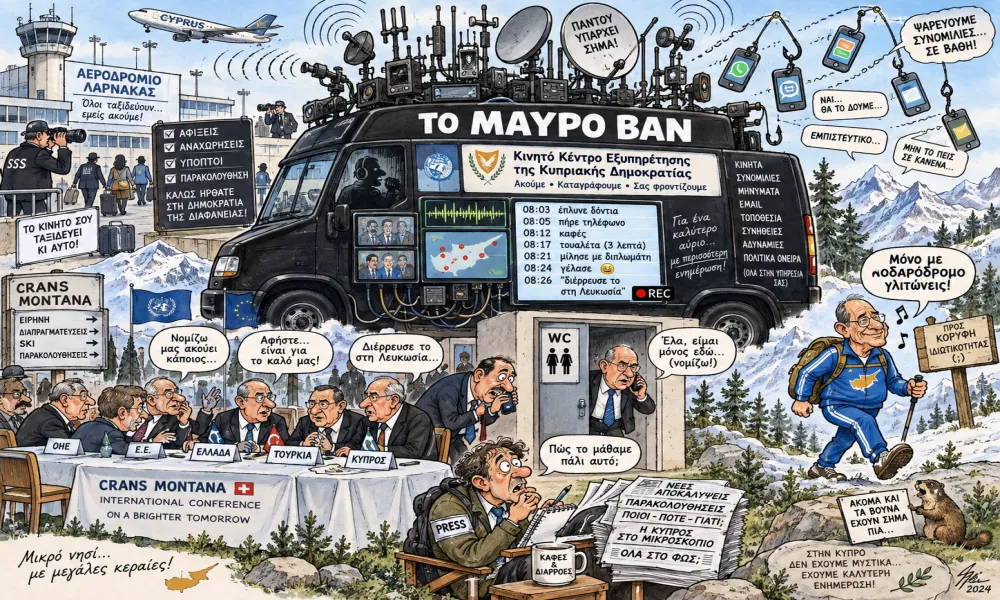

If a foreign observer followed only the headlines of recent days, they might believe the Cyprus problem is on the verge of a breakthrough. Even Espen Barth Eide, remembered for bringing talks within a mile of a deal at Crans-Montana in 2017, might envy such optimism. Back then, Nicos Anastasiades, remembering that he wanted a secont term, returned to Cyprus in time for a pre-election appearance at his daughter’s tequila party, and this way and that, secured re-election.
Today’s landscape is different. We are in the era of his protégé, ‘Little Nikos’, who conveys that an agreement is just around the corner. Optimism here, cautious optimism there, positive signals elsewhere, momentum, movement, preparation, discreet meetings, exchanges of ideas and high-level European involvement. Yet one small problem persists: no one appears to have informed the public that a solution is imminent. Cypriots are instead preoccupied with domestic scandals – Sandy, Videogate, the Mafia State, while faithfully following the proclamations of Anny Alexiou from Moscow.
A plethora of meetings
María Ángela Holguín has been to Cyprus, met the President and the Turkish Cypriot leader and expressed optimism. She met them again before travelling to Turkey, Greece, Brussels and likely any other destination with an airport and decent coffee. She presumably prefers Colombian blends for their superiority.
What she did not achieve was to bring the two leaders into the same room to hold talks. But what’s the bother? On Cyprus, it is widely understood that meaningful meetings happen in summer, in five-star Swiss resorts, not in the sweltering heat of Nicosia. At the shack of the UNSG’s Special Representative Khassim Diagne in the buffer zone, conditions are far less inviting: the air conditioning is bust, the roof leaks mice, and the canteen barely functions as the UN team in Cyprus is on skeleton staff.
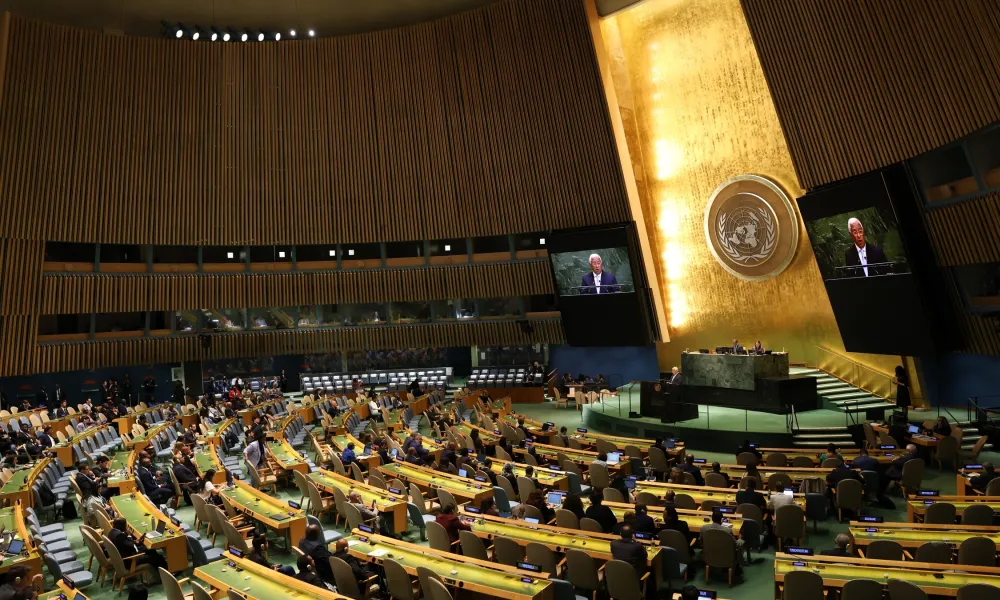
The Cyprus issue has, in effect, entered another dimension, becoming the only problem worldwide persistently on the UN agenda. It is both the issue António Guterres started his career with and one he may end it with. It is perhaps the only peace process in the world where everyone discusses the meeting that will take place later, in order to prepare for the next meeting that will determine whether another meeting can take place much later on. The meeting of the meeting – oh what meeting is this!
The situation resembles a family preparing a wedding for a decade: the bride and groom have clawed each other’s eyes out 100 times, yet have not officially shared a coffee in front of relatives. The scale of activity is striking, but it is happening everywhere except between those who must take the final decisions.
Last week, Cyprus’ foreign minister visited several Turkic republics, Kazakhstan, Uzbekistan, Tajikistan, Turkmenistan – basically all the ‘stans’ – discussing among other matters the Cyprus issue. Yet in Cyprus, President Nikos Christodoulides did not meet Tufan Erhürman one-on-one to discuss the issue directly.
Regional movement, local distance
In any case, Holguín heads to Athens and Ankara, followed by Brussels and London. At the same time, Guterres talks with European Council President António Costa, while Commission President Ursula von der Leyen wants to speak with Erdogan. The EU is considering what it might offer Turkey, while Ankara weighs what it could take from the EU. Everyone is speaking to everyone about everything, with Turkey believing that the entire planet owes it something.
In Cyprus, however, the principal actors remain at a careful distance. Christodoulides discusses Cyprus with Letymbiotis and Kombos while weighing how developments may affect his 2028 re-election prospects. Erhürman avoids public statements so as not to unsettle Ankara. Notably, he has not even shared a coffee with a Greek Cypriot journalist yet.
A diplomatic escape room
The Cyprus issue increasingly resembles a diplomatic escape room: dozens of participants, countless clues, many locked doors and a multitude of mediators stumbling into each other, none entirely certain where the exit lies.
Meanwhile, tensions are visible in the region’s skies. The Greek defence minister visits Cyprus and faces aerial harassment. The French defence minister encounters similar incidents. Greece warns Turkey over its ‘Blue Homeland’ doctrine, deploys submarines in the Aegean and considers replacing Turkish coach Ataman at Panathinaikos basketball club. In Turkey, military and analytical activity continues apace: constant naval movements, patrols by its non-upgraded aircraft, Bayraktar drone operations, while generals, strategists and analysts fill television panels.
Amid all this, the Cyprus issue struggles to find somewhere to stand. The irony is stark: in the eastern Mediterranean everything moves at speed except the problem these efforts are meant to resolve. Activity is constant, yet negotiations remain effectively frozen, like a public sector computer attempting to open a PDF file in 2026.
‘Cautious optimism’ endures
To be fair, the rhetoric has evolved. Did you not hear Christodoulides? There is indeed progress. In the past we heard that there was no movement. Today we hear that there is a lot of movement. It’s just not always clear in which direction. The favourite phrase of Cyprus’ political leadership remains ‘cautious optimism’. They were cautiously optimistic in 2017. Cautiously optimistic in 2024. Our leaders are cautiously optimistic in 2026 as well. With such longevity, cautious optimism now deserves its own seat in parliament.
As summer approaches, the President has warned of a ‘long and endless summer’. We believe it. The outlook suggests a calendar filled with conferences preparing further conferences, meetings leading to more meetings, visits paving the way for additional visits and optimism clearing the path for further optimism.
Holguín will continue her travels from capital to capital. Europeans will search for incentives, Turkey for trade-offs, diplomats for formulas, journalists for news, and Cypriots for the last time they heard that the issue stands at a ‘critical crossroads’.
The only certainty is that movement, especially in the so-called final mile, is not in short supply. The Cyprus problem has been in its ‘final mile’ since 1963. If it came with a frequent flyer programme, Greek Cypriots and Turkish Cypriots might at least have gained something tangible by now, perhaps even free travel for life.